
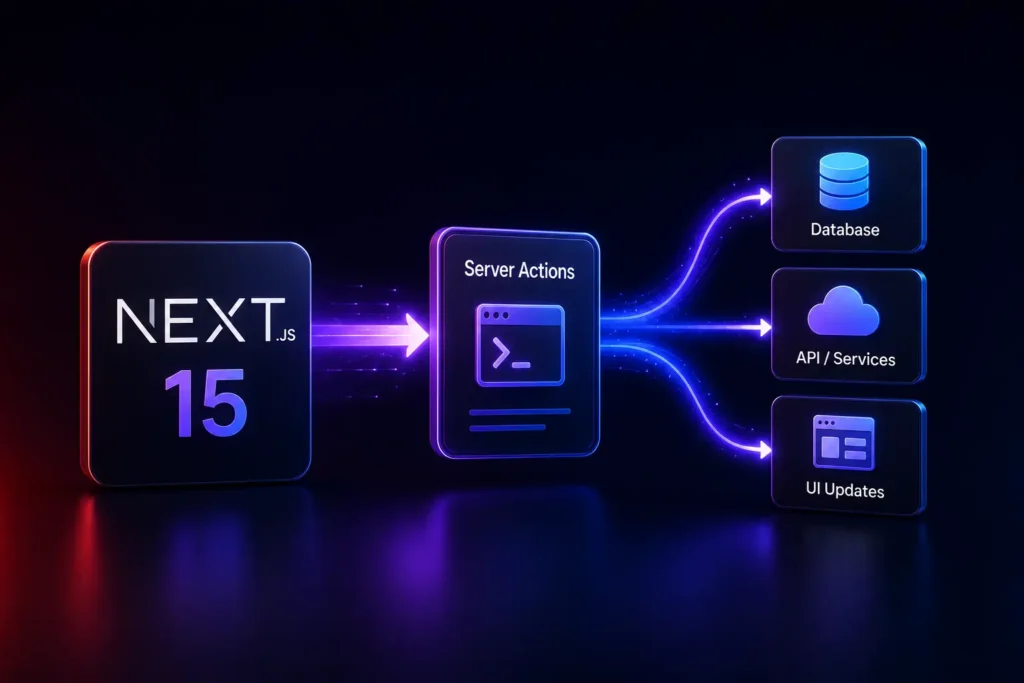
We covered Server Components’ rendering model in a separate piece - this one is specifically about Server Actions, the mutation half of that same shift, because form handling and data mutations in Next.js have quietly gone through their own genuine simplification that a lot of teams haven’t fully adopted yet, often still hand-building API routes for mutations out of habit.
What actually changed for handling mutations
Before Server Actions, a typical form submission in Next.js meant building a dedicated API route, writing client-side code to call it (usually with a loading state, error handling, and a fetch call), and manually revalidating whatever data the mutation affected. Server Actions collapse most of that: a function marked as a server action can be called directly from a form or a client component, runs on the server with direct access to your data layer, and Next.js handles the request plumbing that used to be hand-built boilerplate.
What this actually removes, concretely
- The dedicated API route for straightforward mutations - a server action can be defined right alongside the component that uses it, or in a shared actions file, without a separate route file whose only job was bridging a form to your business logic.
- Manual fetch and loading-state boilerplate - Next.js provides hooks (useFormStatus, useActionState) specifically designed to work with server actions, handling pending states and returned validation errors with meaningfully less hand-written client code than the equivalent manual fetch implementation.
- Manual cache invalidation logic - server actions can trigger revalidation of the specific data paths affected by a mutation directly, rather than the client needing to know what to refetch after a successful mutation.
Where this genuinely matters, and where it’s just a smaller convenience
For applications with a lot of simple form-driven mutations - settings updates, content creation, typical CRUD forms - this is a meaningful reduction in boilerplate and a real simplification of a pattern that used to require touching three or four files for one straightforward mutation. For applications with complex mutation logic that genuinely needs to be a well-documented, versioned API (consumed by mobile apps, third-party integrations, or multiple frontends), a proper API layer is still the right architecture - server actions are convenient specifically for mutations tightly coupled to your Next.js frontend, not a general-purpose API replacement.
What teams get wrong adopting this
Treating every mutation as a candidate for a server action, including ones that genuinely need to be consumed by something other than the Next.js app itself - a mobile app, a partner integration - where a real, documented API endpoint is still the correct architecture. Server actions are excellent for the common case of “this form, on this page, in this app” and a poor fit for “this needs to be callable from anywhere.”
The other common mistake: treating server actions as exempt from the same validation and authorization discipline a normal API endpoint would need - because a server action feels like it’s “just a function call,” it’s easy to skip the same input validation and permission checks you’d never skip on an explicit API route, even though a server action is still a network-callable endpoint under the hood and needs the same security discipline.
What we actually recommend
Adopt server actions for genuinely frontend-coupled mutations - forms, settings updates, content management tied specifically to your Next.js app - with the same validation and authorization rigor you’d apply to any API endpoint. Keep dedicated API routes for anything that’s genuinely a general-purpose API consumed beyond this specific frontend.
We build production Next.js applications using this discipline as part of our web development work. Get in touch if you’re modernizing an existing Next.js app’s mutation handling or scoping a new build.