Academic platforms
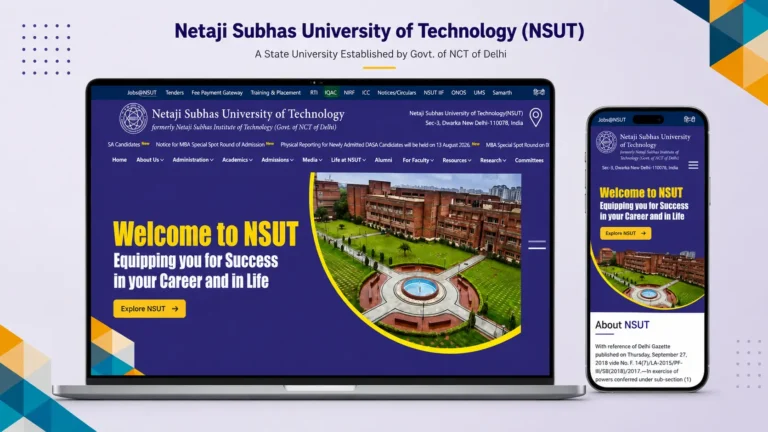
Institution-scale sites serving applicants, students and staff from one structure. Our published work includes an academic platform for NSUT.
Industry
Education platforms take a year of ordinary traffic in the first week of term.
Education software has a load profile almost no other sector shares. For most of the year the system is quiet, and then admissions or results day arrives and a year’s worth of traffic lands inside a few hours, on a date everyone knew about months in advance and cannot move.
That single fact should shape the architecture, and usually has not. Our academic platform for NSUT, published on our work page, was built around exactly this: the interesting engineering was the peak, not the feature list.
The second constraint is that education platforms have three very different audiences at once. Students, faculty and administration each need a different view of the same record, with permissions that hold up when a student is also a teaching assistant. Education software development that treats them as one user with a role flag runs into trouble in the second year.

Sector constraints
Traffic is near zero and then everybody at once. Capacity is planned for those days and rehearsed before them, not measured afterwards.
Applicants, students, faculty and administrators want different things from the same site. The navigation has to serve all four without becoming a directory.
Departments publish independently and staff change. Without a structure that holds, an academic site becomes an archive nobody can search.
An admissions cycle does not slip because a release did. Anything touching enrolment ships well before the date or waits a year.
Institution-scale sites serving applicants, students and staff from one structure. Our published work includes an academic platform for NSUT.
Sized and tested for enrolment and results days, when a year of traffic arrives in an afternoon.
Letting departments publish on their own without the site turning into something nobody can navigate within three years.
Making a large institutional site findable by people who did not choose to be on it.
Engineering a Scalable Drupal Platform for a Premier Technical University
That is the load it should be built for, and tested against before the day rather than during it. Capacity planned around an average is capacity that fails at exactly the moment it matters most. We run the test with you in advance, so the answer is something you have seen rather than something we have promised.
Yes, with a structure and permissions that hold. Independent publishing without either is what turns institutional sites into archives within a few years. The technical part is straightforward. The part that decides whether it works is agreeing what departments can and cannot change, and that conversation is worth having before the build.
It depends what that system exposes, which we review first. Many institutional systems offer limited or awkward interfaces, and pretending otherwise at proposal stage is how projects slip. We will tell you what is genuinely possible before it goes into a scope.
Tell us the constraints you are already aware of. Half of scoping a sector project is working out which of them are real and which are assumed.
Vikalp Development
We usually reply within one business day