
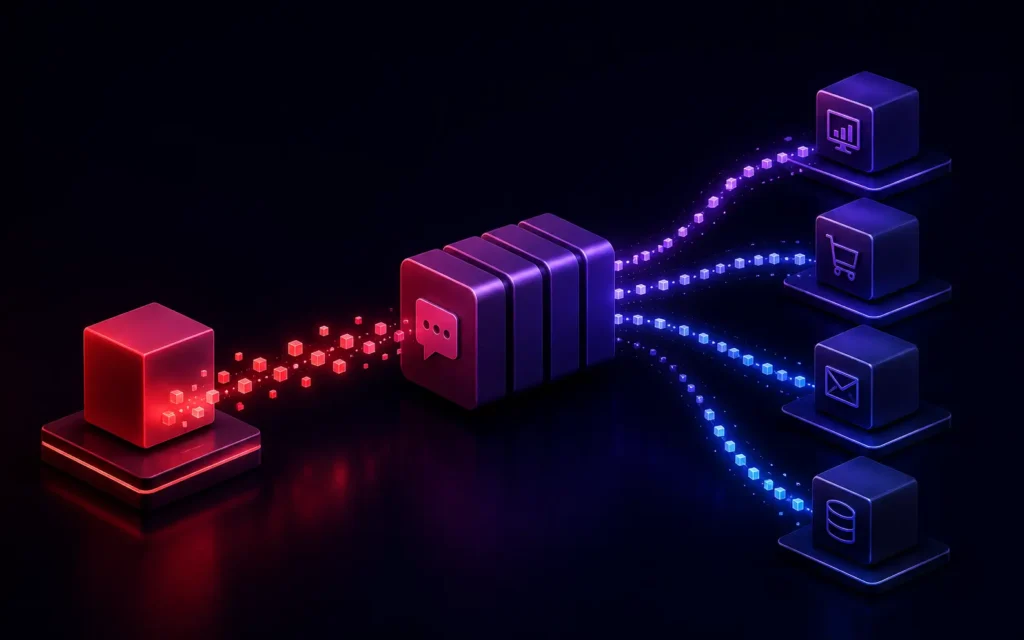
Most systems that call themselves “event-driven” are actually just using a message queue as a slightly more resilient version of a synchronous API call - publish an event, one consumer processes it, done. That’s a legitimate pattern, but it’s not what makes event-driven architecture genuinely powerful for real-time data. The actual value shows up when multiple, independent parts of a system react to the same event without knowing about each other at all.
The core shift: from “call this” to “this happened”
In a traditional request-driven system, one service explicitly calls another - “process this payment,” waits for a response, and the calling service needs to know exactly which service to call and what to do if that call fails. In an event-driven system, a service publishes a fact - “this payment was completed” - without knowing or caring who’s listening. Any number of other services can subscribe to that event and react independently: send a confirmation email, update inventory, trigger a fraud check, update an analytics dashboard - all reacting to the same event, added or removed without the original payment service ever being modified.
Why this matters specifically for real-time data
Request-driven architectures make real-time reactivity expensive to build - polling for changes, or building direct integrations between every pair of services that need to know about each other’s state changes, which becomes an unmanageable web of point-to-point connections as a system grows. Event-driven architecture makes “react immediately when something happens” the default, natural pattern rather than something bolted on - a dashboard showing live order status, a notification system, a real-time analytics pipeline all subscribe to the same event stream rather than each needing a custom integration with the order service.
What this actually requires to build well
- A reliable event broker (Kafka, AWS EventBridge, RabbitMQ, or similar) that guarantees events are delivered even if a consumer is temporarily down - this reliability guarantee is what makes the architecture trustworthy; without it, “event-driven” just means “sometimes things happen in response to other things.”
- Well-designed event schemas, versioned and genuinely stable, because many independent services depend on an event’s structure - a breaking change to an event’s shape can silently break every consumer, not just the one you’re currently thinking about when you make the change.
- Idempotent event handlers. Most event systems guarantee “at least once” delivery, meaning a consumer needs to handle receiving the same event twice without incorrect side effects - sending a duplicate confirmation email, double-processing a payment - which needs explicit handling, not an assumption that delivery is always exactly-once.
- Real observability into the event flow - being able to trace what events were published, which consumers processed them, and where something failed, because debugging a distributed, asynchronous system without this is genuinely difficult in a way debugging a synchronous call chain isn’t.
Where we push back on adopting this by default
For a small application with straightforward, synchronous workflows, event-driven architecture adds real complexity - eventual consistency to reason about, harder debugging, infrastructure to manage - without a corresponding benefit if there’s no genuine need for multiple independent systems reacting to the same events. We reach for this pattern when there’s a real fan-out need (multiple systems genuinely need to react to the same events) or a genuine need for loose coupling between teams’ services, not as a default architectural style for every new system.
We architect event-driven systems as part of our backend architecture work when the actual requirements justify it. Talk to us about whether your system’s real-time and integration needs actually call for this pattern.