
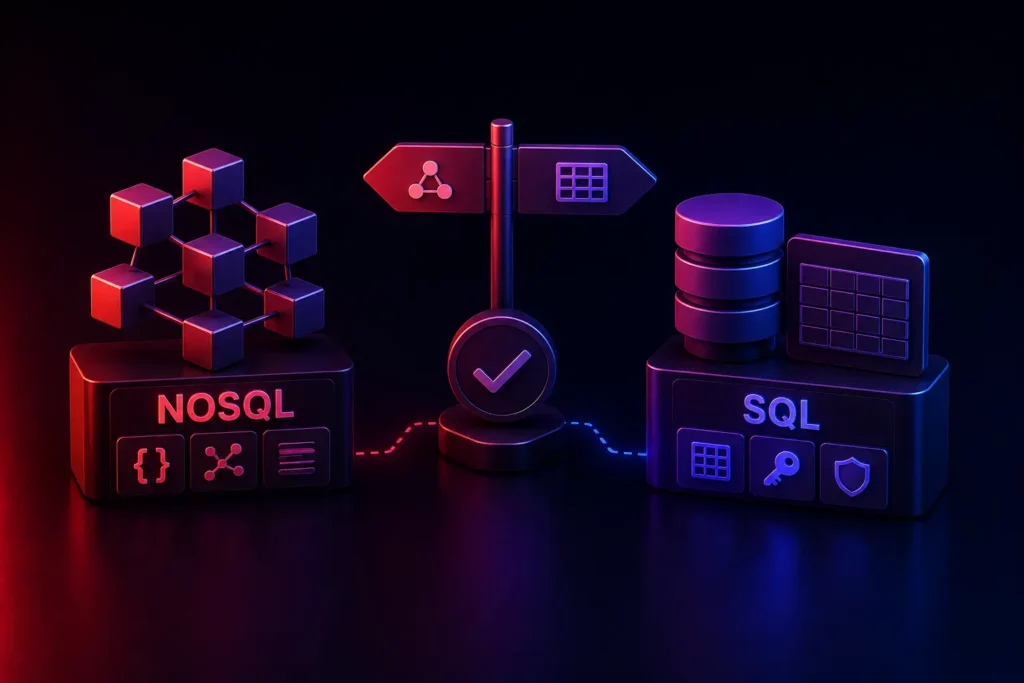
“NoSQL is more scalable” was true enough a decade ago to become conventional wisdom, and conventional wisdom has a way of outliving the conditions that made it true. Modern PostgreSQL and MySQL handle scale that would have justified a NoSQL migration ten years ago, while NoSQL databases have grown their own consistency and querying capabilities in the other direction. The honest 2026 answer isn’t “NoSQL is more scalable” - it’s “match the database to your actual access patterns,” and that requires knowing what your access patterns actually are, not what’s trending.
What actually differs between the two today
Relational databases give you strong consistency, mature transaction support, and a query language (SQL) that lets you ask complex, ad-hoc questions across related data without redesigning your schema every time a new question comes up. That flexibility comes from the relational model itself, and it’s genuinely valuable for data with real structure and relationships - which describes most business applications more than teams often assume.
NoSQL databases (document stores like MongoDB, key-value stores like DynamoDB, wide-column stores like Cassandra) trade some of that flexibility for specific advantages: schema flexibility for rapidly evolving or genuinely unstructured data, and - for the stores designed this way - horizontal scaling patterns that can be simpler to reason about at very high write volumes than scaling a relational database’s write throughput.
The actual decision framework we use
- Do you know your query patterns upfront, or are they evolving? Relational databases are strongest when your data has clear structure and you need flexible, ad-hoc querying across relationships. If your data is genuinely unstructured or your access patterns are still being discovered, a document store’s schema flexibility reduces friction.
- What’s your actual consistency requirement? Financial transactions, inventory counts, anything where “eventually consistent” could mean a real, visible error to a user (double-charging, overselling) needs the strong consistency guarantees relational databases (and some NoSQL stores, with the right configuration) provide by default. Not every NoSQL database is eventually-consistent by default, but it’s worth explicitly verifying rather than assuming.
- What does your actual write volume and pattern look like? Very high write throughput with simple access patterns (logging, event streams, time-series data) genuinely favors purpose-built NoSQL stores. Complex, relational business data at moderate-to-high scale is usually still well-served by a properly indexed and tuned relational database - modern Postgres handles far more scale than the “NoSQL for scale” narrative suggests.
What we actually build most often for SaaS products
For most SaaS applications - which typically have real relationships between entities (users, organizations, subscriptions, permissions) and benefit from ad-hoc querying as the product evolves - we default to a well-designed relational database (usually Postgres) as the primary store, and reach for a purpose-built NoSQL or specialized store for specific sub-problems that genuinely benefit from it: a cache layer (Redis), a search index (Elasticsearch or a vector database for semantic search), a document store for genuinely unstructured content. Polyglot persistence - using the right store for each specific need rather than forcing one database to do everything - is usually the better architecture than picking one paradigm for the whole application.
Where this decision actually goes wrong
The mistake we see most: choosing NoSQL upfront because of its scaling reputation, then discovering months in that the application genuinely needs relational queries and transactional guarantees the chosen database doesn’t provide well, and either bolting on workarounds or facing a costly migration. Matching the database to actual, current access patterns - not anticipated future scale that may never materialize in the form you expect - avoids this.
We make this call as part of backend architecture planning on every project, based on your actual data model, not database trends. Talk to us about what your data actually looks like before committing to a database paradigm.