Auditable transaction systems
Every state change recorded so what happened can be reconstructed later, rather than retried and hoped about.
Industry
Financial software is defined by what happens when something fails, not when it works.

In financial software the hard part is rarely the feature. It is proving afterwards what happened: which value changed, who changed it, when, and what the state was before. A system that cannot answer that is a system that cannot be audited, however well it works day to day.
Two of our published case studies are in this sector, including the Drupal modernisation for Mahindra Insurance Brokers. Fintech software development means designing for that audit trail from the first schema rather than bolting a log table on later, because retrofitting history into a system that never kept it is close to impossible.
One thing we will not claim: we hold no compliance certification, and any page telling you otherwise about any vendor is worth checking. We build to the requirements your compliance team sets, and we expect them to review what we build.

Sector constraints
Retrying is not a recovery plan. Every state change needs a trail that reconstructs what happened, in what order, and to whose money.
Data residency, retention and access rules decide where services run and what may be logged. Finding them out after the build is the expensive route.
A slow or uncertain moment at payment costs more here than anywhere else. Performance on those flows is a requirement, not an optimisation.
Records are corrected by adding to them, not by overwriting. A system that allows silent edits cannot answer the only question that matters afterwards.
Every state change recorded so what happened can be reconstructed later, rather than retried and hoped about.
Payment gateways, insurers, CRMs and core systems connected, and behaving correctly when one of them times out mid-transaction.
Large platforms delivered in stages. Our published work here includes an enterprise insurance broker platform.
The checkout or application flow treated as the priority it is, because that is where hesitation costs real money.
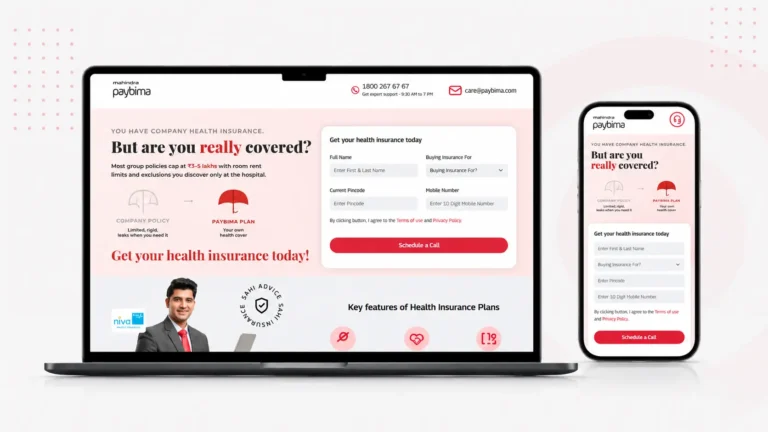
Engineering a High-Performance Lead Capture Micro-Site for Health Insurance
Enterprise Drupal Modernization for BFSI Leaders
As architecture inputs, gathered before anything is designed. Data residency, retention and access rules decide where services can run and what may be logged, and those decisions are expensive to reverse. We build to the requirements your compliance team sets. We do not interpret regulation for you, and any vendor offering to should worry you rather than reassure you.
It is designed for explicitly rather than treated as an edge case. The system records enough to reconstruct the exact state, reconciliation is a defined process rather than a manual investigation, and the customer is told something true rather than a generic error. Getting this right is most of what separates a financial system from an ordinary one.
Usually alongside it rather than replacing it. The core is normally the part nobody wants touched, and for good reason. The common route is to build new services against it, which lets you move without betting the business on a migration. If the core genuinely cannot be integrated with, we will show you why.
Tell us the constraints you are already aware of. Half of scoping a sector project is working out which of them are real and which are assumed.
Vikalp Development
We usually reply within one business day