
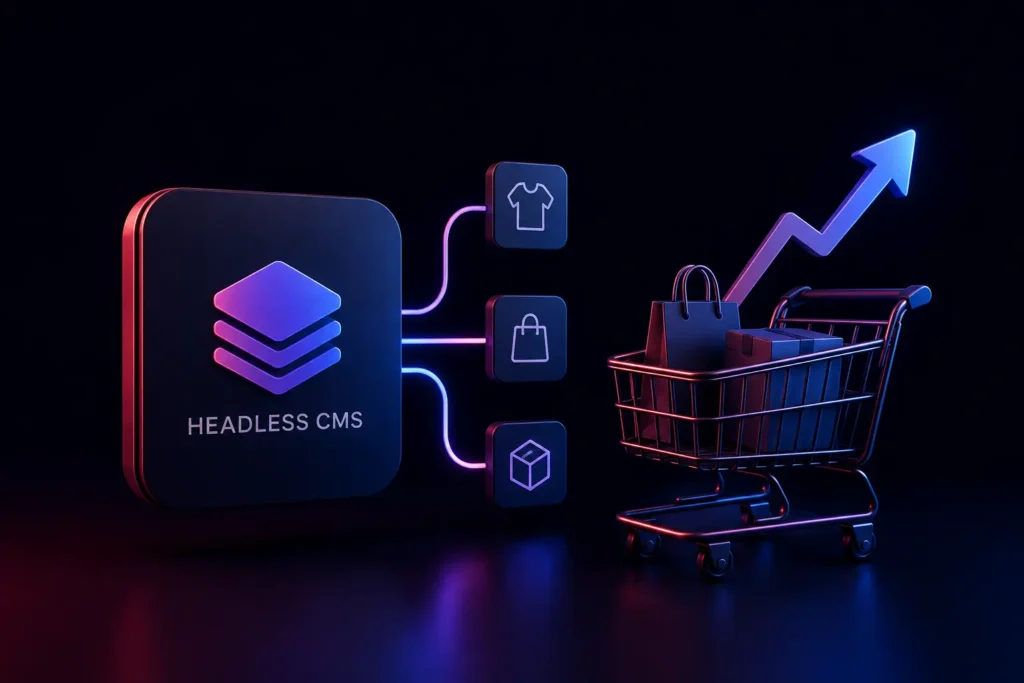
Headless CMS adoption for e-commerce content gets pitched as a pure win - faster, more flexible, better performance - without much honest discussion of what it actually costs to get there, or when a traditional, coupled CMS is genuinely the better call. Here’s the version we actually give clients, trade-offs included.
What “headless” actually changes for content management
A traditional CMS ties your content directly to how it’s presented - the CMS renders the pages itself, following its own templating system. A headless CMS stores and manages content (product descriptions, blog posts, landing page content, marketing copy) but delivers it via API, with your frontend independently responsible for how it’s actually rendered. For e-commerce specifically, this means your marketing team can manage content - landing pages, campaign copy, blog content - through a genuinely flexible content system, while your storefront’s actual presentation layer is built separately, optimized purely for speed and conversion without being constrained by a traditional CMS’s templating limitations.
Where this genuinely boosts sales, not just developer experience
- Faster storefront performance, because the presentation layer isn’t constrained by a traditional CMS’s rendering pipeline - a genuinely fast, purpose-built frontend directly improves conversion rate and SEO, both real revenue levers, not just a technical nicety.
- Content reuse across channels - the same product description, the same marketing content, delivered consistently to your website, your app, and potentially a marketplace listing, from one managed source, rather than manually duplicating and maintaining content separately across each channel.
- Faster marketing team velocity, once set up - a well-configured headless CMS lets marketing ship new landing pages and campaign content without engineering involvement for every change, genuinely speeding up how fast a team can test and launch new campaigns.
What this doesn’t automatically give you, despite the pitch
A headless CMS on its own doesn’t boost sales - it’s infrastructure that enables a faster, more flexible frontend and content workflow, which then needs to actually be built well to realize the performance and conversion benefits. We’ve seen headless CMS migrations that didn’t move any real business metric, because the actual frontend built on top of it wasn’t meaningfully better than what existed before - the CMS migration alone isn’t the win, what you build with the resulting flexibility is.
Where a traditional CMS is honestly still the better call
For a smaller store without a dedicated content or marketing team actively iterating on landing pages and campaigns, and without a specific performance problem the current setup has, the real, ongoing complexity of headless architecture - more moving pieces, a genuine engineering investment to build and maintain the frontend - often isn’t justified by benefits the team won’t actually leverage day to day.
What we actually recommend
Headless makes sense when you have (or plan to build) a marketing team that will genuinely use the content flexibility, a real performance problem the current coupled system is causing, or multi-channel content needs that a traditional CMS can’t cleanly serve. Absent those, the migration cost isn’t usually justified purely by the architectural appeal.
We build headless commerce architectures as part of our e-commerce engineering work, when the underlying business case actually supports it. Talk to us about whether your team and traffic actually justify this migration.