
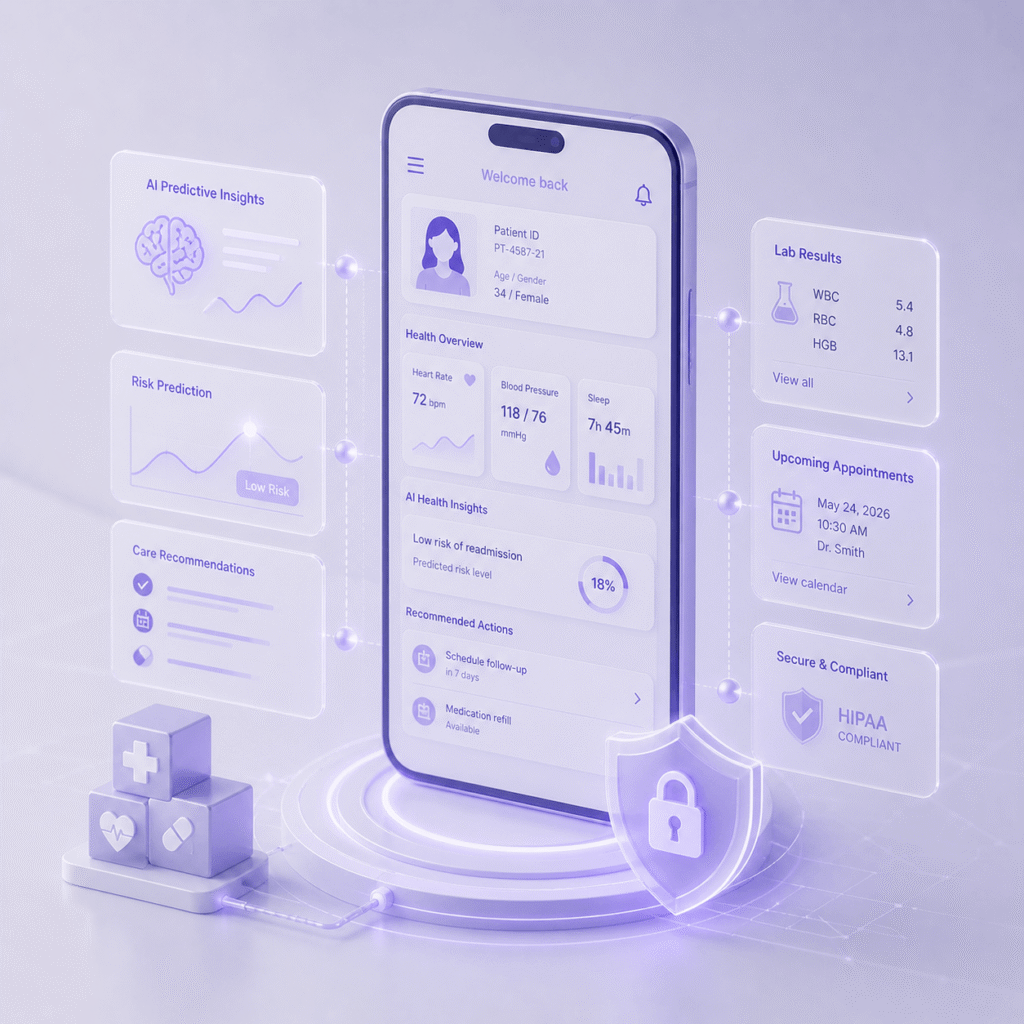
Healthcare is the one industry where we tell clients, upfront and unprompted, to slow down on the AI feature and speed up on the compliance review. Not because predictive patient portals aren’t valuable - they genuinely are - but because in healthcare, the cost of getting the data handling wrong isn’t a bad user experience, it’s a HIPAA violation, a breach notification, and in India increasingly a Digital Personal Data Protection Act problem too, layered on top of whatever the feature was supposed to accomplish.
What a predictive patient portal actually does
The useful version of this isn’t a chatbot bolted onto a patient dashboard. It’s using a patient’s own history - appointment patterns, lab result trends, medication adherence - to surface things a clinician or the patient themselves should act on: flagging a patient likely to miss an upcoming appointment based on their history so staff can proactively reach out, surfacing a lab trend that’s moving in a concerning direction before it becomes an emergency, or predicting which patients are at higher risk of readmission so care teams can prioritize follow-up. Done well, this is genuinely preventive, not just a convenience feature.
Where compliance actually has to shape the architecture, not just the paperwork
A lot of “HIPAA-compliant” claims we see in the industry mean “we signed a BAA,” which is necessary but nowhere near sufficient. The architecture itself has to be built around a few non-negotiables:
- Data minimization in what the model actually sees. A predictive model doesn’t need a patient’s full chart to flag an appointment risk - it needs specific, relevant fields. Every additional field the model has access to is additional exposure if something goes wrong, so scope down aggressively rather than passing everything “just in case.”
- Encryption at rest and in transit, with proper key management - not just TLS on the connection, but field-level encryption on the most sensitive data (diagnoses, treatment details) so a database-level compromise doesn’t mean full record exposure.
- Full audit trails on every access to patient data, not just write operations - who viewed what, when, and through which system. This is both a compliance requirement and, practically, the thing that lets you actually investigate if something does go wrong.
- Explicit consent and clear boundaries on what predictive features are used for. Patients need to understand and consent to their data being used this way, and the system needs hard boundaries preventing that data from being repurposed for anything beyond what was consented to - including, notably, not silently reusing patient data to train models for other purposes.
Where we’ve seen this go wrong elsewhere
The most common failure mode isn’t a dramatic breach - it’s scope creep. A predictive feature built for appointment reminders quietly gets expanded to also inform marketing segmentation, or a vendor integration that was scoped to read appointment data ends up with broader database access because it was easier to configure that way at the time. Neither of those is usually malicious. Both are exactly the kind of gap an audit finds, and exactly the kind of gap that’s cheap to prevent upfront and expensive to unwind later.
What we actually build first
Before any predictive feature, we build the data governance layer - scoped access, audit logging, encryption, consent tracking - as its own piece, tested and reviewed independently of the AI feature sitting on top of it. This sounds like it slows the project down, and in the first phase it does. It’s also the only way we’re comfortable putting a predictive feature in front of real patient data, and every healthcare client we’ve worked with has ultimately agreed it’s not optional once we walk through what a mishandled breach actually costs versus what the extra weeks upfront cost.
We build this as part of our work in healthcare technology, always compliance-first. If you’re evaluating a predictive feature for a patient-facing product, talk to us before you scope the AI part - we’d rather have that conversation early than after an architecture decision is already locked in.