
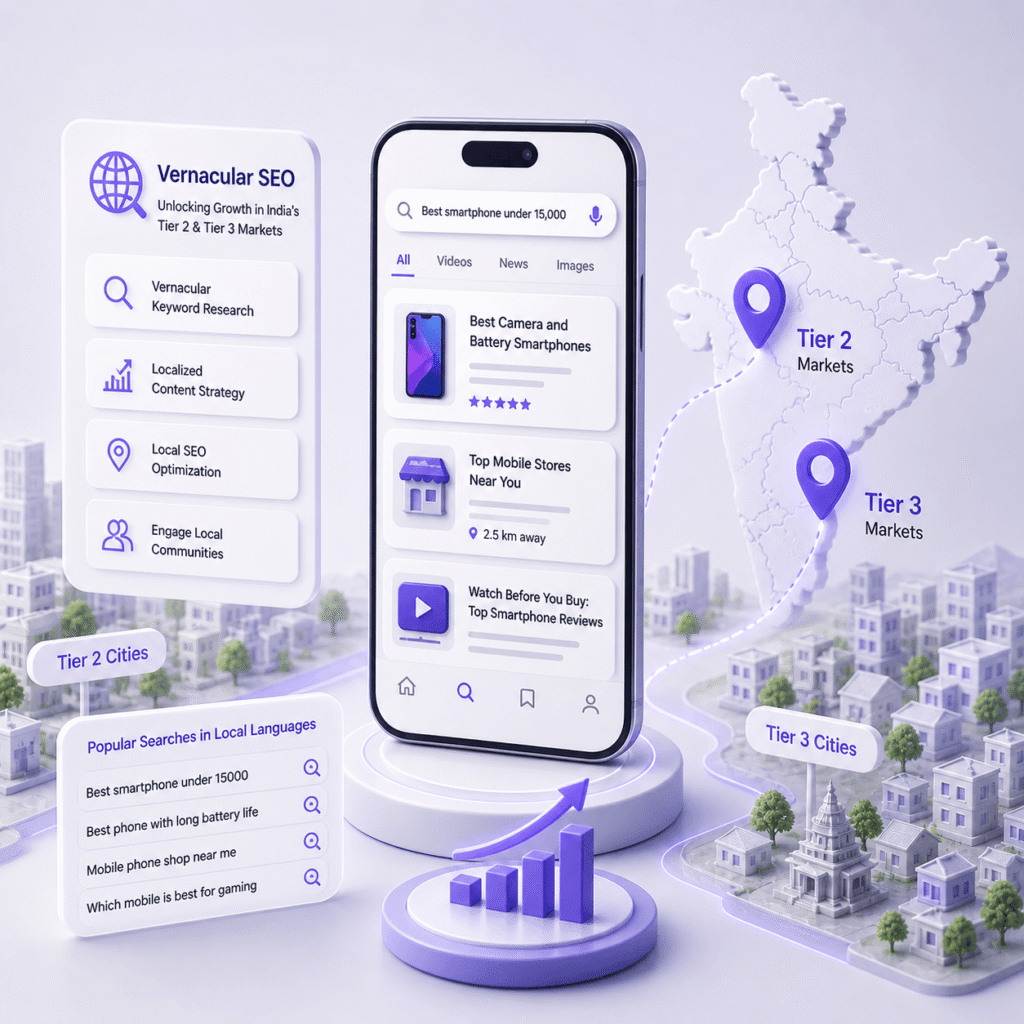
Most Indian brands’ digital growth strategy still treats English-speaking metro India as the whole market, then wonders why growth flattens once that audience is saturated. The next few hundred million internet users in India are overwhelmingly consuming content in Hindi, Tamil, Telugu, Bengali, and a dozen other languages - and Google has been building specifically for that reality with better multilingual indexing, voice search support, and regional query understanding. Vernacular SEO isn’t a niche play anymore. It’s where the actual growth is sitting, largely unclaimed.
Why this is different from just “translating the site”
The mistake we see most often: running the English site through a translation tool and calling it vernacular SEO. That fails for a specific reason - search behavior in regional languages isn’t a direct translation of English search behavior. People searching in Hindi or Tamil often phrase queries differently, use different comparison structures, and have different trust signals (local reviews, regional payment methods, familiar local reference points) than the same person would use searching in English. A literally-translated page can be grammatically correct and still completely miss how people actually search.
The transliteration gap nobody plans for
There is a third case sitting between English and regional-script search, and it is frequently the largest of the three: people typing an Indian language using the Latin alphabet. Someone looking for an affordable phone may type a Hindi phrase in Roman letters rather than switching to a Devanagari keyboard, because switching scripts on a phone is friction and the Latin keyboard is already open.
This matters because a site that has been properly translated into Devanagari may still not match those queries, while the English site does not match them either. The queries fall between two versions of your site and are served by whoever happened to write in the same mixed register - often a forum post or a video, which is why so many of these searches return user-generated results.
Handling it does not mean building a third site. It means letting the natural mixed vocabulary your customers actually use appear in your content rather than editing it out in pursuit of a pure register, and checking Search Console for Roman-script regional queries you are already receiving impressions for. In our experience this is the single most overlooked source of existing, unclaimed demand, precisely because it does not look like a language project at all.
What actually works
- Native keyword research per language, not translated keyword lists. The Hindi query pattern for “best mobile under 15000” isn’t a direct translation of the English query - it needs its own research, ideally involving a native speaker who understands regional phrasing, not just a translator working from an English keyword list.
- Proper hreflang implementation. Google needs to know which language version to serve to which user unambiguously. We regularly find enterprise sites with hreflang tags that are technically present but misconfigured - pointing to the wrong URLs or missing reciprocal tags - which quietly tanks regional visibility without any obvious error showing up.
- Voice search optimization. A meaningful share of regional-language search now happens by voice, particularly on budget Android devices where typing in a non-Latin script is more friction than speaking. That means optimizing for natural, conversational query phrasing rather than the shorter, choppier phrasing typical of typed searches.
- Local trust signals in-language. Reviews, testimonials, and case studies presented in the regional language, not just translated headlines with English proof points underneath - trust signals need to match the language context, not just the words.
Where the language versions should live
Before any content is written, decide the URL structure, because changing it later means migrating and redirecting every regional page you have published.
For almost every Indian business we work with, language subdirectories on the main domain are the right answer - the regional version sits under a path on the same site rather than on its own subdomain or a separate domain. The reason is practical: everything the main domain has earned in credibility applies to the new sections immediately, and there is one site to maintain, one analytics property, and one set of technical fixes rather than several.
Subdomains are defensible when the regional operation is genuinely separate, with its own team and its own catalogue, but they start from a weaker position and they double the technical maintenance. What we would avoid entirely is serving different languages at the same URL based on a visitor’s detected location or browser setting, which leaves search engines unable to index the versions separately and tends to trap users in a language they did not choose.
On hreflang itself, the three mistakes worth checking for specifically: every version must reference itself as well as its alternatives, the references must be reciprocal or they are ignored, and there should be a default declared for users whose language you have not covered. Getting these wrong is common precisely because nothing visibly breaks when you do.
What needs localising besides the sentences
A page can be linguistically perfect and still read as foreign to its audience, which undermines exactly the trust the exercise was meant to build.
- Numbers as people actually write them. Indian digit grouping and the lakh and crore convention, rather than the international grouping a translation tool leaves untouched.
- The payment methods that audience actually uses, shown rather than described, since payment familiarity is a trust signal in its own right at the point of purchase.
- Contact details in a usable form - a phone number formatted as it would be dialled locally, and a contact route people will actually use, which in much of the market is a messaging app rather than an email form.
- Examples and reference points that land. Cities, seasons, and situations from the reader’s context rather than translated versions of metro examples.
- The script itself, tested on real hardware. Which brings us to the technical side.
The technical side most agencies skip
Beyond hreflang, we pay close attention to font rendering and page weight for regional scripts - Devanagari, Tamil, and Bengali script rendering can be noticeably heavier than Latin script if fonts aren’t optimized, which directly hurts Core Web Vitals for exactly the audience you’re trying to reach, who are disproportionately on slower connections and budget devices. A vernacular page that loads slowly for its actual audience defeats the purpose before the content even matters.
Two specifics are worth naming, because they are where the weight actually comes from. Regional script fonts carry far more glyphs than a Latin font, so subsetting them to the characters a page genuinely uses is not a micro-optimisation here, it is the difference between a reasonable page and a slow one. And declaring the page’s language correctly in the markup is what allows the browser to select and render the script properly in the first place, which is a one-line fix that is missing surprisingly often on translated pages.
Who reviews it, and how the versions stay in step
The failure mode for vernacular programmes is rarely the launch. It is month eight, when the English site has moved on and the regional versions describe last season’s products at last year’s prices, which damages trust more thoroughly than never having published them.
Two decisions prevent it. Have a named native speaker review content before it publishes - somebody who can say “nobody says it that way”, which is a different skill from translation and is the one that determines whether the page reads as genuine. And decide, deliberately, which pages are committed to being kept current. A smaller set that is always accurate is worth considerably more than full coverage that silently rots, and it is also a far easier commitment to sustain when the initial enthusiasm has passed.
Where to actually start
Don’t try to launch ten language versions simultaneously. Pick the one or two languages where your existing customer or traffic data already shows demand - check your analytics for what regions and language preferences are already showing up despite having no dedicated content for them, that’s usually a strong signal of where unmet demand already exists. Build that properly, measure it, then expand.
This is part of the broader web development and SEO work we do for brands expanding beyond metro India. If you’re weighing whether Tier 2/3 vernacular expansion is the right next move for your business, get in touch and we’ll look at your actual traffic data before recommending a language strategy.