
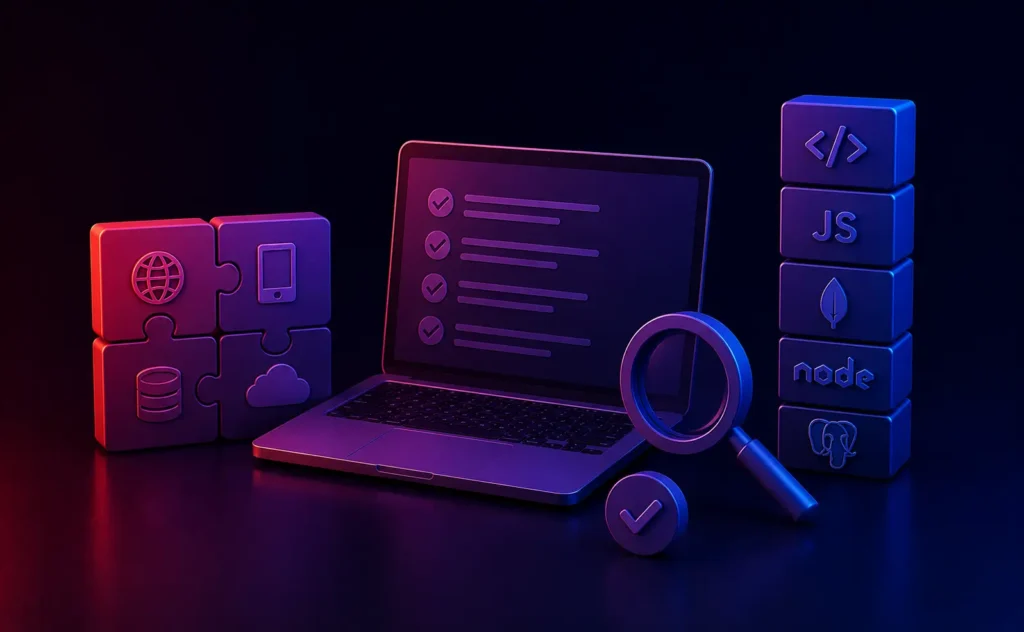
How to Choose the Right Tech Stack for Custom Software in 2026
How do I choose the right tech stack for my software?
To choose the right tech stack, you must analyze your project’s specific requirements. Use React or Next.js for highly interactive user interfaces. Use Python for AI and heavy data processing. Use Node.js for real-time applications (like chat). Finally, ensure your choices align with your team’s expertise and your long-term cloud scalability goals.
For Technical Founders and CTOs, the architectural foundation of a new digital product is laid long before the first line of code is written. When you decide to build a platform-having carefully weighed the Build vs Buy Software debate-the immediate next step is selecting your technology stack.
A “tech stack” is the combination of programming languages, frameworks, and databases used to construct an application. Making the wrong choice here is devastating. Choosing an obscure language might make it impossible to hire developers later; choosing a bloated framework might cripple your app’s load speed.
To ensure your product is scalable, secure, and maintainable, here is a definitive guide on how to choose a tech stack for custom enterprise software in 2026.
1. Defining the Frontend (The User Interface)
The frontend is everything the user sees and interacts with. In modern Custom Web Development, standard HTML and CSS are no longer sufficient for complex platforms.
The Dominant Choice: React & Next.js
In 2026, React (backed by Meta) remains the undisputed king of frontend development. It allows engineers to build highly interactive, component-based UIs that update instantly without reloading the page. When paired with Next.js, it offers Server-Side Rendering (SSR), which guarantees blistering fast load times and perfect SEO compatibility.
The Alternative: Vue.js
If you have a smaller team and need to prototype rapidly, Vue.js offers a gentler learning curve than React while providing excellent performance. However, for massive, enterprise-scale applications, React’s vast platform of third-party libraries makes it the safer long-term bet.
2. Selecting the Backend (The Logic Engine)
The backend is the server-side logic that powers the application, authenticates users, and communicates with the database. Your choice here depends entirely on the function of your software.
- For Real-Time Applications (Node.js): If you are building a real-time chat application, a collaborative document editor, or a live-streaming platform, Node.js is exceptional. It handles thousands of concurrent connections efficiently.
- For AI and Data Science (Python): If your core product relies on AI Integration, smart technology, or complex financial modeling, Python is the absolute industry standard. It possesses the most powerful libraries for data manipulation.
- For Rapid MVP Development (Laravel/PHP): If you are building a standard CRUD (Create, Read, Update, Delete) SaaS platform and want to get to market incredibly fast, PHP frameworks like Laravel offer robust, out-of-the-box features for authentication and routing that save weeks of engineering time.
3. Choosing the Database
Where and how you store your data dictates the speed and reliability of your software.
- Relational Databases (PostgreSQL / MySQL): If your data is highly structured and requires complex relationships (e.g., a standard E-Commerce Platform where a User has many Orders, and Orders have many Products), traditional SQL databases are mandatory for maintaining data integrity.
- NoSQL Databases (MongoDB): If you are storing massive amounts of unstructured data (like social media feeds or massive logs of IoT sensor data), NoSQL databases offer superior flexibility and horizontal scalability.
- Smart Databases: If you are building generative AI tools (like custom ChatGPT wrappers that search your company’s internal documents), you must integrate specialized Smart Databases (like Pinecone) to handle complex similarity searches.
4. Cloud Infrastructure and DevOps
Finally, a modern tech stack is incomplete without defining where the code will live. Do not attempt to host enterprise software on a physical server in your office.
You must utilize modern Cloud Architecture (AWS, Google Cloud, or Microsoft Azure). To ensure your application is scalable and fault-tolerant, containerize your software using Docker. This ensures that your app runs exactly the same way on a developer’s laptop as it does on a massive production server.
Conclusion
Choosing a tech stack for custom software is not about finding the “best” programming language in the world; it is about finding the right tool for your specific business problem. A mismatch between your business goals and your technology stack will result in sluggish performance and massive technical debt.
Unsure which technologies are right for your product roadmap?
Our enterprise architects at VDPL will evaluate your business requirements and design a scalable, future-proof tech stack. Contact us today for a technical consultation.
Frequently Asked Questions (People Also Ask)
What is a technology stack?
A technology stack (or tech stack) is the combination of programming languages, frameworks, libraries, databases, and servers used to build and run a software application. It is typically divided into the frontend (client-side) and backend (server-side).
What is the MERN stack?
The MERN stack is a highly popular, JavaScript-centric tech stack used for building modern web applications. It stands for MongoDB (database), Express.js (backend framework), React (frontend framework), and Node.js (backend runtime environment).
How do I choose the best programming language for my startup?
Choose a language based on your product’s requirements (e.g., Python for AI, Node.js for real-time data) and the availability of engineering talent in your area. Do not choose an obscure, trendy language if you will struggle to hire developers to maintain it a year from now.