
Programmatic Advertising Explained for Executives in 2026
What is programmatic advertising in simple terms?
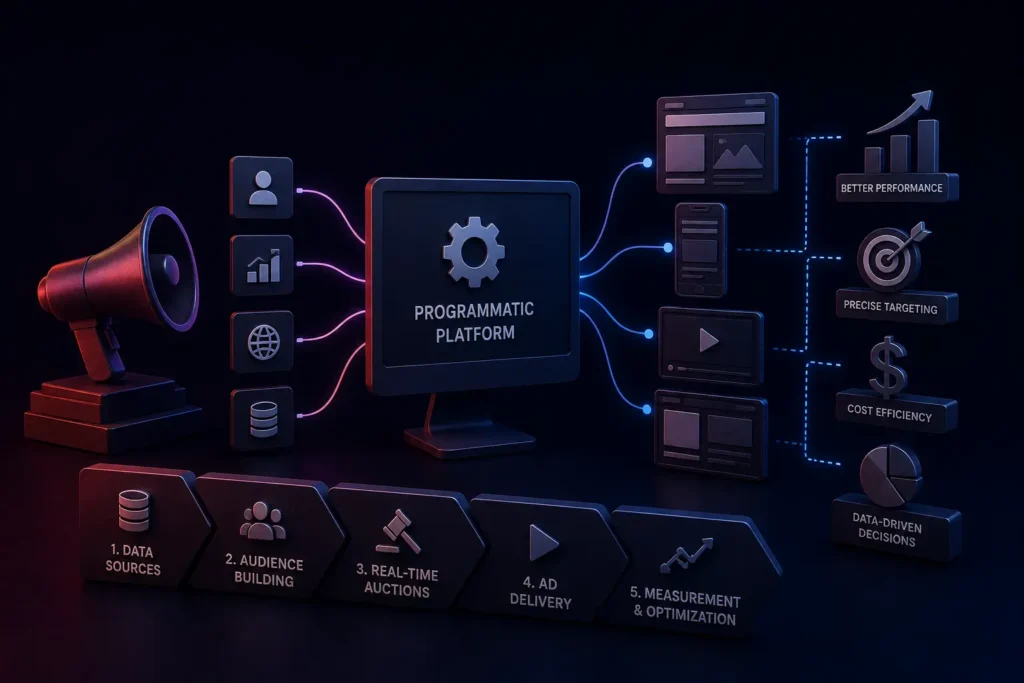
Programmatic advertising is the automated buying and selling of digital advertising space. Instead of human ad buyers negotiating prices with website publishers manually, AI-driven software uses data to purchase ad space in milliseconds, ensuring your ad is shown to the exact right person, at the right time, at the lowest possible price.
For C-Suite Executives and Marketing Directors managing massive media budgets, the traditional method of buying digital advertising is dangerously inefficient.
Historically, if an enterprise wanted to run ads, a media buyer would call a publisher (like The New York Times), negotiate a bulk price for 100,000 impressions, and sign a contract. The ads were displayed to everyone who visited the site, regardless of whether that specific visitor cared about your Custom Software Development services. This resulted in massive wasted spend on unqualified audiences.
In 2026, manual ad buying at scale is extinct. It has been replaced by the high-speed data-driven efficiency of programmatic advertising. Here is the executive breakdown of how automated ad buying works and why it is critical for optimizing your marketing ROI.
The Core Concept: Real-Time Bidding (RTB)
The engine driving programmatic advertising is Real-Time Bidding (RTB). It operates exactly like the digital stock market, but transactions happen in milliseconds.
The Process:
- A user clicks a link to load a webpage (e.g., a financial news site).
- While the page is loading, the publisher’s server instantly signals an Ad Exchange, saying: “I have one ad slot available. The user loading this page is a 45-year-old CFO located in Chicago who recently searched for Cloud Architecture.”
- The Ad Exchange blasts this data to thousands of advertisers.
- Your company’s automated software (Demand-Side Platform, or DSP) evaluates the data. It recognizes that this specific user is your exact target demographic.
- Your DSP automatically submits a bid of $0.50 to show your ad to this specific user.
- If your bid is the highest, your ad is injected onto the webpage before the page even finishes loading for the user.
This entire auction-data analysis, bidding, and ad placement-happens in less than 200 milliseconds.
The Benefits of Programmatic for the Enterprise
1. Audience Targeting vs. Contextual Targeting
Traditional advertising buys context (buying an ad on a golf website, hoping golfers see it). Programmatic advertising buys audiences.
Because programmatic utilizes massive datasets (including first-party CRM data via API Integration), you can target the CFO who loves golf, whether they are currently reading a golf blog, checking the weather, or reading the news. You only pay to show the ad to the exact person you want to reach, eliminating wasted impressions.
2. Massive Multi-platform Scale
You are not limited to one website. Programmatic software taps into global Ad Exchanges, giving you instant access to millions of websites, mobile apps, connected TVs (CTV), and digital billboards globally. You manage this entire massive platform from a single centralized dashboard.
3. Real-Time Optimization
As discussed in our guide to Calculating Marketing ROI, you cannot wait a month to see if a campaign worked. Programmatic algorithms use smart technology to optimize campaigns in real-time. If the AI notices that your ad converts 30% better on mobile devices between 8 AM and 10 AM, it will automatically shift your budget to bid higher during that specific window, constantly driving down your Customer Acquisition Cost (CAC).
The Complexity: Ad Fraud and Brand Safety
Programmatic advertising is not without risks. Because it is highly automated, there is a risk of Ad Fraud (bots clicking ads to drain budgets) and Brand Safety issues (your enterprise ad automatically appearing next to controversial or offensive content on a low-quality website).
This is why enterprises cannot simply “set it and forget it.” Managing programmatic budgets requires highly skilled digital analysts who utilize advanced exclusion lists, private marketplaces (PMPs), and strict brand safety algorithms to ensure your budget is spent securely.
Conclusion
Programmatic advertising is the application of high-speed artificial intelligence to digital marketing. By removing human negotiation and relying on data-driven, millisecond auctions, enterprises can achieve exceptional targeting precision and scale. It ensures that every dollar of your media budget is spent strategically, placing your message only in front of the audiences that drive real revenue.
Looking to integrate advanced marketing data pipelines?
At VDPL, we architect robust, secure custom software that integrates your internal CRM data with global programmatic advertising platforms. Contact us today to upgrade your marketing technology stack.
Frequently Asked Questions (People Also Ask)
What is the difference between Google Ads and Programmatic Advertising?
Google Ads is technically a form of programmatic advertising (it uses automated bidding), but it is a “walled garden,” limiting you primarily to Google’s Search network and its specific Display Network. True enterprise programmatic advertising uses independent Demand-Side Platforms (DSPs) to access multiple ad exchanges simultaneously, offering vastly larger reach across the entire internet, including Connected TV and digital audio.
What is a Demand-Side Platform (DSP)?
A Demand-Side Platform (DSP) is the software used by advertisers and agencies to manage, purchase, and optimize programmatic advertising campaigns across multiple Ad Exchanges and data networks from a single, centralized dashboard.
How does programmatic advertising use data?
Programmatic advertising relies on data (cookies, device IDs, and first-party CRM data) to build highly detailed user profiles. When an ad space becomes available, the software analyzes the data of the user looking at the screen in real-time to determine if they match the advertiser’s target demographic before placing a bid.