
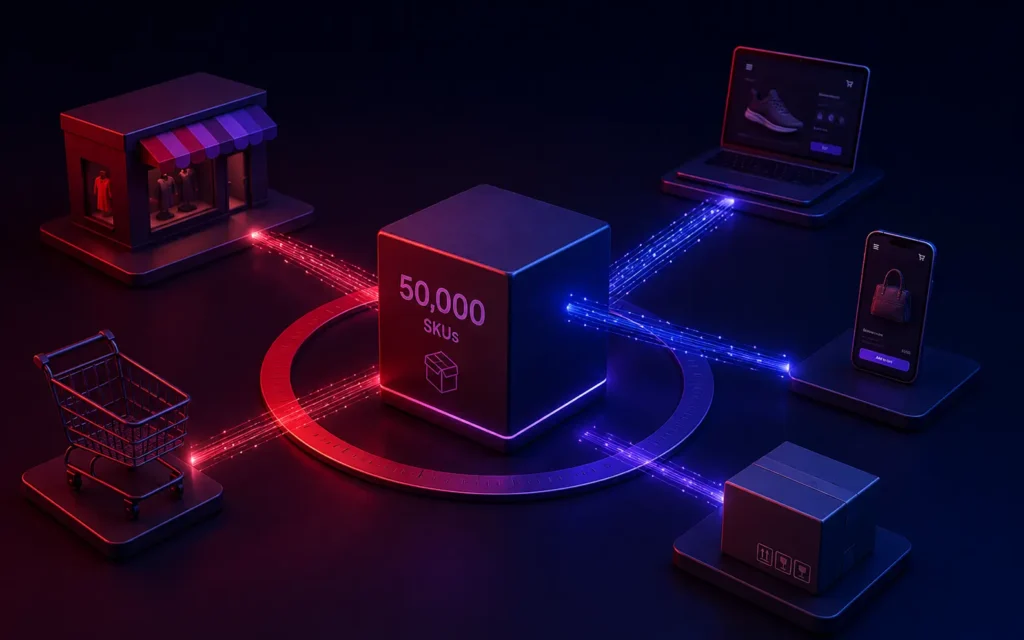
Somewhere around the point a retail brand is selling on their own site, a marketplace or two, and a physical store, inventory sync stops being a background process nobody thinks about and starts being the thing that either makes or breaks the business. Sell the same item twice because two channels didn’t know about each other’s order in time, and you’ve got a cancelled order, a refund, and a customer who won’t come back. At real scale - tens of thousands of SKUs across multiple channels - this isn’t a rare edge case, it’s a daily operational risk if the architecture isn’t built for it.
Why this gets hard specifically past a certain scale
At a few hundred SKUs and one or two channels, a straightforward “update inventory on every order” approach works fine - the volume is low enough that occasional lag doesn’t cause real problems. Past tens of thousands of SKUs across three or more channels, the same simple approach starts producing real oversell incidents, because you’re now dealing with genuine race conditions: two channels processing near-simultaneous orders for the same low-stock item, sync delays between systems compounding under load, and the sheer volume making manual reconciliation impossible.
What actually solves this at scale
- A single source of truth for inventory, not per-channel counts. Every channel - your own site, marketplaces, POS - reads from and writes to one central inventory system, rather than each channel maintaining its own count that gets periodically reconciled. Periodic reconciliation is exactly where oversell incidents originate; a shared source of truth removes the reconciliation gap entirely.
- Event-driven updates instead of polling. Inventory changes should propagate to all channels as events the moment they happen, not on a scheduled sync job running every few minutes - a few minutes of lag at real order volume is enough time for a popular low-stock item to oversell multiple times.
- Buffer stock logic for high-velocity SKUs. For your fastest-moving items specifically, holding back a small buffer from what’s shown as available absorbs the milliseconds of propagation delay that even a well-built event system will have, without needing perfect real-time consistency everywhere.
- Idempotent order processing. Systems that can safely handle the same order event arriving twice (a real occurrence in distributed systems, from retries and network hiccups) without double-decrementing inventory - this is a subtle failure mode that causes phantom stockouts if it’s not explicitly handled.
Where we’ve seen this actually implemented well
The strongest pattern we’ve built: a central inventory service that every channel integration talks to through the same API, publishing inventory-changed events that each channel’s listing sync subscribes to independently. When a marketplace order comes in, it decrements the central count and publishes an event; the brand’s own site and every other marketplace integration receive that event and update their displayed availability within seconds, not minutes. This architecture also makes adding a new sales channel much less risky - it’s one more subscriber to an existing event stream, not a new point-to-point integration with every other channel.
What we tell clients before they scale multi-channel
If you’re at a few hundred SKUs and one channel, don’t over-engineer this - a simpler synchronous approach is genuinely fine and this level of architecture would be premature complexity. The moment to invest here is when you’re actively adding channels and SKU count is climbing into the thousands, because retrofitting proper inventory architecture after oversell incidents have already damaged customer trust is a much harder sell internally than building it in ahead of the scale that needs it.
We build this as part of our e-commerce platform work for brands scaling into multi-channel selling. If oversells are already becoming a recurring operational headache, talk to us - we’ll look at your current integration architecture before recommending a rebuild.