
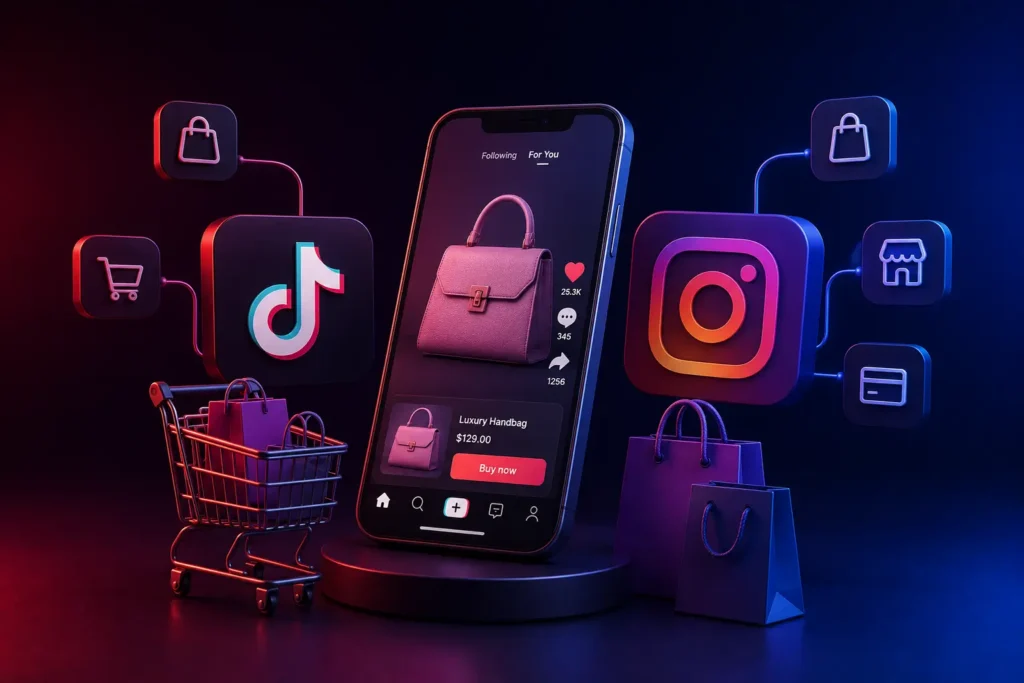
Social Commerce: Selling Directly on TikTok and Instagram in 2026
What is social commerce?
Social commerce is the process of selling products directly within social media platforms. Instead of redirecting a user to a separate external website, the entire shopping experience-from product discovery to checkout and payment processing-happens natively inside apps like TikTok, Instagram, and Pinterest.
For E-Commerce Founders, the traditional digital sales funnel was simple: run an ad on social media, make the user click a link, wait for your website to load, hope they add the item to their cart, and pray they finish the checkout process.
Every single step in that traditional funnel introduces “friction.” In the digital economy, friction kills conversions. If your mobile website takes three seconds to load, 50% of users will abandon the process.
In 2026, the solution to this friction is social commerce. Social media giants have transformed their platforms from discovery networks into massive, self-contained digital malls. If you are not actively selling on TikTok and Instagram using native shopping integrations, you are ignoring the fastest-growing revenue channel in retail. Here is how to master the social commerce platform.
1. The Power of Native Checkout
The core advantage of social commerce is the native checkout experience.
When a user sees a beautiful pair of sunglasses in an Instagram post or a TikTok video, they no longer have to click a “Link in Bio,” navigate a clunky mobile website, and manually type in their credit card number.
Through advanced API Integration with backend platforms like Shopify, the user simply taps the product tag hovering over the sunglasses in the video. A native checkout drawer slides up, utilizing biometric authentication (FaceID) and Apple Pay/Google Pay. The user buys the product in exactly two taps without ever leaving the social media app. This frictionless environment regularly sees conversion rates 3x to 5x higher than traditional mobile web checkouts.
2. Livestream Commerce (The QVC of the Digital Age)
Livestream commerce, heavily popularized in Asian markets, has completely dominated Western social commerce in 2026.
Brands host live video broadcasts on TikTok or Instagram featuring influencers demonstrating their products in real-time. Crucially, the products being demonstrated are pinned to the bottom of the live screen. Viewers can ask questions in the chat (“Does that jacket run true to size?”), the host answers live, and the viewer taps the pinned product to purchase it instantly while continuing to watch the stream.
This creates a highly engaging, FOMO-driven (Fear Of Missing Out) purchasing environment that traditional, static E-Commerce Platforms cannot replicate.
3. User-Generated Content (UGC) as the Ultimate Ad
In social commerce, highly polished, studio-quality commercials perform terribly. The algorithm and the audience heavily favor raw, authentic User-Generated Content (UGC).
The most successful social commerce strategy involves sending your product to micro-influencers and having them film raw, unscripted review videos on their iPhones. You then run these videos as “Shoppable Ads.” Because the video feels like a genuine recommendation from a friend rather than a corporate advertisement, the viewer’s guard drops, drastically lowering your Customer Acquisition Cost (CAC).
4. The Backend Architecture Challenge
While the frontend experience of social commerce is incredibly simple for the user, the backend architecture is highly complex for the brand.
You must maintain absolute inventory synchronization. If you sell the last pair of sneakers on your main website, that item must instantly show as “Out of Stock” on your TikTok Shop and Instagram Store. If it doesn’t, you will oversell the item, resulting in furious customers and account penalties from the social platforms.
This requires robust Cloud Architecture and custom middleware to ensure inventory, pricing, and order routing data flows instantly between the social networks and your central ERP or fulfillment center.
Conclusion
Social commerce is the inevitable convergence of entertainment and retail. By removing the friction of external websites and allowing consumers to purchase products at the exact moment of peak emotional inspiration, brands can unlock massive, rapid revenue growth. The future of retail is meeting the customer exactly where they already spend their time.
Is your e-commerce backend struggling to sync with social platforms?
At VDPL, we build custom e-commerce architectures and robust API middleware that perfectly syncs your central inventory with TikTok, Instagram, and global marketplaces. Contact us today to streamline your multi-platform retail strategy.
Frequently Asked Questions (People Also Ask)
What is the difference between e-commerce and social commerce?
E-commerce traditionally refers to selling products on an independent, dedicated website or app (like an online Shopify store or Amazon). Social commerce refers specifically to the practice of selling products directly within a social media platform (like checking out inside the TikTok app), without the user ever visiting an external website.
Is TikTok Shop effective for small businesses?
Yes, TikTok Shop is highly effective for small businesses, primarily because of the platform’s unique content algorithm. Unlike older platforms that require massive follower counts to get views, TikTok’s “For You Page” algorithm can push a highly engaging product video from a brand-new, small business account to millions of potential buyers overnight.
How do I set up Instagram Shopping?
To set up Instagram Shopping, you must have a business account, comply with Instagram’s merchant policies, and connect your account to a Facebook Catalog. Most modern e-commerce platforms (like Shopify or BigCommerce) have built-in API integrations that automatically sync your website’s product catalog directly to your Instagram and Facebook shops.