
5 Ways Mobile Apps Can Transform the Healthcare Industry in 2026
How do mobile apps improve healthcare?
Healthcare mobile apps improve the industry by decentralizing patient care. They enable remote telehealth consultations, provide real-time patient monitoring via IoT wearables, automate administrative scheduling, ensure secure access to Electronic Health Records (EHR), and utilize AI to offer immediate diagnostic triage, ultimately reducing hospital readmissions.
For Healthcare Administrators and Clinical Directors, the pressure to reduce operational costs while simultaneously improving patient outcomes has never been higher. In 2026, the solution is no longer found in building larger hospitals; it is found in the digital infrastructure connecting the patient to the provider.
The proliferation of “mHealth” (Mobile Health) solutions has proven that a well-architected mobile platform can drastically reduce the administrative burden on doctors while giving patients exceptional agency over their own health data. The Healthcare Industry is notoriously slow to adopt new technology due to strict compliance regulations (like HIPAA), but those who fail to invest in healthcare mobile apps are rapidly losing market share to tech-forward competitors.
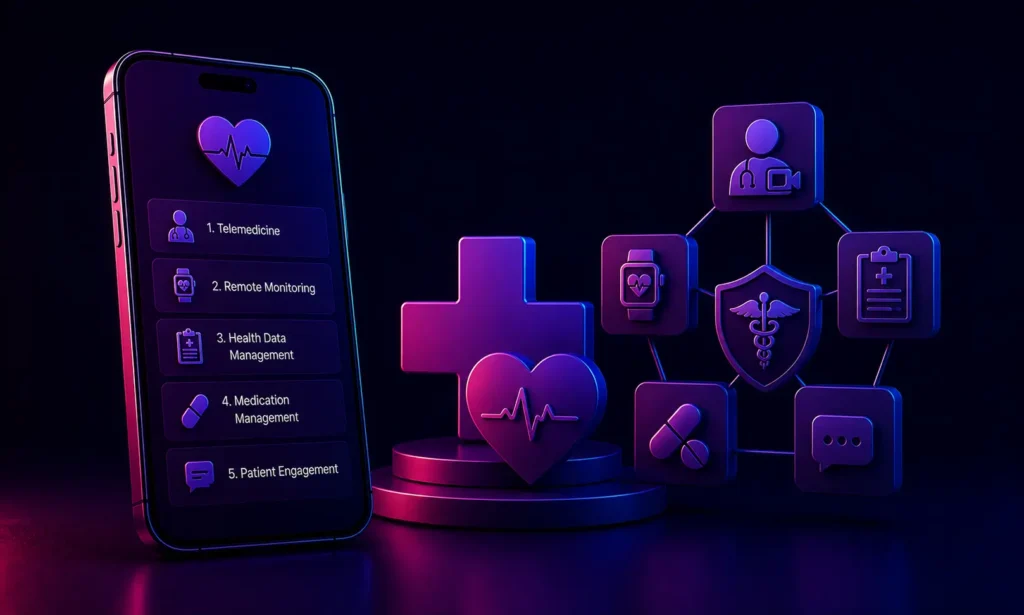
Here are five specific ways custom mobile app development is transforming the healthcare industry today.
1. Asynchronous Telehealth and Remote Triage
Telehealth is no longer just a Zoom call between a doctor and a patient. The true transformation lies in asynchronous telehealth powered by AI triage.
When a patient experiences a minor symptom, they can open their provider’s mobile app and describe their symptoms to an AI-driven chatbot. By leveraging deep AI Integration, the app can instantly cross-reference the patient’s EHR and current symptoms to determine the severity of the issue. If it is minor, the app can automatically schedule an asynchronous consultation or prescribe basic care. This filters out non-emergency cases, freeing up emergency rooms and clinical staff for critical patients.
2. IoT Wearable Integration for Chronic Care
Managing chronic diseases (like diabetes or hypertension) is the most expensive segment of global healthcare. Healthcare mobile apps are transforming chronic care by acting as the central hub for Internet of Things (IoT) medical wearables.
In 2026, a patient’s smartwatch or continuous glucose monitor syncs smoothly with their provider’s mobile app via Bluetooth. If a patient’s vitals cross a dangerous threshold, the app automatically alerts their primary care physician and dispatches emergency processs if necessary. This shift from reactive medicine (treating a heart attack) to proactive, data-driven medicine (preventing a heart attack based on anomalous data) is the most significant leap in modern medical history.
3. Frictionless Patient Administration
A significant portion of a hospital’s budget is wasted on administrative friction: missed appointments, lost physical paperwork, and manual billing errors.
A custom Mobile App Development strategy eliminates these bottlenecks. Patients can use the app to book appointments, verify their insurance eligibility instantly, and fill out intake forms digitally before they ever step foot in the waiting room. Apps that utilize predictive push notifications (reminding a patient to fast before a blood test) drastically reduce costly no-show rates.
4. Secure, Decentralized EHR Access
Historically, Electronic Health Records (EHR) were locked in legacy systemic databases that were incredibly difficult to share between different hospitals or specialists.
Modern mHealth apps, often utilizing principles of Web 3.0 Integration, are decentralizing this data. Patients carry their entire medical history-including high-resolution MRIs and genetic screening results-securely encrypted on their mobile devices. They can instantly grant cryptographic access to a new specialist, entirely bypassing the sluggish hospital records department.
5. Automated Medication Adherence
Medication non-adherence is a massive problem that leads to severe clinical complications and hospital readmissions. Mobile apps transform this behavior through subtle gamification and automated reminders.
Apps can track a patient’s prescription schedule and send a push notification when it is time to take a pill. In advanced deployments, the app integrates with smart pill bottles that report back to the mobile device when the cap is opened. If the patient misses a dose, the app can automatically notify their designated caregiver or family member.
Conclusion
The transformation of the healthcare industry relies on moving the point of care out of the hospital and into the patient’s pocket. By investing in healthcare mobile apps, administrators can drastically improve operational efficiency, secure patient data, and deliver a standard of proactive, personalized care that was previously impossible.
Is your healthcare facility ready for digital transformation?
Building HIPAA-compliant mHealth solutions requires specialized engineering. Partner with VDPL to architect secure, scalable mobile applications tailored for the healthcare industry.
Frequently Asked Questions (People Also Ask)
What are healthcare mobile apps?
Healthcare mobile apps (mHealth apps) are software programs designed specifically for mobile devices that provide health-related services. These range from patient-facing telehealth and fitness tracking apps to provider-facing apps used for accessing EHR data and managing clinical schedules.
How do apps improve patient care?
Apps improve patient care by providing immediate access to medical records, enabling remote monitoring of chronic conditions via wearables, and offering automated medication reminders. This empowers the patient and allows doctors to practice proactive, rather than reactive, medicine.
Are healthcare mobile apps secure?
A well-developed healthcare app is highly secure and fully compliant with regulations like HIPAA (USA) or GDPR (Europe). Achieving this security requires expert Custom Web Development and cloud architecture to ensure patient data is encrypted both in transit and at rest.