
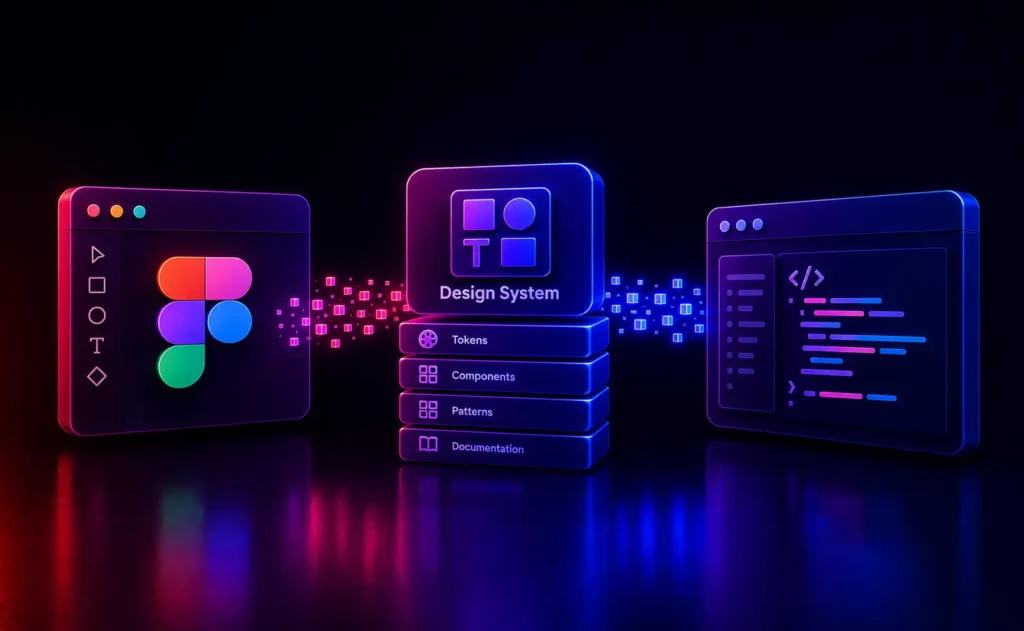
Every design system project we’ve inherited from another team has the same origin story: a beautiful Figma library that, six months later, no longer matches what’s actually in production. Not because the design team stopped caring - because nobody built the pipeline that keeps them in sync, and manually keeping two separate sources of truth aligned is a losing battle against time and changing requirements.
Why this gap forms even with good intentions
Design and engineering naturally drift apart because they’re solving different problems with different tools. A designer in Figma is optimizing for visual clarity and design intent. An engineer implementing that component in code is optimizing for reusability, performance, and edge cases the design file never had to consider - what happens with a very long label, an empty state, a loading state. Without a deliberate bridge between the two, each side makes small decisions that accumulate into real divergence, and nobody notices until a stakeholder points out the live product doesn’t match the latest deck.
What actually closes this gap
- Design tokens as the single source of truth. Colors, spacing, typography, and other foundational values defined once - in a format like tokens that both Figma (via plugins) and code (via a build step) can consume - rather than a designer picking a hex code in Figma and a developer independently hardcoding a slightly different one in CSS. This alone eliminates the most common and most visible drift.
- Component parity reviews, not just visual QA. Beyond “does this look right,” a real review checks that the component’s actual behavior (states, interactions, responsive behavior) matches what’s documented in Figma - visual QA alone misses behavioral drift entirely.
- Figma-to-code pipelines for the mechanical parts. Tools that generate component scaffolding, token values, or even basic markup directly from Figma structure remove the manual translation step where small inconsistencies creep in - not a full replacement for engineering judgment, but a real reduction in the surface area for drift.
- One shared component inventory, referenced by both sides. A living documentation site (Storybook or equivalent) that both designers and engineers treat as the actual source of truth for “what exists and how it behaves” - not the Figma file, not the codebase in isolation, but the documented, reviewed component library both sides update together.
Where teams over-invest
Fully automated design-to-code pipelines that attempt to generate production-ready component code directly from Figma files sound appealing and are, in our experience, rarely worth the engineering investment for most teams - the generated code usually needs enough manual cleanup that the automation saves less time than expected, while adding real maintenance overhead to the pipeline itself. We recommend automating the mechanical, low-judgment parts (token sync, basic scaffolding) and keeping actual component implementation as a deliberate, reviewed engineering task, not a fully automated one.
What we actually build for clients
A token pipeline that keeps foundational values in sync automatically, a documented component library that’s the genuine reference for both design and engineering, and a review process - not just a one-time project - that catches drift early rather than after it’s compounded across dozens of components. This is ongoing discipline more than a one-time deliverable, and the design systems that stay in sync over time are the ones where this process is actually maintained, not just set up once and abandoned.
We build and maintain design systems with this pipeline as a core deliverable, not an afterthought. If your Figma library and your production UI have drifted apart and you’re not sure how bad the gap actually is, talk to us - an honest audit of the current state is usually the fastest way to find out what’s actually worth fixing first.