
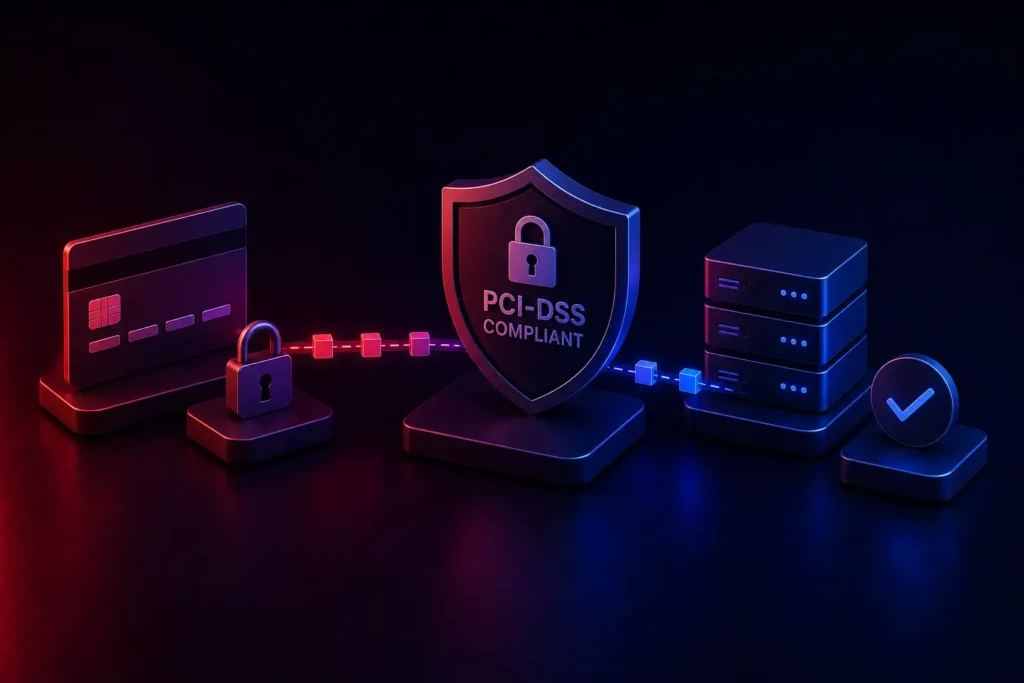
PCI-DSS compliance gets treated by a lot of engineering teams as a paperwork exercise handled by whoever fills out the self-assessment questionnaire, rather than a set of concrete architectural requirements that should shape how a payment system is actually built. That gap - compliance as documentation versus compliance as architecture - is exactly where we’ve seen otherwise well-built payment systems fail an audit, or worse, get breached in a way an audit would have caught.
The single highest-leverage decision: don’t touch raw card data at all
The single most effective compliance strategy is architectural, not procedural: never let your own systems handle raw card numbers in the first place. Using a PCI-compliant payment gateway’s tokenization and hosted fields (where the actual card input happens in an iframe served directly by the payment provider, not your own code) means the sensitive card data never touches your servers, which dramatically reduces both your compliance scope and your actual breach risk - you can’t leak what you never had. This single architectural decision eliminates most of the hardest PCI-DSS requirements before they’d otherwise apply to you.
What still needs real engineering discipline even with tokenization
- Secure handling of payment tokens - even though tokens aren’t raw card data, they’re still sensitive and need encryption at rest, restricted access, and audit logging on who accesses them and when.
- Network segmentation. Any system that does touch payment-related data - even just tokens and transaction records - should be isolated from the broader application network, so a compromise elsewhere in your infrastructure doesn’t have a direct path to payment systems.
- Strict access control and logging. Every access to payment-related systems and data needs to be authenticated, authorized at the minimum necessary level, and logged - this is both a compliance requirement and, practically, what lets you actually investigate if something goes wrong.
- Regular vulnerability scanning and penetration testing of anything in the payment data flow, not as an annual box-check but as an ongoing practice - PCI-DSS explicitly requires this, and for good reason, since the threat landscape changes faster than an annual audit cycle.
Where we’ve seen “compliant on paper” systems actually fail
The gap is almost always between what the self-assessment questionnaire describes and what the actual running system does. A development or staging environment that has looser security than production but somehow still has access to a copy of real payment-related data. Logging that captures more than it should - full request bodies that inadvertently include sensitive fields, stored in logs with far weaker access controls than the actual payment database. Third-party integrations or analytics scripts that have broader access to a page (and therefore, potentially, to payment form data) than anyone explicitly reviewed and approved.
What we actually build first, before anything else
Before writing payment integration code, we map the exact scope of what will touch payment data - which systems, which environments, which third-party scripts have access to the checkout page - and deliberately minimize that scope before building anything. Reducing PCI-DSS scope through architecture (tokenization, hosted fields, network isolation) is dramatically cheaper than trying to secure a broad scope after the fact, and it’s the difference between a compliance audit being a formality and being a stressful scramble to fix architectural gaps under a deadline.
The honest bottom line
PCI-DSS compliance done right is mostly an architecture decision made early, not a checklist completed late. If your payment flow currently touches raw card data anywhere in your own systems, that’s the first thing worth re-architecting, regardless of what the current compliance paperwork says.
We build payment-handling systems with compliance scope minimization as a first-class architectural decision. If you’re building or auditing a payment flow, talk to us before the architecture is locked in.