
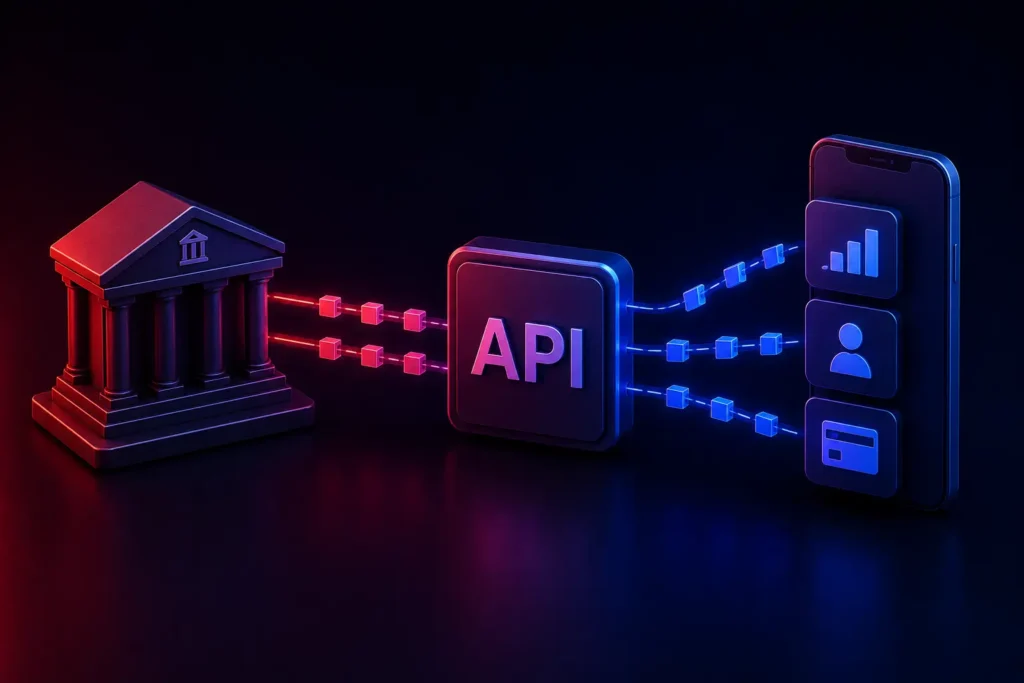
Open banking in India has moved faster on the regulatory side (the Account Aggregator framework, UPI’s continued expansion) than a lot of product teams’ actual architecture has caught up to. Building genuine bank-to-app connectivity is a different engineering problem than integrating a single payment gateway, and treating it like the same problem is where we’ve seen fintech teams get into real trouble.
What open banking architecture actually has to solve
Unlike a single payment gateway integration, open banking means your application needs to reliably connect to multiple financial institutions, each with their own API quirks, rate limits, and data formats, while maintaining strict security and consent boundaries around genuinely sensitive financial data. The Account Aggregator framework in India standardizes some of this, but “standardized” doesn’t mean “identical in practice” - different AA providers and financial institutions still have real implementation differences that your architecture needs to handle gracefully.
The core architectural pieces that actually matter
- A proper abstraction layer over multiple bank/AA integrations. Your core application logic shouldn’t need to know the specific quirks of each financial institution’s API - a well-designed integration layer normalizes different providers’ responses into one consistent internal format, so adding a new bank connection doesn’t mean touching business logic throughout the app.
- Consent management as a first-class system, not an afterthought. Under the Account Aggregator framework, consent has explicit scope, duration, and purpose - your system needs to track exactly what a user consented to share, with whom, and for how long, and be able to demonstrate this clearly if audited. Treating consent as a simple boolean flag rather than a structured, auditable record is a common and costly mistake.
- Resilient handling of partial failures. When you’re aggregating data across multiple financial institutions, some connections will be slow or temporarily unavailable while others respond fine. The architecture needs to handle partial data gracefully - showing what’s available with clear indication of what’s pending - rather than failing the entire request because one of five bank connections timed out.
- Encryption and data minimization specifically for financial data. Beyond standard security practices, only requesting and storing the specific data fields actually needed for your use case, with the sensitive fields encrypted at rest - the same discipline we push on every fintech project, particularly important here because open banking access can expose broader financial data than a single transaction ever would.
Where we’ve seen open banking integrations actually fail in production
Not usually a dramatic security breach - more often a reliability problem. A team builds and tests against one or two bank integrations, ships, and then discovers in production that the long tail of smaller institutions have meaningfully different response times, error formats, and edge cases the initial testing never covered. Building the abstraction layer and error handling to be genuinely provider-agnostic from the start, rather than hardcoding assumptions from the first integration, is the difference between this scaling smoothly and every new bank integration being a fragile, one-off project.
What we actually recommend building first
Before building against a long list of financial institutions, build the abstraction and consent-management layer against two or three genuinely representative providers - one that’s well-behaved and fast, one that’s slower or has quirkier responses. Getting that foundation right against a deliberately varied test set catches most of the integration problems before they show up as production incidents with your fiftieth bank connection.
We build this kind of infrastructure as part of our fintech engineering work. If you’re architecting an open banking integration and want a second opinion on whether your current approach will hold up past the first few institutions, get in touch.