
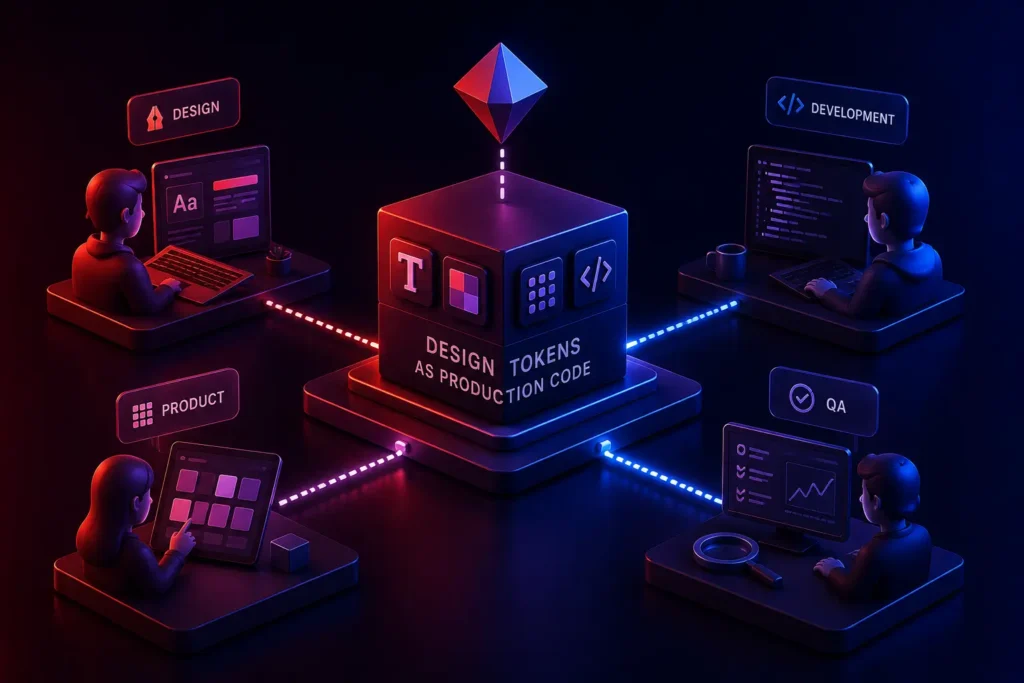
A distributed team’s biggest, quietest brand risk isn’t a rogue tweet - it’s five designers in five time zones each making their own small, reasonable-seeming decision about a shade of blue or a button’s border radius, none of them wrong in isolation, all of them slightly different from each other. Six months later the product looks like it was stitched together by different companies, because in practice, it was.
Why “just follow the style guide” doesn’t actually solve this
A static style guide - a PDF or a Figma page showing the correct colors and spacing - describes the intent, but it doesn’t enforce it, and it goes stale the moment someone updates a value in one place and forgets the other. In a distributed team without daily in-person alignment, small drift compounds faster than anyone individually notices, because nobody’s reviewing the whole product for consistency day to day - everyone’s heads-down on their own piece.
What “design tokens as production code” actually means
Design tokens are the foundational values of a design system - colors, spacing, typography, border radii - defined once, in a single source of truth, and consumed programmatically by both design tools (via Figma plugins) and actual production code (via a build step that generates CSS variables, or platform-specific values for mobile). The critical shift: these values live in version-controlled code, not a document someone has to remember to reference - a designer or engineer literally cannot easily use “a slightly different blue” because the only blue available in the actual tooling is the one the token system defines.
Why this specifically solves the distributed-team problem
- Drift becomes technically difficult, not just discouraged. When “primary blue” is a single token value pulled into every component automatically, there’s no separate place for a slightly-off shade to sneak in - the correct value is also the path of least resistance, which changes behavior far more reliably than a guideline document.
- Changes propagate everywhere at once. Updating a token value once updates every component and every team’s output that consumes it, rather than requiring a coordinated, manually-tracked update across every team’s separate implementation.
- It’s reviewable like any other code change. A pull request changing a design token goes through the same review process as any other code change - visible, diffable, and requiring approval - rather than a design decision made in a tool nobody else on the team is actively watching.
What this requires organizationally, not just technically
The tooling alone doesn’t solve this without a genuine process alongside it - a clear owner (or small group) responsible for the token system itself, a defined process for proposing and approving new tokens rather than every team member adding their own when the existing set doesn’t quite fit their immediate need, and a habit of new components being built from existing tokens by default, treating a request for a new, one-off value as something that needs a real reason, not a default.
Where distributed teams get this wrong even with tokens in place
The most common failure we see even after a token system exists: tokens defined but not actually enforced anywhere in the build or review process, so a developer under deadline pressure hardcodes a value instead of using the token, and nobody catches it until much later. Linting rules that flag hardcoded values where a token should be used, and genuinely including this in code review standards, is what makes the system actually hold up under real deadline pressure across a distributed team - not just at kickoff when everyone’s paying close attention.
We build token-based design systems specifically for distributed teams, with the enforcement mechanisms built in, not just the token values themselves. If your product’s visual consistency has drifted as your team has grown or spread across locations, get in touch for an honest audit of where the drift is coming from.