
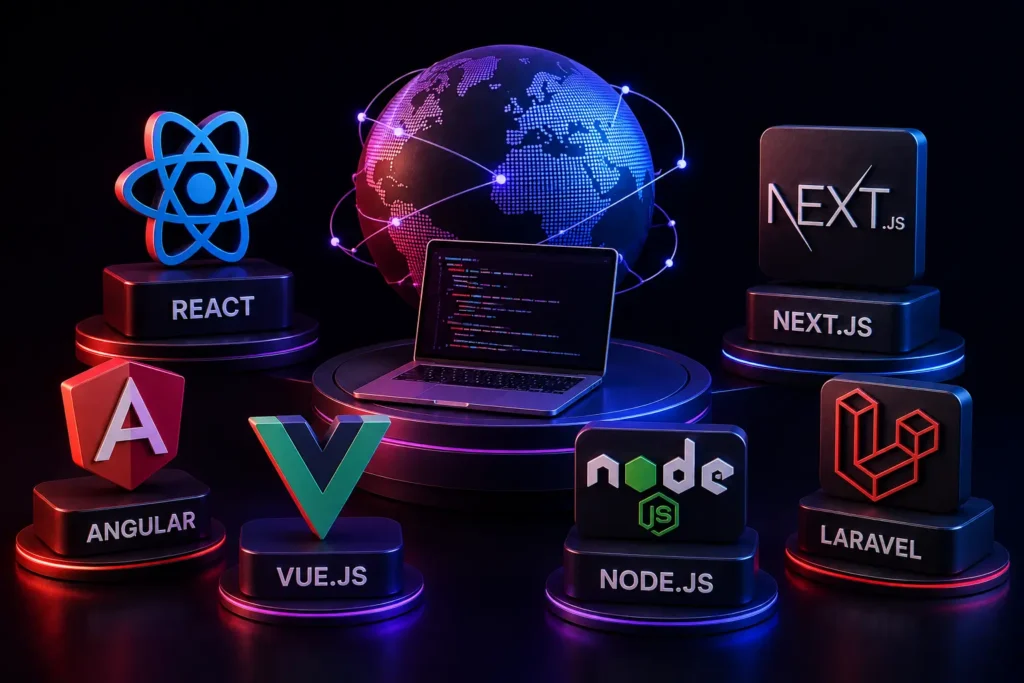
Beyond the established options we default to for most client work, a few newer frameworks are worth understanding specifically for what they’re doing differently - not because we’re recommending a switch, but because the specific problems they’re solving are worth knowing about even if you stay on a more established option.
The questions that actually determine the right answer
- What does your content and functionality actually need to do? A content-heavy marketing site, a complex web application with real user accounts and data, and an e-commerce store have genuinely different technical needs — the right framework for one is often a poor fit for another, and “what’s popular” matters far less than which category your actual site falls into.
- Who’s going to maintain this after launch? If you have an in-house team or a specific agency relationship you plan to continue, their existing expertise should weigh heavily — a technically excellent framework choice that nobody on your ongoing team knows well creates real ongoing cost and risk, regardless of how well-suited it is on paper.
- How much does content need to change without a developer? If your team needs to regularly update content, pricing, or product listings without engineering involvement, that points toward a framework with strong content management capabilities (or a proper headless CMS paired with it) — a genuinely different requirement than a mostly-static site that rarely changes after launch.
- What’s your actual growth trajectory? Building for scale you don’t have yet adds real, unnecessary cost and complexity. Building without any consideration for likely growth means a probable rebuild sooner than necessary. The honest answer is usually somewhere between these, informed by a realistic 12–24 month view, not a five-year hypothetical.
What “scalable” actually means for a typical growing business site
“Scalable” for a business website usually means something more modest than the term suggests — most business sites don’t need to handle millions of concurrent users, they need to grow gracefully from a handful of pages to a genuinely large content library, additional functionality, and multiple contributors, without needing a rebuild at each stage. That breaks down into three distinct things worth planning for separately:
- Content scalability — going from tens to thousands of pages without the CMS or architecture becoming unwieldy, which is more about clean content modelling than raw server capacity.
- Team scalability — multiple content contributors and eventually multiple developers working on the site without stepping on each other, which points toward a headless or well-structured CMS setup over a tightly coupled, single-editor system.
- Functional scalability — adding genuinely new capability (a booking system, a member area, an e-commerce section) without the original architecture fighting the addition.
Most business websites never come close to needing the kind of raw traffic-handling infrastructure the word “scalable” evokes in an engineering context. Investing heavily in autoscaling infrastructure for a site that gets a few thousand visitors a month solves a problem that doesn’t exist yet, at the expense of the content and functional scalability that actually determines how these sites grow in practice.
Translating the decision into business terms
When a technical team recommends a framework to a non-technical founder or board, the conversation usually breaks down at the same point: the technical team explains features and architecture, and the stakeholder needs to know what it means for cost, timeline, and risk. Four questions do most of that translation work:
- What does this cost, total — not just to build but to maintain? A framework choice affects developer hourly rates (talent scarcity drives cost up), ongoing hosting and infrastructure cost, and how much custom work versus off-the-shelf functionality is needed.
- What does this mean for time to launch? Some frameworks get a team to a working first version faster because of strong conventions and built-in functionality; others require more custom foundational work before feature development can start.
- What’s the risk if this doesn’t work out? How hard would it be to change course later if this choice turns out to be wrong — is this a decision with a real, expensive rebuild attached, or a more easily reversible one?
- Can you actually hire and keep a team on this? Talent pool size is a real, practical constraint that translates directly into a business risk — can you actually staff this project, now and as you grow — that a purely technical comparison doesn’t surface.
Be skeptical of a recommendation that can’t translate cleanly into these terms; that usually means the trade-offs haven’t been fully thought through, not that the technology is simply too complex to explain.
What adoption data does and doesn’t tell you
Adoption data — download numbers, GitHub stars, job postings — is a genuinely useful signal, but a framework “dominating” by those measures doesn’t automatically mean it’s the right choice for your specific project. What it reliably tells you: talent pool size (a widely-adopted framework has a larger available hiring pool), ecosystem depth (more third-party libraries, more community-produced learning resources), and a rough longevity signal, though an imperfect one — a framework can be widely adopted today while showing warning signs a raw adoption number doesn’t capture, like a declining growth trajectory or maintainer instability.
What it doesn’t tell you is whether it’s the right technical fit for your specific requirements. A dominant, widely-adopted framework can still be a poor fit for a specific technical need that a less popular, more specialised option handles better. Use adoption data as one input among several and let it break ties between options that are otherwise comparably suited — not override a genuine fit consideration.
Astro: content-first sites with minimal JavaScript by default
Astro’s core bet is that most content-heavy sites ship far more JavaScript than they need - its “islands” architecture renders static HTML by default and only ships JavaScript for genuinely interactive components, opted into explicitly. For content-driven sites (blogs, marketing sites, documentation) with limited interactive needs, this produces meaningfully smaller bundles than a general-purpose framework defaulting to more client-side JavaScript. Worth genuine consideration for content-first projects specifically; less relevant for applications that are inherently interactive throughout.
Qwik: resumability instead of hydration
Most frameworks “hydrate” - re-executing JavaScript on the client to make server-rendered HTML interactive, which costs real time and computation on page load. Qwik’s resumability model aims to skip this entirely, serializing application state so the client can resume exactly where the server left off without a full hydration pass. This is a genuinely novel architectural approach to a real, well-understood performance problem, though the ecosystem and tooling maturity are still well behind established options - worth watching, not yet a default recommendation for production client work.
Solid: fine-grained reactivity without a virtual DOM
Solid’s reactive primitives update the DOM directly and precisely when state changes, without React’s virtual DOM diffing step - this produces genuinely fast update performance for highly reactive interfaces. The trade-off is a smaller ecosystem and talent pool than React, which is exactly the kind of real, practical constraint we’ve written about weighing against pure technical merit elsewhere.
Where we’d actually consider one of these today
A genuinely content-heavy site with minimal interactivity is a reasonable place to evaluate Astro specifically, given its architecture is purpose-built for exactly that case. The others remain more in “worth tracking” territory for us than “ready to recommend for client production work” as of today.
We track this landscape continuously as part of our web development practice. Talk to us if you’re curious whether one of these newer approaches genuinely fits your specific project.
What “getting it wrong” actually looks like in practice
Rarely a dramatic technical failure - more often a slow accumulation of friction that becomes an obvious problem only in hindsight. A framework chosen for quick initial development that can’t cleanly support a feature the business now genuinely needs. A CMS-driven site that made sense for a small content team but can’t scale to the content volume and workflow complexity the business has grown into. A stack that was fine for the original team’s skills, now a hiring bottleneck because the framework has a smaller, harder-to-find talent pool than the team assumed when they chose it.
The actual, concrete costs when this happens
- A rebuild, not an upgrade. Once a framework’s fundamental architecture can’t support what the business needs, the fix is rarely an incremental change - it’s rebuilding the affected parts of the system on different foundations, which is dramatically more expensive and disruptive than the original decision would have been to get right.
- Lost velocity during the transition. A rebuild competes directly with new feature development for the same limited engineering time, meaning growth initiatives slow down precisely when the business needs them to speed up.
- Talent and knowledge disruption. A framework migration often means either retraining an existing team or bringing in new expertise, both of which carry real onboarding cost and risk of losing institutional knowledge about the existing system in the process.
Why this is genuinely hard to see coming at the time of the original decision
Early-stage framework decisions are usually made under real time pressure, with incomplete information about how the business will actually grow - this isn’t a criticism of teams that made a reasonable call with the information available at the time. The actual fix isn’t “predict the future perfectly,” it’s building in enough flexibility at the architectural seams most likely to need to change, the same discipline we’ve written about in the context of minimum viable architecture - not over-engineering for hypothetical scale, but not choosing a framework so rigid that reasonable, foreseeable growth requires a full rebuild.
What actually reduces this risk without over-investing upfront
Choosing a framework with a genuinely healthy talent pool and active long-term maintenance, even if a narrower, more specialized option looks marginally better on paper for the current specific need. Building clean separation between business logic and framework-specific code, so a future migration - if it ever becomes necessary - is a contained project rather than a full rewrite. And revisiting the framework decision explicitly at genuine growth milestones, rather than assuming a choice made at launch should hold indefinitely without ever being reconsidered.
What we actually recommend, by situation
For a content-driven marketing or informational site with a small team managing updates, WordPress remains a genuinely strong, well-supported choice — mature, widely known, with a large talent pool if you ever need to change agencies or hire in-house. For a web application with real interactivity, user accounts, and custom business logic, a modern JavaScript framework (React or Next.js, depending on specific needs) is usually the better foundation, with genuinely better long-term extensibility for complex features. E-commerce platform choice depends heavily on catalogue size and complexity, and is worth scoping as its own conversation.
The instinct to choose whatever framework a competitor or a well-known brand uses, without evaluating whether your actual needs match theirs, is one of the more common mistakes we see — a framework right for a company at a completely different scale isn’t automatically right for you. The other common mistake: choosing based purely on developer preference, without weighing the actual business requirements and long-term maintenance implications.
The decision checklist, in order
- What are you actually building — content-driven site, custom web application, e-commerce store, or internal tool? Each points toward a genuinely different starting shortlist.
- What does your team already know well? Existing expertise is a real, immediate cost factor that should weigh heavily against a marginally “better” unfamiliar option.
- What stage is your business actually at? MVP speed, post-PMF growth, or enterprise scale each shift the right priorities meaningfully.
- What’s the long-term viability of the options on your shortlist? Who maintains it, how’s adoption trending, what’s the migration track record — factors that matter for a decision meant to last years.
- Can you actually explain the trade-off to your business stakeholders in cost, timeline, and risk terms? If the technical team can’t translate the decision into these terms, the trade-offs likely haven’t been fully thought through.
No framework decision is permanently safe from ever needing to change. “Future-proof” realistically means choosing an option with genuine longevity signals and building with clean architectural boundaries that make a future change contained rather than catastrophic if it’s ever needed — not that the decision never needs revisiting.
Past a certain point, further analysis on the framework choice costs more than any marginal improvement in decision quality would deliver. For most well-established, well-supported options on a reasonable shortlist, execution quality matters more than which specific option among several reasonable choices you picked — we’ve seen more projects damaged by an over-long selection process than by choosing the second-best option among several genuinely sound ones.
We help clients move through this decision as part of scoping every new web development project, so the choice gets made well without becoming its own bottleneck. Talk to us about what you’re building and we’ll help you make this call quickly and confidently.