
Cloud infrastructure
Environments on AWS, Azure or GCP, defined in Terraform so they can be rebuilt exactly rather than remembered.
Cloud & DevOps
Infrastructure written down as code, and deployment that is routine instead of a maintenance window. The goal is boring: shipping on a Tuesday afternoon without anyone holding their breath.
Teams usually call about infrastructure for one of three reasons. The bill climbs every month and nobody can say why. Deploys are frightening enough that they happen at midnight. Or the system falls over under load that should have been ordinary.
All three are symptoms of the same thing: infrastructure that grew by hand instead of being written down. Our cloud and DevOps services in Delhi start by putting what exists into code, so the environment can be recreated, reviewed and reasoned about, and a deploy becomes a routine Tuesday afternoon rather than an event.
This is rarely a project on its own. It usually runs alongside a build, and the measure of it is boring: fewer incidents, a bill you can explain line by line, and a release nobody schedules around. We have no standalone cloud case study published, so this page describes the approach rather than delivered work.
Environments on AWS, Azure or GCP, defined in Terraform so they can be rebuilt exactly rather than remembered.
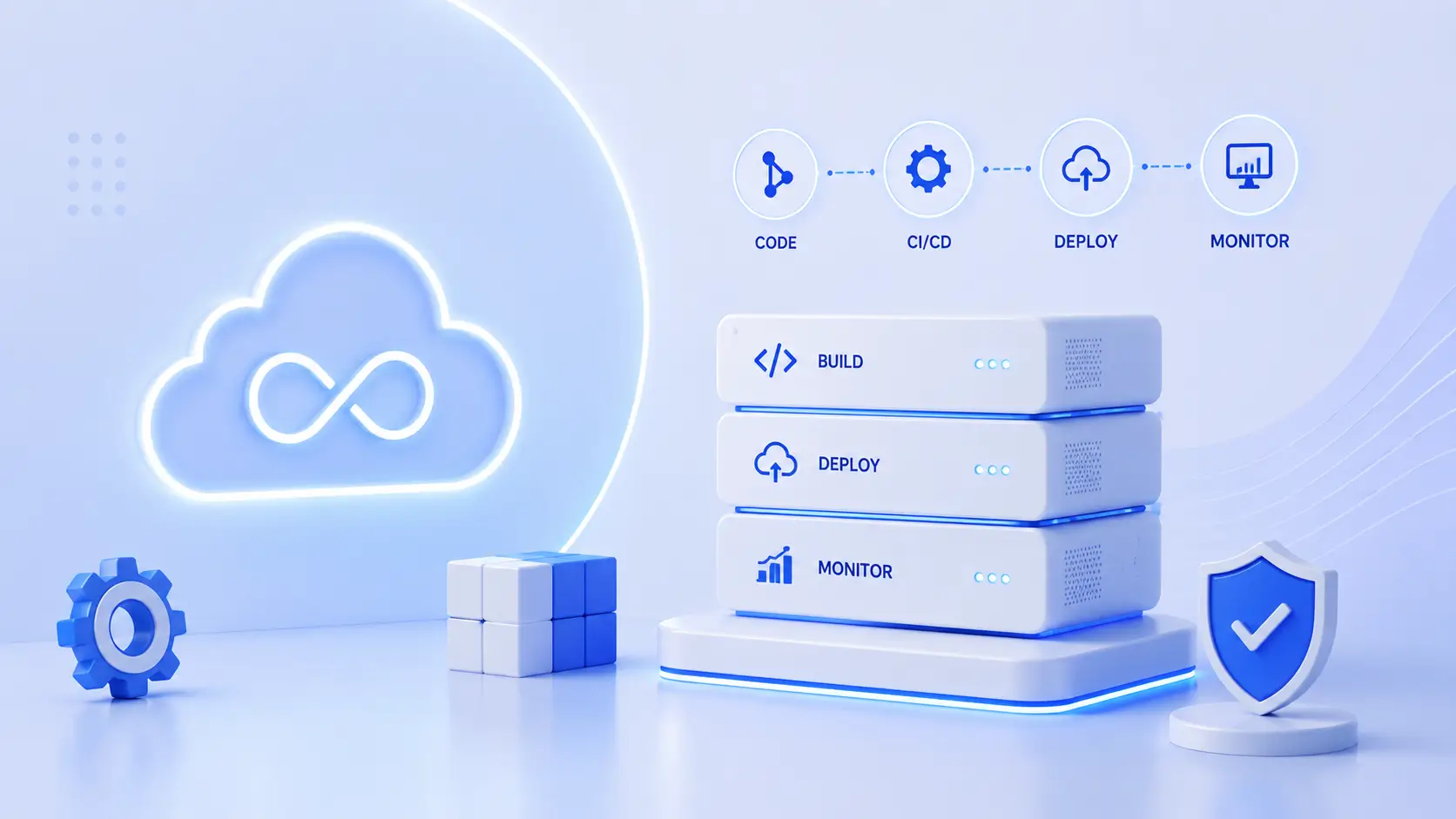
Build, test and release automated in GitHub Actions or Jenkins. Deploys become a routine action rather than an event.
Docker and Kubernetes where the workload justifies them, and something simpler where it does not.
Knowing something is wrong before your customers tell you, and having enough detail to find it.
Backups that are tested by restoring them. An untested backup is a belief, not a plan.
Who can reach what, and where credentials live. Usually the fastest security improvement available to a team.
Finding what you are paying for and not using. Cloud bills grow quietly and rarely shrink without someone looking.
Moving from a server somebody set up years ago, in stages, with a way back at each step.
What is different about how this team does the work, rather than what every agency says about it.
Environments are defined in code and kept in version control. A server configured by hand is a server nobody can rebuild when it fails at two in the morning.
Not for a diagram. Most systems we are asked to review are paying for capacity they have never used, while missing the one thing that actually breaks under traffic.
If releasing is risky, teams release rarely, and rare releases are bigger and riskier. Automating the pipeline is what breaks that loop.
Runbooks, access and documentation are part of the work. You should be able to operate this without calling us, and call us because you want to.
Chosen for what the project needs, not for what is new. If you already have a stack, we work in it.
Named pieces of work inside this capability, each with a known shape and a scoped price.
An audit of what is actually running, what it costs, and what can go without breaking anything.
Probably not, and we will say so. Kubernetes solves real problems at real scale, and it brings real operational cost with it. If your application is a handful of services with predictable traffic, a simpler setup will be cheaper to run and far cheaper to understand at three in the morning. We recommend it when the workload genuinely calls for it, and we are happy to talk you out of it when it does not.
Usually yes, and often significantly. Cloud costs grow quietly through unused capacity, oversized instances, forgotten environments and data transfer nobody accounted for. We start with a review of what you are actually paying for against what is actually used. The findings are normally specific and actionable, and the first round of savings tends to cover the cost of looking.
In most cases, yes, and that is how we would plan it regardless. Migration happens in stages, with the old system running until the new one has proven itself, and a way back at every step. A single cutover looks cheaper on paper and carries risk most businesses cannot absorb. Where genuine downtime is unavoidable, we tell you exactly how long and schedule it with you.
You do. Accounts, domains and credentials are registered to your company, and access is documented and handed over. We will keep supporting you if you want that, but the arrangement should be one you can end without it becoming a project. Any vendor who is vague about this is telling you something.
Tell us what your release process looks like today. We will tell you what is worth fixing first.
Vikalp Development
We usually reply within one business day