
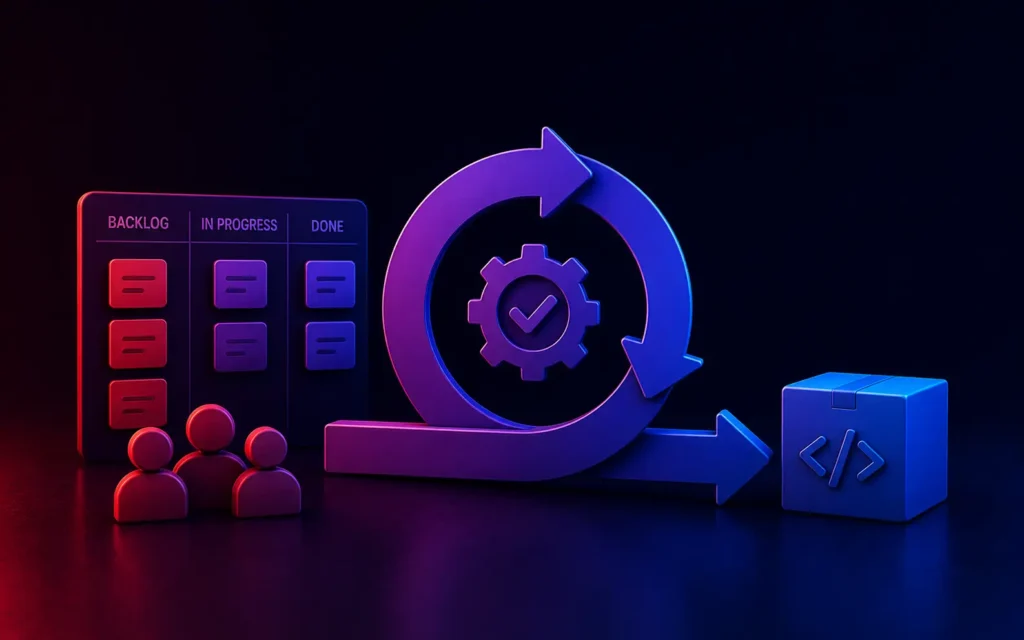
Is Agile software development still used?
Yes, Agile software development remains the dominant project management methodology in 2026. In an era where market conditions and technology stacks change rapidly, Agile allows engineering teams to work in iterative cycles (sprints), adapting to user feedback instantly rather than rigidly following outdated, years-long product roadmaps.
For Project Managers and Product Owners, delivering a complex digital platform on time and under budget is notoriously difficult. Historically, the software industry relied on the “Waterfall” methodology: you spend six months planning, a year coding, and then you launch the final product.
The fatal flaw of Waterfall is that by the time you launch a year later, the market has completely changed, and the product you built is no longer what the customer wants.
To survive in the hyper-competitive landscape of 2026, flexibility is paramount. This is why Agile software development is not just relevant; it is the absolute foundation of modern Custom Web Development.
The Core Philosophy of Agile
Agile is not a specific set of tools; it is a philosophy based on the Agile Manifesto written in 2001. Its primary objective is to deliver working software to the customer as quickly as possible, gather feedback, and iterate.
Instead of building a massive E-Commerce Platform all at once, an Agile team breaks the project down into bite-sized “User Stories.” They might spend two weeks building just the checkout cart, launch it to a small group of beta testers, see how it performs, and then adjust their strategy for the next two weeks.
This iterative approach ensures that you are always building exactly what the user needs today, drastically reducing wasted engineering hours.
Scrum vs. Kanban: Which Agile Framework?
While Agile is the philosophy, Scrum and Kanban are the actual frameworks teams use to execute the work. Understanding Scrum vs Kanban is critical for Project Managers.
1. Scrum: Structured Iterations
Scrum is the most popular framework. Work is divided into fixed-length iterations called “Sprints” (usually two weeks long).
- Before the Sprint begins, the team commits to a specific amount of work.
- Once the Sprint starts, no new work can be added.
- At the end of the two weeks, the team delivers a tangible, working piece of software.
Scrum is highly structured and requires specific roles (Scrum Master, Product Owner). It is exceptional for building complex, entirely new software products where defining short-term goals is necessary to maintain momentum.
2. Kanban: Continuous Flow
Kanban is far more fluid. It visualizes the entire workflow on a board with columns (e.g., To Do, In Progress, Code Review, Done).
- There are no fixed two-week Sprints.
- Instead, there is a strict “Work In Progress (WIP) Limit” to prevent bottlenecks (e.g., only 3 tasks can be in the ‘Code Review’ column at once).
Kanban is perfect for ongoing maintenance, bug fixing, or continuous DevOps Engineering, where priorities change daily and the team needs to react to incoming support tickets instantly.
Why Agile is Mandatory in 2026
The complexity of modern technology makes rigid planning impossible.
For example, if you are building an app with heavy AI Integration, the AI models available on the market might evolve drastically in the middle of your development cycle. If you are using Waterfall, you are locked into the outdated technology you planned for a year ago. If you are using Agile, you simply pivot in your next Sprint and integrate the newer, faster AI model.
Agile inherently reduces financial risk. Because you are launching Minimum Viable Products (MVPs) and gathering feedback continuously, you will never spend your entire budget building a platform that nobody wants to use.
Conclusion
Agile software development remains the gold standard because it acknowledges a fundamental truth: we cannot predict the future. By embracing change, organizing work into manageable iterations, and prioritizing continuous feedback, Agile frameworks empower engineering teams to deliver world-class software that perfectly aligns with market demands.
Need a development team that moves at the speed of your business?
VDPL operates on strict Agile methodologies, ensuring transparency, speed, and continuous delivery. Contact us today to discuss your next project.
Frequently Asked Questions (People Also Ask)
What is Agile software development in simple terms?
Agile is a project management approach that breaks large software projects into small, manageable chunks. Instead of trying to deliver the entire project at the very end, the team delivers working pieces of software frequently (usually every two weeks), allowing them to gather user feedback and adjust their plans constantly.
What is the difference between Scrum and Kanban?
Scrum organizes work into fixed, time-boxed intervals (Sprints, usually two weeks) where the team commits to specific tasks. Kanban is a continuous flow model without fixed timeboxes, focusing on visualizing the workflow and strictly limiting the number of tasks being worked on simultaneously to prevent bottlenecks.
Why did Agile replace Waterfall?
Agile replaced Waterfall because Waterfall is too rigid. In Waterfall, if a client wants to change a feature halfway through development, it derails the entire project timeline. Agile embraces changing requirements, allowing teams to pivot instantly based on new market data or client feedback without breaking the workflow.