
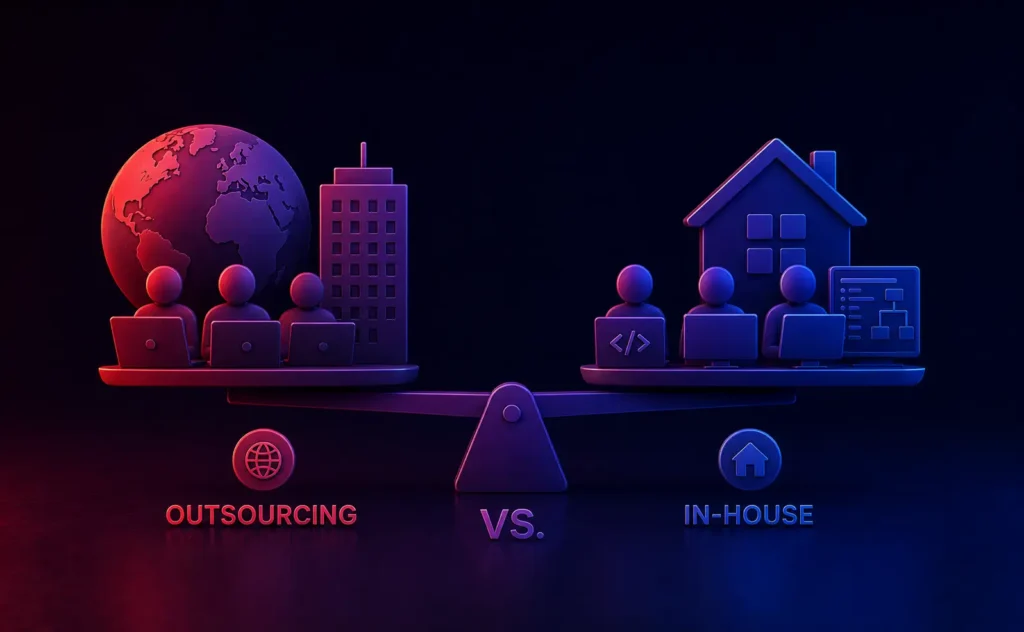
Outsourcing vs. In-House Software Development in 2026
Should I outsource software development or build an in-house team?
You should build an in-house team if software is your company’s absolute core competency and you have the massive budget required for recruitment, salaries, and benefits. You should outsource software development if you need to scale rapidly, require specialized niche talent (like AI engineers), or want to drastically reduce operational overhead while accelerating time-to-market.
For Chief Technology Officers (CTOs) and HR Directors, scaling a technical department is one of the most challenging logistical hurdles in modern business. When a company decides to build a new digital platform, they are immediately faced with a critical staffing decision: do we hire our own developers, or do we partner with an agency?
In 2026, the global talent shortage is severe. The demand for Senior DevOps engineers, AI specialists, and Full-Stack developers vastly outweighs the supply. Consequently, the debate of outsourcing vs in-house software development has shifted. Outsourcing is no longer just a cost-cutting measure for cheap labor; it is a strategic maneuver to access elite global talent instantly.
Let’s break down the realities of both approaches to help you build the optimal engineering team.
The Reality of In-House Development
Building an in-house team means you are hiring full-time W-2 employees. They work exclusively for your company and integrate deeply into your corporate culture.
The Pros of In-House
- Deep Cultural Alignment: In-house employees understand the nuances of your business goals and company culture better than external vendors.
- Immediate Availability: You can walk down the hall (or jump on a quick Slack call) and get an immediate response without navigating external project management layers.
- Absolute Control: You have total control over the development environment, the tech stack, and the daily priorities of the team.
The Cons of In-House
- Astronomical Costs: Beyond base salaries (which are incredibly high for senior talent in 2026), you must pay for recruitment fees, healthcare, 401(k) matching, software licenses, and expensive hardware.
- Slow Scaling: It can take three to six months to recruit, interview, hire, and onboard a single Senior React Developer. If you are racing to launch a Mobile App to beat a competitor, this delay is fatal.
- The Firing Friction: If the project ends, or if you simply needed a database specialist for two months, you cannot easily downsize a full-time W-2 employee without significant HR friction and severance costs.
The Reality of Outsourcing Software Development
Outsourcing involves partnering with a specialized software agency (like VDPL) to design, build, and maintain your application.
The Pros of Outsourcing
- Instant Scalability: Need a Cloud Architecture expert this month and a dedicated React & Next.js frontend team next month? An agency can scale the team up or down instantly based on the project’s current phase, ensuring you only pay for the exact talent you need, when you need it.
- Access to Elite, Niche Talent: Most mid-market companies cannot afford to keep a dedicated Smart Technology PhD on staff full-time. Outsourcing allows you to utilize elite talent for specific AI Integration tasks without the burden of a massive full-time salary.
- Reduced Operational Overhead: The agency handles recruitment, benefits, sick leave, hardware, and ongoing training. Your HR and Finance departments are unburdened, allowing them to focus on your core business.
The Cons of Outsourcing
- Communication Barriers: If you offshore to an agency with a massive time zone difference and poor English proficiency, communication friction will destroy the project timeline. (This is why nearshoring or partnering with agencies that guarantee overlapping hours is critical).
- Security Risks: Handing over proprietary code or customer data to an external vendor requires immense trust. You must enforce strict Non-Disclosure Agreements (NDAs) and verify their security compliance processs.
The Hybrid Approach (Team Augmentation)
Many successful enterprises in 2026 utilize a hybrid model called Staff Augmentation. You maintain a small, core in-house team (usually the CTO and a Lead Architect) who direct the project, and you outsource the heavy lifting to an external agency.
The agency developers integrate directly into your Agile sprints, attend your daily stand-ups, and write code under the direction of your internal leadership. This provides the cultural control of an in-house team with the infinite scalability of an outsourced agency.
Conclusion
The decision to hire in-house or outsource is dictated by speed, budget, and specialized requirements. If you have infinite time and an unlimited budget, building an in-house team is fantastic. However, in the fast-paced digital economy of 2026, outsourcing software development is often the only realistic way to deploy complex, enterprise-ready technology rapidly and cost-effectively.
Struggling to find the right technical talent?
VDPL provides world-class dedicated development teams and custom software engineering services. Contact us today to instantly scale your engineering capabilities.
Frequently Asked Questions (People Also Ask)
Is outsourcing software development a good idea?
Yes, it is highly beneficial if you need to launch a product quickly, lack specialized technical expertise (like AI or Cloud DevOps) on your internal team, or need to drastically reduce the operational costs associated with hiring full-time employees.
What are the risks of offshore software development?
The primary risks include severe communication delays due to differing time zones, cultural misalignments, varying standards of code quality, and potential intellectual property (IP) security risks if the offshore agency does not follow strict data protection laws.
What is staff augmentation?
Staff augmentation is a type of outsourcing where an external software agency provides specific, highly skilled developers to temporarily join and work directly alongside your existing in-house engineering team, filling specific skill gaps without the commitment of hiring full-time.