
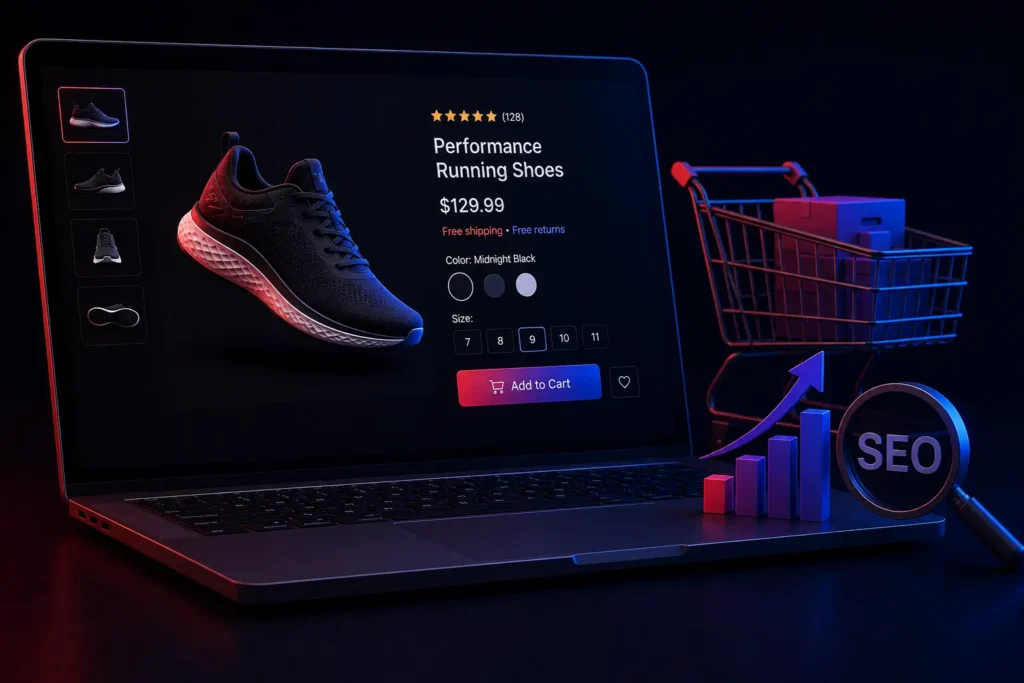
E-Commerce SEO: Optimizing Product Pages for Conversion in 2026
What is e-commerce SEO?
E-commerce SEO is the process of optimizing an online store’s architecture, category pages, and individual product pages to rank higher in search engine results. The goal is to capture high-intent buyers searching for specific products, driving free, organic traffic directly to checkout without relying on paid advertising.
For E-Commerce Founders, relying exclusively on paid advertising (like Facebook Ads or Google PPC) is a dangerous game. As ad costs continually rise and tracking becomes more restricted, profit margins are squeezed to the breaking point.
The most profitable digital retailers rely heavily on organic traffic. However, e-commerce SEO is wildly different from traditional blog SEO. You are not trying to rank a 2,000-word educational article; you are trying to rank a page that exists solely to sell a pair of shoes.
If your E-Commerce Platform is losing traffic to Amazon or massive retail aggregators, your product pages are likely suffering from “thin content” or technical bloat. Here is the strategy for product page optimization that drives both traffic and conversions in 2026.
1. Eradicate Manufacturer Descriptions (The Duplicate Content Killer)
The most common, and most destructive, mistake in e-commerce SEO is copying and pasting the manufacturer’s product description.
If you are selling a Sony camera, and you use the description provided by Sony, you now have the exact same text on your website as 5,000 other retailers. Search engines will view your page as “duplicate content” and will refuse to rank it, favoring larger, older domains (like Amazon) instead.
The Fix: You must write 100% unique, highly compelling product descriptions for every single SKU. As we discussed in our guide to Generative AI for Business, you can utilize custom AI models to rewrite 10,000 product descriptions rapidly, ensuring they are unique, on-brand, and SEO-optimized, saving hundreds of hours of manual copywriting.
2. High-Intent Keyword Targeting (The Long Tail)
Nobody ranks for the keyword “Shoes” except massive global corporations.
E-commerce SEO is won in the long tail. A user searching for “shoes” is browsing. A user searching for “Women’s waterproof trail running shoes size 8 black” has their credit card in their hand and is ready to buy.
Your product page titles, H1 tags, and meta descriptions must explicitly target these highly descriptive, bottom-of-funnel queries. Ensure your URL structure is clean and reflects this hierarchy (e.g., /womens/running-shoes/waterproof-trail-black).
3. Implementing Product Schema Markup
If you look at search results for a product, you often see star ratings, the price, and “In Stock” status directly on the Google results page. This does not happen by accident.
It happens because the Custom Web Development team implemented Product and Review Schema Markup. This is a specific type of microdata added to the HTML code that feeds exact product specifications directly to search engine bots. Products with rich schema markup experience significantly higher Click-Through Rates (CTR) because they stand out visually in the search results.
4. User-Generated Content (Reviews as SEO Fuel)
Search engines crave fresh, constantly updating text. However, a product description rarely changes. How do you keep a product page “fresh”?
Customer reviews. Every time a customer leaves a detailed review, they are adding fresh, highly relevant text to your product page, often naturally utilizing long-tail keywords you didn’t even think to target (e.g., “These shoes were perfect for my hike in the Adirondacks“).
Implement strong post-purchase automated email flows to solicit reviews (see our guide on Email Marketing Automation). Integrating reviews is a massive dual-benefit: it provides fresh SEO content and acts as social proof to increase the conversion rate of human buyers.
5. Obsessive Focus on Page Speed
E-commerce pages are inherently heavy; they require multiple high-resolution images, video players, and complex checkout JavaScript.
However, as noted in our Technical SEO Audit guide, slow loading times will destroy your rankings and your conversions. If an e-commerce page takes longer than 2.5 seconds to load, bounce rates skyrocket. You must utilize next-gen image formats (WebP), aggressive caching, and a premium Content Delivery Network (CDN) to ensure lightning-fast rendering.
Conclusion
Mastering e-commerce SEO requires balancing the needs of the search engine bot with the desires of the human buyer. By writing unique descriptions, injecting structured schema data, prioritizing site speed, and leveraging user reviews, you transform your product pages into highly visible, high-converting digital assets that insulate your business from rising ad costs.
Is your e-commerce platform struggling with slow load times or poor organic traffic?
At VDPL, we engineer custom, high-performance e-commerce architectures optimized from the ground up for maximum SEO visibility. Contact us today to discuss upgrading your digital storefront.
Frequently Asked Questions (People Also Ask)
Why is my e-commerce site not ranking on Google?
E-commerce sites typically fail to rank due to three main reasons: using duplicate manufacturer product descriptions (thin content), suffering from technical bloat resulting in extremely slow page load times, or having a confusing, deeply nested URL structure that prevents search engines from crawling the product catalog efficiently.
What is e-commerce Schema Markup?
Schema markup is a specialized code (microdata) added to an e-commerce website that explicitly tells search engines details about a product, such as its price, availability, star rating, and brand. This allows search engines to display “Rich Snippets” directly in the search results, making your listing stand out and increasing click-through rates.
Are category pages or product pages more important for SEO?
Both are vital, but they serve different intents. Category pages (e.g., “Men’s Running Shoes”) are optimized for broader, mid-funnel keywords to capture users who are still browsing options. Individual product pages are optimized for highly specific, long-tail keywords (e.g., “Nike Pegasus 39 Men’s Size 10”) to capture users ready to make an immediate purchase.