
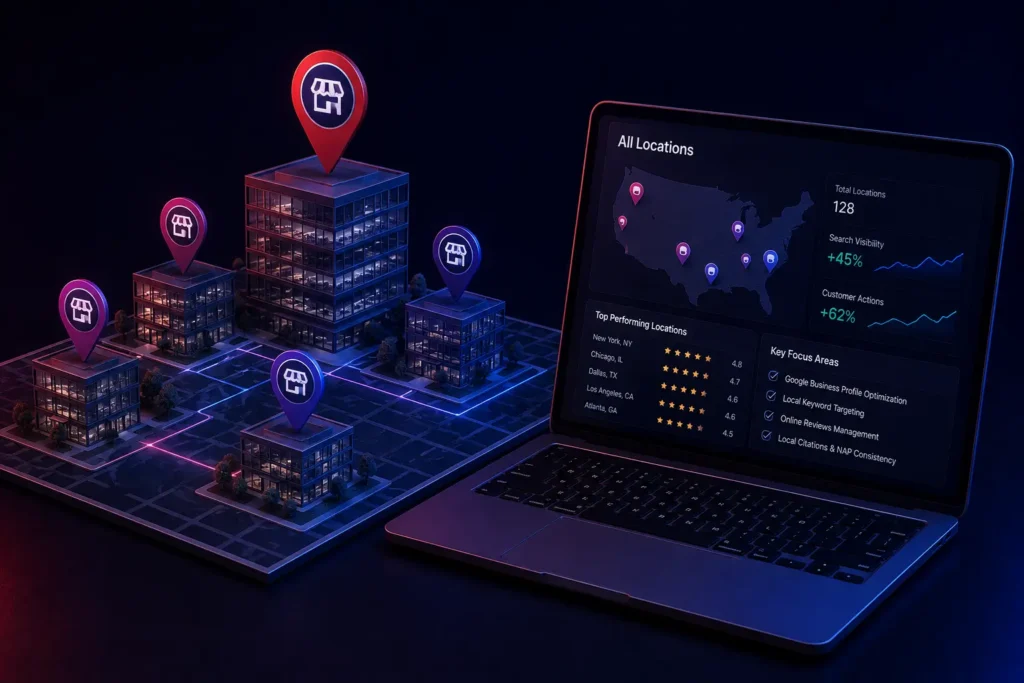
Local SEO for Enterprise Businesses with Multiple Locations in 2026
How do you do SEO for a business with multiple locations?
SEO for a multi-location enterprise requires establishing a distinct, highly optimized Google Business Profile for every single physical location, creating unique, localized landing pages on the corporate website for each branch, and utilizing specialized API software to ensure business hours and NAP (Name, Address, Phone) data remain perfectly synchronized across thousands of local directories.
For Regional Directors and Enterprise CMOs, local SEO is a logistical nightmare.
If you own a single coffee shop, ranking in the Google “Map Pack” (the top three local map results) is relatively straightforward. But what if you manage a corporate franchise with 500 bank branches, or a national healthcare provider with 1,200 clinics?
Scaling local SEO across hundreds of geographic markets simultaneously requires a strict architectural framework. A single bad data import can overwrite the phone numbers for 300 locations, destroying local foot traffic and infuriating branch managers. Here is the definitive guide to enterprise local SEO for multi-location businesses in 2026.
1. Master the Google Business Profile (GBP) API
The foundation of local SEO is the Google Business Profile (formerly Google My Business). If you want to rank for “Pediatrician near me,” your GBP is the most critical factor.
For an enterprise, manually logging into 500 different Google accounts to update holiday hours is impossible. The foundation of multi-location SEO relies on deep API Integration.
Enterprises must utilize specialized location management software (like Yext, Uberall, or custom-built middleware) that connects directly to the Google Business Profile API. This allows the corporate marketing team to push bulk updates-such as modifying business hours for a national holiday, or updating a corporate logo-across all 500 locations simultaneously from one central dashboard.
2. Dynamic, Localized Landing Pages (Location Pages)
A massive enterprise mistake is pointing all 500 Google Business Profiles to the main corporate homepage (www.enterprise.com).
Google wants to send users to the most locally relevant page possible. Your Custom Web Development team must build a scalable, dynamic architecture for “Location Pages.”
Every physical branch must have its own unique URL (e.g., www.enterprise.com/locations/chicago-downtown/). This page is not a generic template; it must be highly localized:
- Embed a specific Google Map to that exact branch.
- List the specific services offered at that branch.
- Include unique photos of the exterior and staff of that location.
- Feature local customer reviews pulled in via API.
This level of localization proves to Google that this specific branch is highly relevant to a searcher in downtown Chicago.
3. Enforcing Strict NAP Consistency
NAP stands for Name, Address, and Phone number.
Search engines verify the legitimacy of your business by cross-referencing your NAP data across hundreds of digital directories (Yelp, Apple Maps, Bing, YellowPages). If Branch #42 is listed as “Acme Corp” on Google, but “Acme Corporation Inc.” on Yelp, and has a disconnected phone number on Apple Maps, Google loses trust in the data and will drop that location from the Map Pack.
For enterprises, maintaining NAP consistency requires aggressive data governance. This is where the centralized API management software mentioned above becomes critical, locking down the NAP data and continuously overwriting any incorrect variations found on third-party directories.
4. Scalable Review Management Strategy
Reviews are a massive local ranking factor. A location with a 4.8-star average and 500 reviews will almost always outrank a location with a 3.2-star average and 12 reviews.
Managing reviews at an enterprise scale requires automation. (See our guide on Email Marketing Automation). When a transaction is completed in the CRM, an automated SMS or email should immediately request a review for that specific branch. The centralized API dashboard must alert regional managers instantly when a 1-star review is posted, allowing for rapid customer service intervention.
Conclusion
Enterprise local SEO is less about traditional marketing and more about thorough database management and scalable web architecture. By centralizing data control through APIs, enforcing strict NAP consistency, and deploying hyper-localized landing pages at scale, massive corporate entities can dominate local search results with the agility and relevance of a small, local business.
Is your multi-location enterprise struggling with local search visibility?
At VDPL, we architect robust, scalable enterprise web platforms and API integrations designed to manage massive, multi-location SEO deployments effortlessly. Contact us today to discuss your technical infrastructure.
Frequently Asked Questions (People Also Ask)
What is the difference between local SEO and national SEO?
National SEO focuses on ranking for broad keywords across an entire country (e.g., “Best CRM software”), usually prioritizing informational content. Local SEO focuses on ranking for geographically specific searches (e.g., “Plumber in Chicago” or “Coffee shop near me”), prioritizing the Google Business Profile, local reviews, and physical proximity to the user.
Why is NAP consistency important in SEO?
NAP (Name, Address, Phone Number) consistency is crucial because search engines like Google cross-reference this data across the internet to verify that a business is legitimate and operational. Inconsistent data confuses search engines, leading them to lower the trust and ranking of that specific business location.
How do I manage multiple Google Business Profiles?
For businesses with up to 10 locations, you can manage them manually via the Google Business Profile dashboard using location groups. For enterprises with dozens or hundreds of locations, you must use a third-party enterprise location management tool (like Yext or SOCi) that utilizes the Google API to manage all profiles simultaneously from a single interface.