
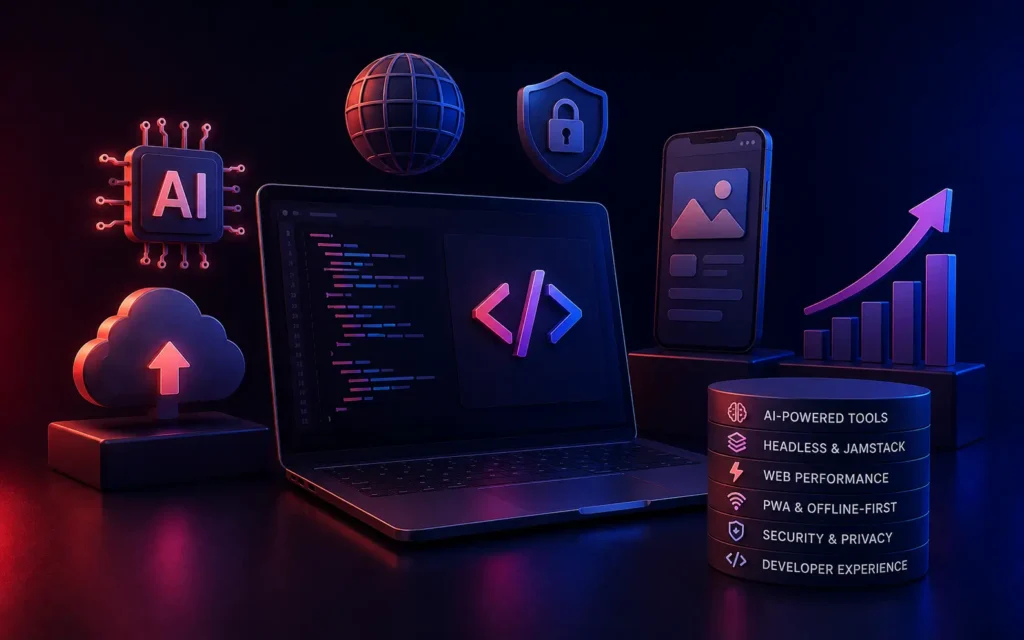
What is the future of web development in 2026?
In 2026, the future of web development is defined by AI-driven code generation, the widespread adoption of WebAssembly for near-native browser performance, and edge computing for instantaneous load times. Businesses are prioritizing accessible, highly personalized web experiences powered by Generative AI and decentralized Web 3.0 infrastructure to secure competitive advantages.
The digital landscape is shifting at an exceptional speed. As a CTO or business owner, looking at the web development landscape today compared to just a few years ago can feel like looking at two completely different industries. The tools, frameworks, and fundamental architectures we rely on to build scalable, high-performance web applications are evolving rapidly.
In 2026, we have moved past the hype cycle of many emerging technologies. Artificial intelligence is no longer just a buzzword; it is an integrated part of the development lifecycle. Performance is no longer a luxury; it is a strict ranking factor enforced by generative search engines. For enterprise leaders, understanding the “future of web development” isn’t merely an academic exercise-it is a critical requirement for maintaining market relevance, driving conversions, and ensuring that digital infrastructure doesn’t become obsolete before it even launches.
So, what are the modern web technologies defining this year, and how should your organization adapt? Let’s dive deep into the top web development trends of 2026 and explore how they are actively reshaping business operations.
1. Generative AI and Dynamic User Interfaces (UI)
The most visible shift in web development right now is the integration of Generative Engine Optimization (GEO) and Generative AI into both the backend development process and the frontend user experience.
Historically, user interfaces were static. A developer built a specific layout, and every user interacted with the same structure, perhaps personalized only by a name or localized pricing. In 2026, AI-driven UI generation allows websites to adapt their layout, content hierarchy, and even navigation flow in real-time based on the user’s historical behavior, real-time intent, and demographic data.
For example, a B2B SaaS platform might highlight deep technical documentation on the homepage for a returning developer, while simultaneously displaying a high-level ROI calculator for a visiting CFO.
Development teams at Vikalp Development Pvt. Ltd. (VDPL) are utilizing AI copilots not just for autocomplete, but for entire architectural scaffolding, security auditing, and automated testing. This accelerates the deployment cycle and significantly reduces the time-to-market for Custom Web Development projects.
2. WebAssembly (Wasm) Achieves Mainstream Enterprise Adoption
JavaScript has been the undisputed king of the browser for over two decades. While it isn’t going anywhere, it finally has a powerful partner in WebAssembly (Wasm).
WebAssembly allows developers to write code in languages like C++, Rust, and Go, and run it directly in the web browser at near-native speeds. In 2026, this is revolutionizing what is possible on the web. Complex applications that previously required massive local downloads-such as high-fidelity video editing software, 3D rendering engines, and heavy enterprise ERP dashboards-now run smoothly in a standard web browser.
Business Impact:
If your organization relies on heavy computational software, WebAssembly allows you to transition these tools to a cloud-based, accessible-anywhere model without sacrificing performance. This reduces hardware dependency for your workforce and creates entirely new SaaS product opportunities.
(External Reference: To understand the technical specifications driving this adoption, you can review the latest documentation from the W3C WebAssembly Working Group.)
3. Serverless Architecture Evolves into Edge Computing
Serverless architecture has been popular for a while, allowing developers to build and run applications without managing servers. However, 2026 has seen this model aggressively evolve into Edge Computing.
Instead of relying on a centralized cloud server located in a massive data center hundreds of miles away from the user, edge computing executes application logic and caches data at the “edge” of the network-meaning on a server geographically closest to the end-user.
For global brands, this means a user in Tokyo and a user in New York experience the exact same instantaneous load times. When milliseconds translate directly into conversion rates, moving your processing to the edge is a massive competitive advantage. When we design Cloud Solutions for our enterprise clients, edge caching and edge compute are now foundational requirements, ensuring that global latency is virtually eliminated.
4. The Decentralized Web (Web 3.0) Becomes Practical
For years, Web 3.0 was heavily conflated with cryptocurrency speculation. In 2026, the underlying technologies-specifically blockchain and decentralized data storage-have matured into practical, highly secure web development tools.
Enterprises are now utilizing Web 3.0 concepts for:
- Decentralized Identity (DID): Allowing users to own their login credentials securely without relying on third-party data brokers.
- Supply Chain Transparency: Using immutable ledgers directly integrated into web dashboards to provide real-time, tamper-proof tracking of physical goods.
- Smart Contracts: Automating escrow and B2B transactions directly through web portals without intermediaries.
While not every website requires a blockchain backend, platforms handling highly sensitive data or peer-to-peer transactions are increasingly migrating to decentralized architectures to mitigate the risk of centralized data breaches.
5. Hyper-Accessibility and Voice Navigation
Web accessibility is no longer just a moral obligation or a way to avoid legal penalties under WCAG guidelines. It is a fundamental expectation.
In 2026, we are seeing the rise of Voice User Interfaces (VUI) integrated directly into traditional web applications. As smart speakers and voice-activated AI assistants become the primary search vehicle for millions of users, websites must be structured to communicate smoothly with these devices.
This means:
- Implementing strict semantic HTML.
- Ensuring screen readers can parse complex interactive elements smoothly.
- Building websites that can be navigated entirely via voice command APIs.
Optimizing for voice search and accessibility directly ties into your overall SEO performance, as search engines heavily penalize sites that fail to provide inclusive experiences.
6. The API-First Economy
Modern web applications are rarely built in silos. They are interconnected webs of microservices and third-party tools. The “API-First” approach dictates that before a single line of frontend code is written, the Application Programming Interface (API) is designed, mapped, and secured.
This allows organizations to be incredibly agile. If you have a robust API, you can smoothly connect your web application to a new CRM, push data to a Mobile App, or integrate with external AI & Automation Solutions without needing to rebuild your core infrastructure. An API-first architecture future-proofs your digital investments by ensuring maximum interoperability.
How Business Leaders Should Prepare
Understanding these web development trends for 2026 is only the first step. The real challenge is strategic implementation. As a business leader, you should ask yourself the following questions:
- Is our current architecture scalable? If your user base doubles overnight, will your legacy systemic backend crash, or do you have a microservices architecture that can handle the load?
- Are we maximizing performance? Have you audited your Time to First Byte (TTFB) and Core Web Vitals recently?
- Are we secure by design? With AI-powered cyber threats increasing, is your web platform utilizing modern encryption and strict security authentication?
If the answer to any of these is no, it may be time to evaluate a legacy modernization strategy. Rebuilding or refactoring your digital infrastructure using modern web technologies is an investment in your company’s operational resilience.
Conclusion
The future of web development in 2026 is dynamic, highly distributed, and incredibly fast. By embracing trends like AI-generated UIs, WebAssembly, edge computing, and API-first architectures, businesses can build digital platforms that are not only future-proof but also actively drive growth and customer retention.
At VDPL, we specialize in translating these complex technological advancements into tangible business value. Whether you are looking to build a high-performance web application from scratch or modernize a legacy system, our engineering team has the expertise to execute your vision.
Ready to future-proof your digital presence?
Schedule a Consultation with our technical experts today and let’s discuss how custom web development can accelerate your business goals.
Frequently Asked Questions (People Also Ask)
What are the biggest web development trends in 2026?
The most significant trends include the integration of Generative AI for dynamic UIs, the use of WebAssembly for high-performance browser applications, the shift toward Edge Computing for faster load times, and an increased focus on API-first architectures and Web 3.0 security processs.
Will AI replace web developers in 2026?
No, AI is not replacing developers; it is augmenting them. AI tools like coding copilots handle repetitive scaffolding and boilerplate code, allowing human developers to focus on complex software architecture, security, and solving high-level business problems.
Why is WebAssembly important for the future of web development?
WebAssembly allows code written in powerful languages like Rust or C++ to run in the browser at near-native speeds. This allows developers to build heavy, resource-intensive applications (like video editors or complex enterprise software) directly on the web without requiring users to download desktop applications.
How does edge computing improve website performance?
Edge computing physically moves the server processing and data caching closer to the user’s location. Instead of data traveling across the globe from a central server, it is delivered from a local edge node, virtually eliminating latency and resulting in instantaneous page loads.
What is the difference between Web 2.0 and Web 3.0 development?
Web 2.0 relies on centralized servers and databases controlled by single entities (like major tech corporations). Web 3.0 utilizes decentralized technologies like blockchain, giving users more ownership over their data and creating highly secure, tamper-proof web environments.