
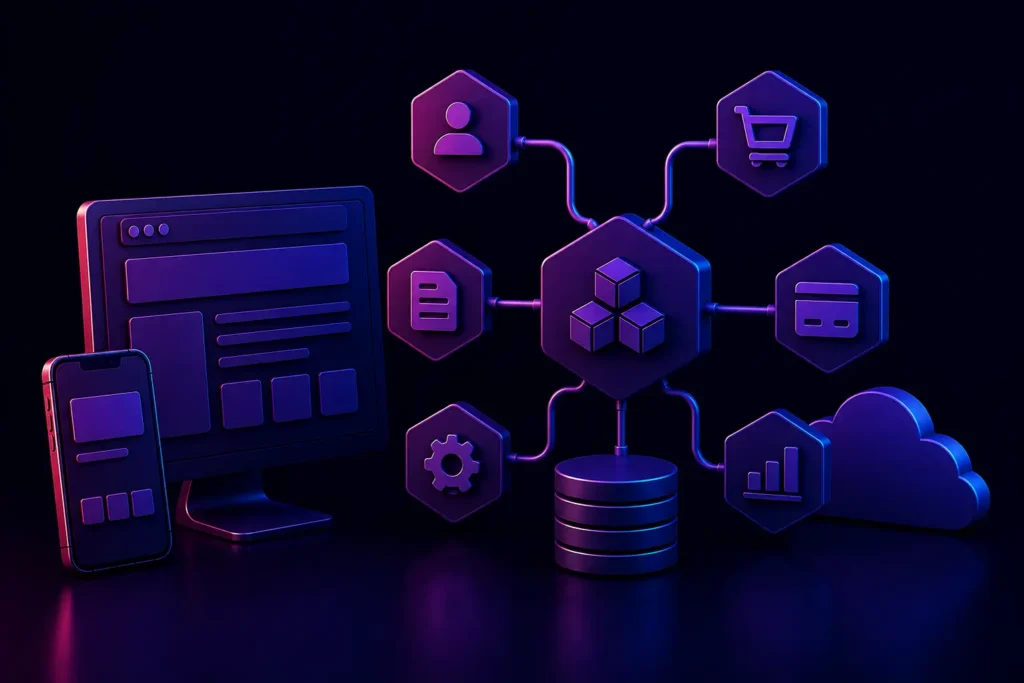
The Role of Microservices in Modern Web Architecture in 2026
What is a microservices architecture?
Microservices architecture is a software development method where a large application is built as a suite of small, independent services. Each service runs its own unique process, manages its own database, and communicates with other services via lightweight APIs. This allows development teams to build, deploy, and scale specific features without affecting the entire application.
For the past two decades, the vast majority of web applications were built as legacy systems. In a legacy systemic architecture, the user interface, the business logic, the database access layer, and the payment processing are all bundled into a single, massive codebase.
While legacy systemic applications are simple to build initially, they become incredibly difficult to maintain as a company scales. If a single developer makes a typo in the payment processing module, it can crash the entire application. Deploying a minor update requires redeploying the entire multi-gigabyte application, slowing down engineering speed.
In 2026, enterprise scalability requires agility. For Technical Architects, transitioning to a microservices architecture is the definitive strategy to modernize web applications, isolate faults, and drastically accelerate deployment cycles.
Breaking Down the Legacy system
To understand the role of microservices, consider a massive E-Commerce Platform. In a legacy system, the product catalog, shopping cart, user reviews, and payment gateway are all intertwined.
In a microservices architecture, you modernize these functions into distinct, autonomous services:
- The Catalog Service: Manages product details and images.
- The Cart Service: Manages the user’s active session and chosen items.
- The Payment Service: Handles credit card validation and processing.
These services do not share a database. They operate completely independently. If the Catalog Service needs to know if a payment was successful, it asks the Payment Service via a highly secure, internal API integration.
The Core Advantages of Microservices
1. Independent Scalability
As we discussed in our guide to Scaling Web Applications, not all parts of your application experience the same traffic. During a Black Friday sale, your “Product Search” service might be under immense strain, while your “User Profile Settings” service is barely used.
Microservices allow you to allocate extra server resources (via Cloud Architecture) exclusively to the Search Service without wasting money scaling the entire application.
2. Technology Agnosticism
In a legacy system, you are locked into a single technology stack (e.g., everything must be written in PHP or Ruby). Microservices free your engineering teams from this constraint.
If your data science team builds a brilliant AI recommendation engine in Python, they can deploy it as an independent microservice. Meanwhile, your frontend team can build the user interface using React & Next.js, and your backend transactional engine can run on Node.js. The services communicate smoothly via REST or GraphQL APIs, regardless of the underlying language.
3. Fault Isolation
In a microservices architecture, a failure in one service does not bring down the entire system. If the “User Reviews” microservice crashes due to a database error, the rest of the e-commerce site-including product browsing and checkout-remains fully functional. The UI simply hides the review section or displays a fallback message until the service automatically restarts.
The Challenges of Decoupling
While microservices offer incredible enterprise agility, they introduce significant operational complexity.
- Infrastructure Overhead: Instead of managing one server, you are now managing dozens or hundreds of independent services. This requires robust Docker and Kubernetes (k8s) management to manage containers efficiently.
- Data Consistency: Because microservices do not share a single database, maintaining data consistency across services (e.g., ensuring inventory levels match cart checkouts) requires complex event-driven architectures and message brokers (like Kafka or RabbitMQ).
- Deployment Complexity: You can no longer just drag and drop files via FTP. You absolutely must implement strict CI/CD & DevOps Engineering pipelines to automate the testing and deployment of individual services.
Conclusion
The shift from legacy systemic to microservices architecture is not merely a technical upgrade; it is an organizational transformation. It empowers small, autonomous engineering teams to innovate rapidly, deploy features continuously, and build platforms that are inherently resilient.
For businesses anticipating hyper-growth or dealing with legacy codebases that are too fragile to update, decoupling is the path forward.
Is your legacy systemic application holding your business back?
Reach out to the enterprise architecture team at VDPL to discuss modernizing your infrastructure with a tailored microservices strategy.
Frequently Asked Questions (People Also Ask)
What is the difference between legacy systemic and microservices architecture?
A legacy systemic architecture builds all application features, logic, and databases into a single unified codebase. A microservices architecture breaks the application down into small, independent services that run their own processes and communicate with each other via APIs over a network.
Why do companies migrate to microservices?
Companies migrate to microservices to improve development speed, isolate system failures, and enable independent scalability. It allows large engineering departments to work on different parts of an application simultaneously without causing code conflicts or breaking the entire system.
When should you NOT use microservices?
You should not use microservices if you are a small startup building a Minimum Viable Product (MVP), if you lack dedicated DevOps engineers, or if your application is relatively simple. The infrastructure overhead of microservices is massive and can paralyze small teams that would be better served by a well-structured legacy system.