
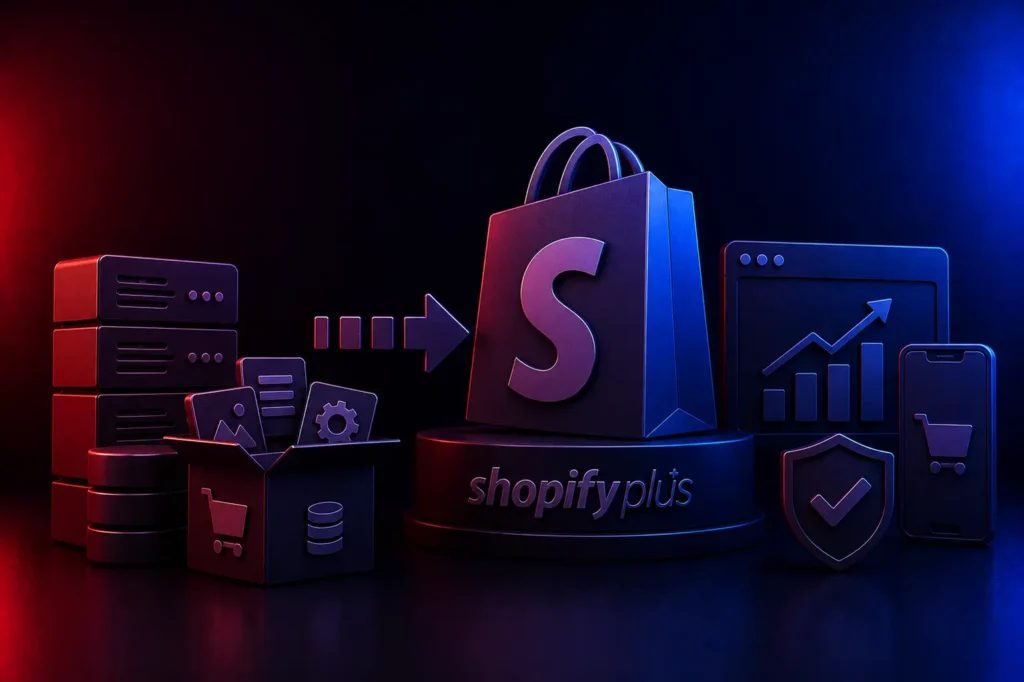
When should a business migrate to Shopify Plus?
A business should migrate to Shopify Plus when their e-commerce revenue scales beyond $1M-$2M annually, and they require advanced B2B wholesale capabilities, automated complex workflows (via Shopify Flow), international expansion tools, and direct access to customize the checkout process (checkout.liquid or Checkout Extensibility).
For Enterprise Retailers and CTOs running legacy platforms (like Magento or custom legacy systemic builds), maintaining the underlying server architecture is a massive, expensive headache.
If your website crashes during a massive Black Friday traffic spike, you lose hundreds of thousands of dollars in an hour. This is the primary driver behind the massive industry shift toward SaaS-based enterprise e-commerce.
Migrating to Shopify Plus offloads server maintenance entirely, allowing your Custom Web Development team to focus exclusively on building features that drive revenue. If you are preparing for an enterprise migration, here is the comprehensive guide to the benefits of Shopify Plus and the migration process.
The Core Advantages of Shopify Plus
Before undertaking a massive data migration, you must understand exactly what the $2,000+ monthly fee for Shopify Plus actually unlocks.
1. Checkout Customization (The Conversion Engine)
Standard Shopify absolutely forbids editing the checkout page (to maintain PCI compliance).
Shopify Plus unlocks the checkout environment. This allows your developers to inject custom UI/UX Design elements, add custom fields for complex B2B shipping requirements, and utilize advanced Shopify Scripts to dynamically change shipping rates or apply tiered wholesale discounts in real-time.
2. Shopify Flow (Enterprise Automation)
Shopify Flow is a visual automation builder exclusive to Plus. It replaces the need for dozens of third-party apps.
You can build complex, “If This, Then That” logic directly into the backend. For example: If a customer places an order over $5,000, Then automatically tag the customer as “VIP,” notify the Customer Success team in Slack, and send a custom gift card via email.
3. B2B on Shopify
Historically, managing Wholesale and Direct-to-Consumer (DTC) required running two completely separate websites. Shopify Plus natively integrates B2B functionalities into a single platform. You can set company-specific price lists, net payment terms, and custom catalogs for your wholesale buyers directly alongside your DTC retail store.
4. Unlimited Scalability and API Limits
Standard Shopify severely restricts API calls. If you are integrating a complex ERP system, standard Shopify will throttle your data flow. Shopify Plus provides massive API rate limits, allowing for real-time inventory syncing across thousands of SKUs and enabling complex Headless Architecture builds.
The Migration Process: Mitigating Risk
Migrating an enterprise platform is highly dangerous. A single mistake can destroy your E-Commerce SEO.
- The Data Map: The first step is mapping your legacy database (Products, Customers, Historical Orders, Metafields) to Shopify’s strict data structure. This requires extensive API Development and custom scripts.
- The SEO 301 Redirect Strategy: This is the most critical step. Your old website had thousands of URLs (e.g.,
store.com/category/mens/shoes/nike). Shopify uses a rigid URL structure (e.g.,store.com/collections/mens-shoes/products/nike). You must map a 1-to-1 301 Redirect for every single old URL to the new Shopify URL. If you fail to do this, all your Google rankings will instantly vanish. - ERP / Middleware Integration: Before launching, the new Shopify Plus store must be securely connected to your existing ERP, 3PL (warehouse), and accounting software, ensuring orders flow flawlessly on Day 1.
Conclusion
Migrating to Shopify Plus is a strategic operational shift. It moves your enterprise away from constantly fighting server fires and technical debt, and allows you to utilize a massively scalable, highly flexible SaaS infrastructure. While the migration process requires meticulous technical planning, the resulting increase in speed, automation, and conversion optimization provides a massive ROI for scaling retailers.
Are you ready to replatform your enterprise e-commerce architecture?
At VDPL, our senior technical architects specialize in complex, high-volume data migrations from Magento, BigCommerce, and custom legacy systems to Shopify Plus. Contact us today to discuss a secure migration plan.
Frequently Asked Questions (People Also Ask)
How much does Shopify Plus cost?
Shopify Plus pricing starts at $2,000 per month on a 1-year term (or $2,500/month month-to-month). Once your store generates roughly $800,000 in monthly revenue, the pricing shifts to a revenue-based model, typically around 0.25% of eligible sales volume.
What is the difference between Advanced Shopify and Shopify Plus?
While Advanced Shopify is powerful, Shopify Plus is built specifically for enterprise scale. Plus provides exclusive access to customize the checkout code, significantly higher API limits for complex integrations, B2B wholesale features, the Shopify Flow automation tool, and a dedicated Merchant Success Manager.
Will migrating to Shopify hurt my SEO?
If a migration is handled poorly, it can destroy your SEO. Because Shopify forces a specific URL structure, all of your old website links will break (resulting in 404 errors) unless you implement a thorough, mathematically perfect 301 Redirect map to point search engines from the old URLs to the new Shopify URLs.