
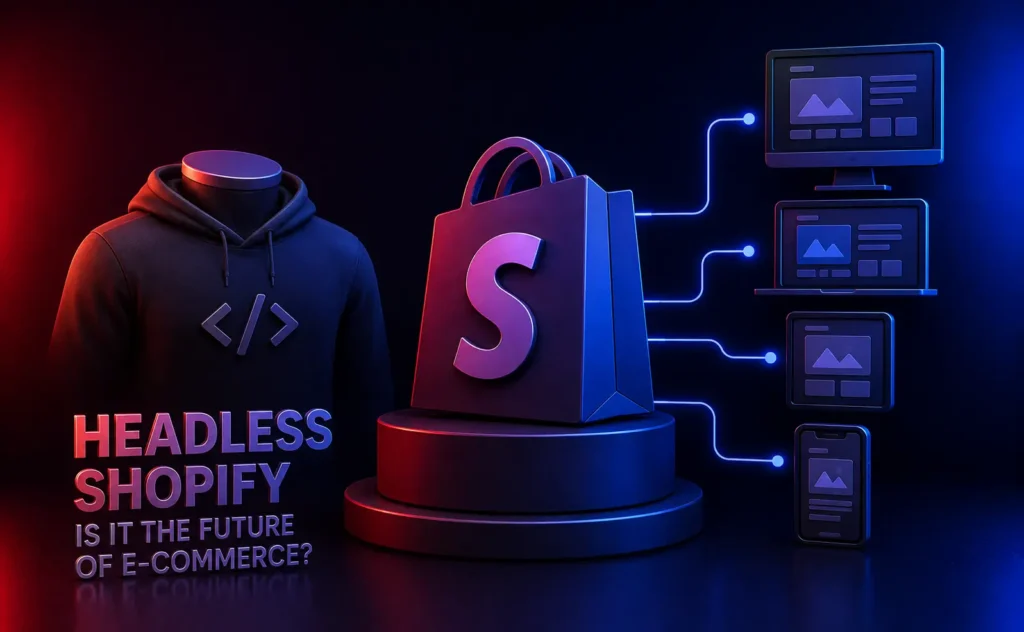
What is a headless Shopify architecture?
Headless Shopify is an advanced architectural approach where the “head” (the frontend visual design that customers interact with) is completely modernized from the backend (Shopify’s e-commerce engine that handles inventory and checkout). The two systems communicate via API, allowing developers to build blazing-fast, entirely custom frontend experiences using modern frameworks like React, while still relying on Shopify for secure transactions.
For Enterprise E-commerce Directors and CTOs scaling past $10M in annual revenue, traditional legacy systemic e-commerce platforms eventually become a bottleneck.
While Customizing Your Shopify Store using Liquid is powerful, you are ultimately still constrained by Shopify’s proprietary frontend rendering engine. If you want a mobile shopping experience that feels as instant and fluid as a native iOS app, standard Shopify themes struggle to deliver.
Enter the future of enterprise retail: Headless Shopify. By separating the presentation layer from the database, brands unlock limitless scaling potential. Here is why enterprise brands are migrating to headless architecture in 2026.
1. Sub-Second Performance and Core Web Vitals
The primary driver for going headless is speed.
Standard Shopify themes, weighed down by heavy Liquid rendering and third-party apps, often struggle to pass strict Core Web Vitals metrics.
By going headless, your Custom Web Development team can build the frontend using React (specifically frameworks like Next.js or Remix). These modern frameworks generate static, heavily cached pages that load in milliseconds. Page transitions are instantaneous, creating an app-like experience. This drastic reduction in latency actively reduces bounce rates and drives up conversion percentages.
2. Absolute Total Design Freedom
Standard Shopify requires developers to adhere to the rigid structure of Liquid templates.
With Headless Shopify, there are zero UI/UX constraints. Because the frontend is a completely separate application, designers can implement massive, complex Spatial UI and Micro-interactions that would normally break a standard theme. You can create hyper-immersive, 3D interactive product configurators or highly complex storytelling pages that smoothly blend into the shopping experience.
3. True Multi-platform Delivery
In a legacy systemic architecture, your website is your only storefront.
In a headless architecture, Shopify acts purely as a central data engine, feeding inventory and pricing data via API Integration to any “head” you want.
- Want to build a custom React website? Use the API.
- Want to build a native mobile app for iOS? Use the same API.
- Want to sell directly through a smart refrigerator or a VR headset? Use the same API.
Headless allows you to future-proof your business by distributing your products across any digital medium instantly, all managed from a single, centralized Shopify backend.
4. The Complexity Cost: Is It Right for You?
Headless Shopify is incredibly powerful, but it is not for small businesses. It introduces significant complexity.
You are no longer managing one platform; you are managing two distinct codebases (the React frontend and the Shopify backend). You can no longer simply install a $10 app from the Shopify store to add a countdown timer; your developers must custom-code every single feature into the React frontend.
Going headless requires a dedicated, elite engineering team and a substantial budget. It is strictly recommended for enterprise brands that require absolute performance and bespoke functionality that legacy systemic Shopify simply cannot provide.
Conclusion
Headless Shopify is the ultimate evolution of e-commerce architecture. By decoupling the presentation layer, enterprise retailers shatter the limitations of standard themes, unlocking instantaneous performance, limitless creative freedom, and total multi-platform flexibility. For brands looking to dominate their market with an unparalleled digital experience, headless is not just a trend; it is the required foundation for the future of retail.
Is your enterprise e-commerce platform struggling to scale or deliver peak performance?
At VDPL, our senior React and Shopify Plus architects specialize in migrating massive retail catalogs to lightning-fast headless architectures. Contact us today to discuss a technical discovery session.
Frequently Asked Questions (People Also Ask)
What does it mean when e-commerce is “headless”?
“Headless” e-commerce means the frontend of the website (the visual “head” that users see and click on) is physically separated from the backend database (where inventory, pricing, and orders are managed). The two disconnected systems pass data back and forth in real-time using Application Programming Interfaces (APIs).
Do you need Shopify Plus to go headless?
Technically, you can build a headless architecture on a standard Shopify plan using the Storefront API. However, it is highly recommended to use Shopify Plus for headless builds because Plus offers vastly higher API rate limits, dedicated enterprise support, and critical access to advanced features necessary for scaling massive custom platforms.
What is the disadvantage of headless Shopify?
The main disadvantages are cost and complexity. You lose access to the “plug-and-play” simplicity of the Shopify App Store and standard theme editors. Managing a headless build requires a dedicated team of advanced developers (usually specializing in React/Next.js) to build, host, and maintain the custom frontend infrastructure, making it an expensive enterprise solution.