
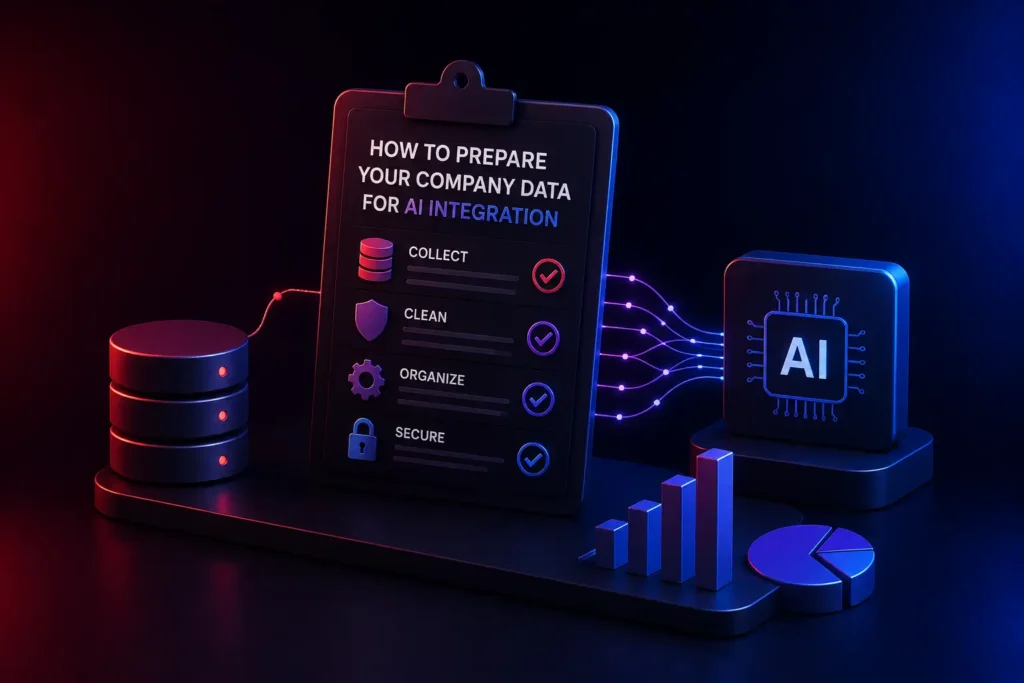
How to Prepare Your Company Data for AI Integration in 2026
How do you prepare data for artificial intelligence?
To prepare data for AI, you must first break down corporate data silos and centralize all information into a single cloud data lake. Next, you must thoroughly clean the data to remove duplicates, format inconsistencies, and bias. Finally, for generative AI, you must convert unstructured data (like PDFs and emails) into embeddings using Smart Databases.
For IT Data Managers and Chief Information Officers (CIOs), the mandate to implement AI is loud and clear. However, executing that mandate reveals a harsh reality: your AI model is entirely dependent on the quality of your data.
There is a famous adage in computer science: “Garbage In, Garbage Out” (GIGO). If you feed a state-of-the-art smart technology model a diet of duplicated, outdated, and poorly formatted spreadsheets, it will produce highly confident, entirely incorrect business predictions.
Before you can build Custom AI Solutions or deploy predictive analytics, you must achieve “Data Readiness.” Here is the step-by-step guide on how to prepare data for AI integration in your enterprise.
Step 1: Break Down Data Silos (Centralization)
In most legacy enterprises, data is fragmented. The marketing department uses HubSpot, sales uses Salesforce, finance uses an archaic on-premise ERP, and customer support uses Zendesk.
AI requires a holistic view of the business to identify cross-departmental patterns. The first step of Legacy System Modernization is breaking down these silos.
You must utilize robust API Development to extract data from these isolated systems and funnel it into a centralized Cloud Data Warehouse (like Snowflake or Amazon Redshift) or a Data Lake.
Step 2: Data Cleaning and Standardization
Once the data is centralized, the tedious but critical phase begins: data cleaning.
- Deduplication: The same customer might exist in the database three times (e.g., “John Doe”, “J. Doe”, and “Johnathan Doe”). AI models will treat these as three distinct entities, skewing your metrics. These must be merged.
- Handling Missing Values: If an AI model is trying to predict housing prices, and 30% of the dataset is missing the “square footage” variable, the model will fail. You must decide whether to delete incomplete rows or use statistical methods to impute (guess) the missing values.
- Standardization: Ensure all dates follow the same format (YYYY-MM-DD), all currencies are converted to a standard baseline, and all text is properly cased.
Step 3: Preparing Unstructured Data (Smart Databases)
Historically, smart technology only understood structured data (rows and columns in a database).
However, in 2026, the real value lies in unstructured data: decades of corporate emails, PDF training manuals, Slack messages, and audio transcripts of customer service calls. This unstructured data is the fuel for Generative AI for Business.
To make unstructured text understandable to an AI (specifically for Retrieval-Augmented Generation or Smart Search), it must be converted into numerical vectors (embeddings) that represent the semantic meaning of the text. This requires deploying specialized Smart Databases (like Pinecone or Weaviate). This infrastructure allows the AI to instantly search through millions of documents based on meaning, rather than just keyword matching.
Step 4: Ensuring Ethical Data Governance
As we discussed in our guide to the Ethics of AI, you must sanitize your data to prevent data-driven bias.
Before training begins, you must audit the dataset. Are you training a hiring algorithm on resumes from the past twenty years? If historical hiring practices favored a specific demographic, the AI will learn that bias. You must aggressively scrub Personally Identifiable Information (PII) from the training data to ensure GDPR and HIPAA compliance.
Conclusion
Preparing company data for AI is not a glamorous task. It involves heavy DevOps Engineering and meticulous administrative auditing. However, skipping this phase is the primary reason enterprise AI initiatives fail. By investing the time to centralize, clean, and structure your data today, you build the unshakable foundation required for powerful, accurate AI deployments tomorrow.
Is your data trapped in legacy silos?
At VDPL, we engineer enterprise-ready data pipelines, robust cloud architectures, and specialized Smart Databases to prepare your business for the AI revolution. Contact us today to discuss your data strategy.
Frequently Asked Questions (People Also Ask)
Why is data cleaning important for smart technology?
Data cleaning is critical because smart technology algorithms learn by recognizing patterns in historical data. If that data contains duplicates, errors, missing fields, or extreme outliers, the algorithm learns those errors as truth, resulting in inaccurate and unreliable predictions (Garbage In, Garbage Out).
What is the difference between structured and unstructured data?
Structured data is highly organized and formatted, typically living in the rows and columns of a relational database (like an Excel spreadsheet of sales transactions). Unstructured data lacks a predefined format, encompassing things like text-heavy emails, PDF documents, images, and audio files.
What is a Smart Database?
A Smart Database is a specialized database designed to store and query high-dimensional vectors (numerical representations of data). It is essential for modern AI because it allows algorithms to rapidly search through massive amounts of unstructured data (like text) based on semantic meaning and similarity, rather than exact keyword matches.