
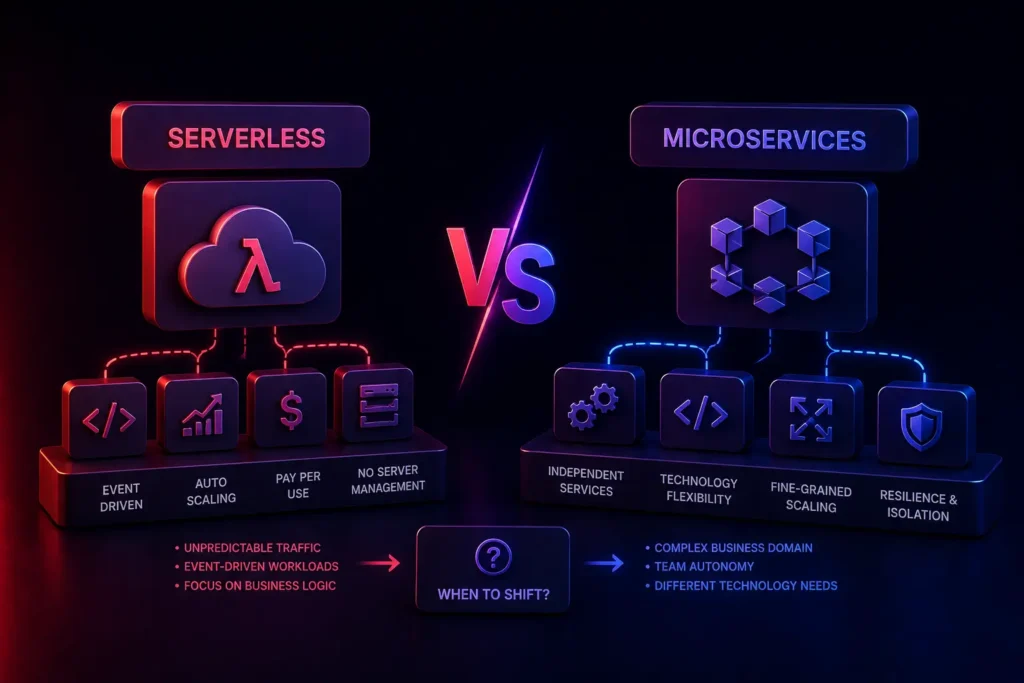
Microservices became the default “serious engineering” answer for so long that we regularly meet early-stage teams who’ve adopted them without a clear reason beyond “that’s what scalable companies do.” Serverless gets pitched as the modern alternative, sometimes with equally vague justification. Neither is a default. Both solve specific organizational and technical problems, and the honest first question is whether you actually have either problem yet.
What microservices actually solve - and it’s not primarily performance
The real, defensible case for microservices is organizational: multiple teams needing to develop, deploy, and scale different parts of a system independently, without blocking on each other’s release cycles or risking one team’s bug taking down an unrelated part of the product. It’s a coordination and blast-radius solution more than a performance one - a well-built monolith can serve enormous traffic; microservices don’t inherently make a system faster, they make it possible for large, multiple teams to move independently.
Where microservices genuinely create cost, not just complexity
Every service boundary is a network call that didn’t used to be one - what was an in-process function call in a monolith becomes a network request with its own latency, failure modes, and need for retry logic and circuit breakers. Distributed tracing, service-to-service authentication, and debugging an issue that spans multiple services are all real, ongoing operational costs that don’t exist in a monolith. For a small team, this overhead routinely outweighs the coordination benefit that doesn’t apply yet, because there’s no multi-team coordination problem to solve.
What serverless actually solves - and where it doesn’t compete with microservices at all
Serverless is really a deployment and scaling model, not fundamentally an architectural philosophy the way microservices is - you can build a serverless monolith (a single large function or a small number of functions handling most logic) or serverless microservices (many small, independently deployed functions). The actual serverless decision is about workload shape: spiky, event-driven, or intermittent traffic benefits from paying only for actual execution; sustained, predictable, high-throughput traffic usually doesn’t.
The decision framework we actually use, in order
- Do you have multiple teams that need genuinely independent release cycles? If not, that’s the primary argument for microservices, and without it, a well-structured monolith is very likely the right call regardless of company size or ambition.
- What does your traffic pattern actually look like? Spiky and unpredictable favors serverless execution; sustained and predictable favors traditional always-on infrastructure - this decision is largely independent of the monolith-vs-microservices question above.
- What’s your team’s actual operational capacity? Both microservices and a well-managed Kubernetes-based system require real, ongoing operational expertise most early-stage teams don’t have and shouldn’t spend their limited engineering time building before it’s needed.
What we actually recommend for most growing companies
Start with a well-structured monolith - one that has clean internal boundaries and clear separation of concerns, so it could be decomposed into services later if a genuine organizational need arises, without that decomposition being a rewrite. Layer in serverless functions for genuinely event-driven or spiky-traffic pieces around that monolith where it makes sense (background jobs, webhooks, scheduled tasks), rather than treating “serverless” and “microservices” as a single combined architectural philosophy you either fully adopt or fully reject.
The honest signal that it’s time to actually shift
Not a headcount milestone or a funding round - the actual signal is when a specific team is genuinely blocked by needing to deploy independently from another team, or when a specific workload’s traffic pattern is genuinely mismatched with your current infrastructure’s cost model. Shift the specific piece that has the real problem, not the whole system preemptively.
We help teams make this call as part of our architecture and DevOps work. If you’re deciding on architecture for a new build or reconsidering an existing one, talk to us about what’s actually driving the decision before committing to either path.