
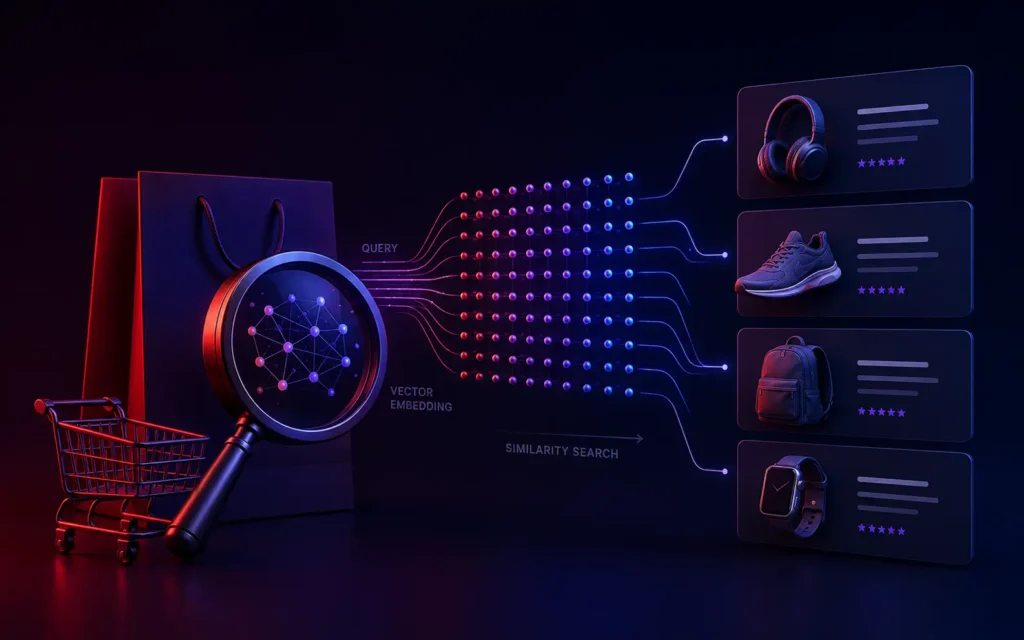
Traditional retail search is why “search” has such a bad reputation among online shoppers - type “warm winter jacket” into a keyword-matching search bar and watch it return nothing, because the product is tagged “insulated outerwear” and there’s no lexical overlap. Vector search fixes exactly this class of problem, and it’s one of the few AI-adjacent retail features we’d recommend to almost any catalog-based business, not just the ones chasing a trend.
What vector embeddings actually do, without the math
An embedding is a numerical representation of meaning - a product description, an image, or a search query gets converted into a vector (a list of numbers) such that things with similar meaning end up close together in that numerical space, regardless of whether they share any actual words. “Warm winter jacket” and “insulated outerwear” end up near each other in vector space because they mean similar things, even with zero word overlap. Vector search then finds the products whose embeddings are closest to the query’s embedding, instead of matching literal keywords.
This is also what makes “find products similar to this one” and “search by image” work well - an image gets embedded the same way text does, into the same kind of vector space, so you can search across modalities.
Where this actually changes conversion, not just search quality
- Recovering “zero results” searches. Every retailer we’ve audited has a meaningful share of searches returning nothing or near-nothing, purely because of vocabulary mismatch between how customers describe things and how the catalog is tagged. Vector search directly recovers a chunk of these searches into actual, relevant results - and those are searches that would otherwise convert to nothing.
- Better “similar products” recommendations. Instead of similarity based on shared category tags (which produces obviously-wrong results - two products in the same category that look nothing alike), embedding-based similarity captures actual visual and descriptive resemblance, which measurably improves click-through on recommendation modules.
- Natural language and long-tail queries. Customers increasingly search the way they’d describe something to a person - “dress for a summer wedding, not too formal” - rather than keyword fragments. Keyword search handles this badly by design; vector search handles it as a first-class case.
What we actually build
In practice, we don’t recommend pure vector search replacing keyword search outright - the strongest implementations we’ve built are hybrid: combining vector similarity for semantic matching with traditional keyword and filter logic (exact SKU lookup, brand names, precise attribute filters like size or color still need exact matching, not fuzzy semantic matching). Purely vector-based search can actually perform worse on precise queries where a customer knows exactly what they want and types the exact model number.
We typically implement this with a dedicated vector database - Pinecone, Weaviate, or Qdrant depending on scale and existing infrastructure - sitting alongside the existing catalog search, with the application layer deciding when to lean on semantic search versus exact matching based on query characteristics.
The part that’s easy to get wrong
Embedding quality depends heavily on what data went into generating them - a product catalog with thin, generic descriptions produces mediocre embeddings regardless of how good the underlying model is. The highest-leverage work before implementing vector search is often improving the actual product data: richer descriptions, consistent attribute tagging, good image quality for image embeddings. Skipping this and expecting the vector search to compensate for thin catalog data is the most common reason these projects underdeliver.
Is this worth it for your catalog
Scale matters here - a 50-product catalog doesn’t have enough complexity for vector search to meaningfully outperform good keyword search with solid filters. A catalog in the thousands or tens of thousands, with real vocabulary diversity in how customers might describe products, is where this earns its cost. If you’re not sure which side of that line you’re on, talk to us - we’ll look at your actual search logs and zero-result query volume before recommending a rebuild.