
Every few months a client asks us the same question in a different wrapper: “Should we go headless?” Usually what they actually mean is “our current site is slow, our marketing team can’t ship a landing page without waiting two weeks for a developer, and someone at a conference told them ‘composable’ is the future.” Both of those problems are real. The fix isn’t always the same architecture.
So let’s actually separate the two terms, because most articles online use them interchangeably and that’s exactly what gets teams into trouble picking the wrong stack.
Headless commerce, in plain terms
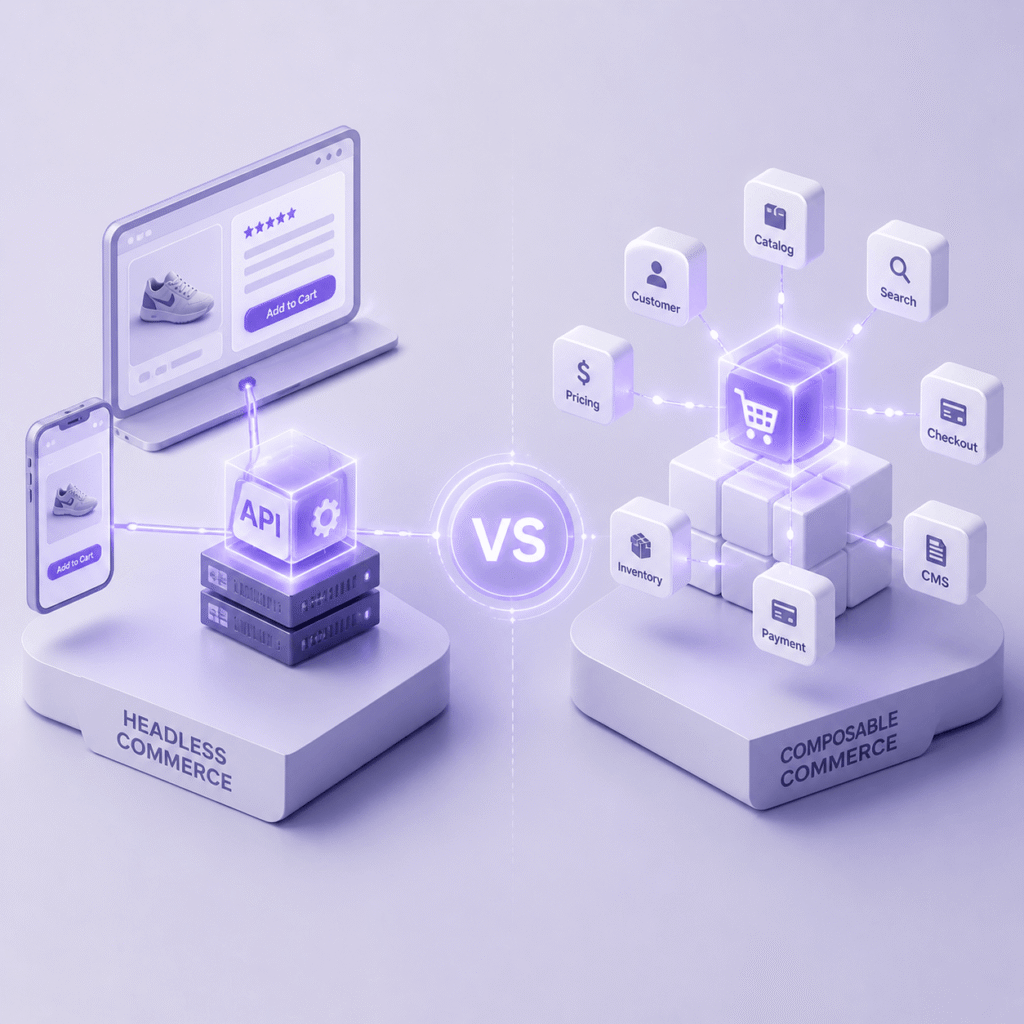
Headless just means the frontend (what customers see) is decoupled from the backend (where products, orders, and inventory live). Your storefront talks to your commerce platform through an API instead of being baked into it. That’s it. You could build a headless storefront on Shopify, on Medusa, on a custom Node backend - the “headless” part only describes the split between presentation and data.
The upside is real: your frontend team can build in React or Next.js without touching backend templating, page speed improves because you’re not shipping a bloated monolithic theme, and you can put the same product data behind a website, a mobile app, and an in-store kiosk without duplicating logic.
The cost is also real: you now own more of the stack. Search, checkout, cart persistence, SEO metadata - things a platform like Shopify used to hand you for free - become your responsibility, or at least your integration problem.
Composable commerce is a bigger commitment
Composable takes the headless idea and applies it to everything, not just the frontend. Instead of one commerce platform with a decoupled frontend, you assemble best-of-breed services - a dedicated search provider, a separate CMS, a payments layer, a subscription engine - and wire them together yourself, usually through a middleware layer sometimes called an “orchestration” layer or MACH stack (Microservices, API-first, Cloud-native, Headless).
This is where a lot of teams overreach. Composable architecture is genuinely powerful for a brand doing ₹50+ crore a year in GMV with a dedicated platform team. It’s genuinely painful for a brand doing ₹2 crore a year with two developers, because now every vendor integration is a project, every outage is three vendors pointing at each other, and your total cost of ownership goes up before your conversion rate does.
How we actually decide with clients
We ask three questions before recommending either path:
- Is the bottleneck marketing agility or platform limits? If your team just needs to ship landing pages and campaigns faster, headless on your existing platform (Shopify, WooCommerce) usually solves it without a rebuild.
- Do you have (or can you afford) a team to own the integration layer? Composable isn’t a product you buy, it’s a system you maintain. If the answer is “we’d need to hire for this,” that’s a real cost to weigh against the theoretical flexibility.
- Where’s the growth actually coming from? Multi-channel selling (web, app, marketplace, physical retail) is the strongest real argument for going composable. If you’re single-channel and just want a faster website, you’re solving the wrong problem with the bigger hammer.
What we’ve built both ways
For a mid-size fashion retailer, we kept them on Shopify but rebuilt the storefront headless in Next.js - page load dropped from around 4 seconds to under 1.5, and their marketing team started shipping campaign pages without engineering involvement. That was a two-month project, not a six-month one, because we didn’t touch the backend. You can see a similar rebuild in our case study for Shutiq.
For an enterprise client running multiple brands across web, app, and B2B wholesale, we went properly composable - separate search (Algolia), separate CMS, a custom orchestration layer in Node. That took the better part of a year and needs an internal team to keep running. It was the right call for them because the alternative was three separate systems that didn’t talk to each other at all.
The honest recommendation
If you’re reading this because your site feels slow or your team feels blocked, start with headless on your current platform before you consider composable. It’s a smaller, faster, cheaper change, and for most retailers below a certain scale it solves 90% of the actual pain. Composable earns its complexity once you’re genuinely multi-channel and have the team to run it - not before.
If you want a second opinion on which one actually fits your situation, we’re happy to look at your current stack and tell you honestly whether you need a rebuild or just a faster frontend. Talk to us - that conversation is free and we’d rather talk you out of an unnecessary rebuild than sell you one. You can also see the range of what we build on our e-commerce development page.