
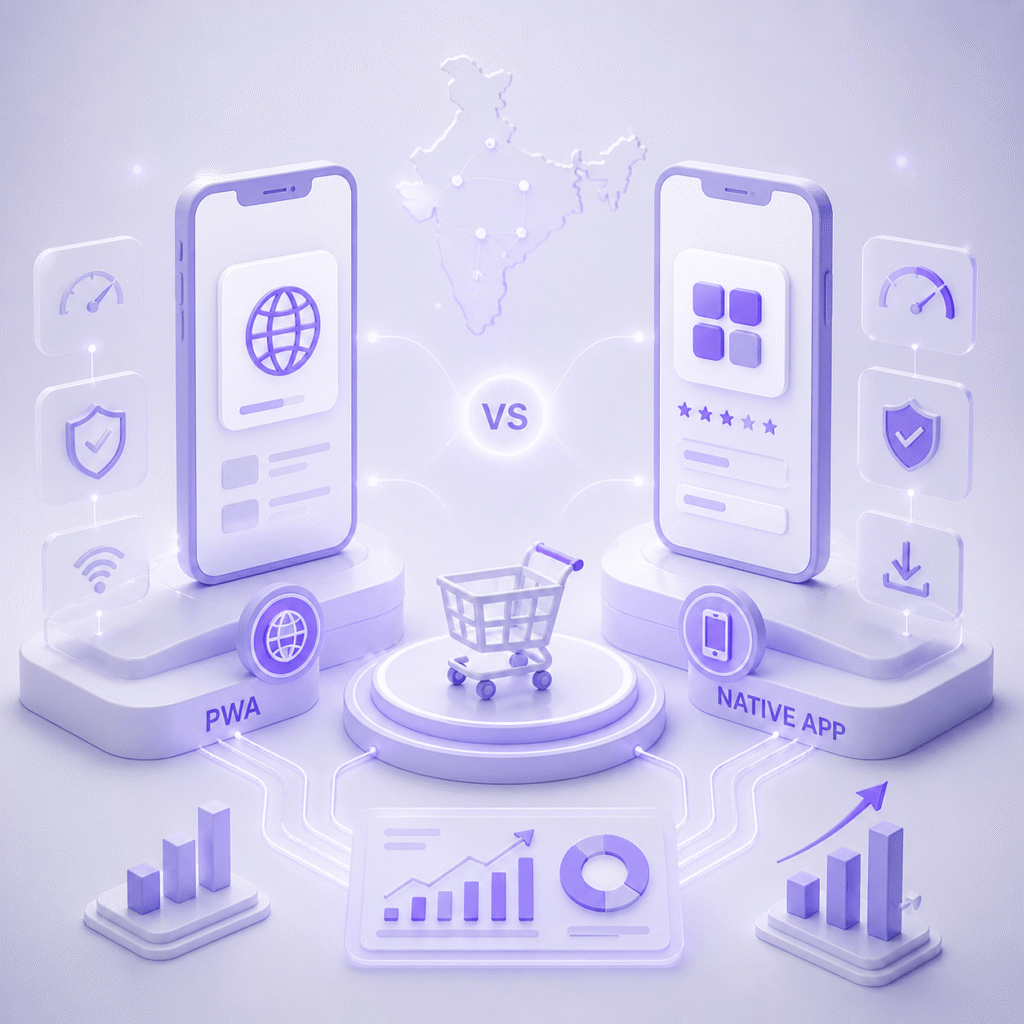
Every couple of months a founder tells us their next app “has to be native” without being able to explain why, beyond a vague sense that native is more “real.” For a genuine subset of apps that’s true. For a lot of Indian e-commerce brands, it’s an expensive assumption nobody tested. Let’s actually run the numbers instead of repeating the assumption.
What a PWA actually gets you
A Progressive Web App is your website, enhanced to behave like an app - installable to the home screen, works offline for cached content, sends push notifications, loads fast on repeat visits. Critically, it’s still just your website under the hood: one codebase, no app store approval process, no forced updates sitting in review for days, and - this is the part that actually moves the needle for e-commerce - a customer can go from an Instagram ad to your checkout page in one tap, with zero install step in between.
That last point is the whole ballgame for Indian D2C brands specifically. Native app install rates from paid social traffic are brutal - you’re asking someone mid-scroll to leave the app they’re in, go to the Play Store, download, wait, open, and then buy. Most people don’t survive that funnel. A PWA skips every one of those steps.
Where native genuinely wins
We’re not going to pretend native doesn’t have real advantages, because it does, in specific situations:
- Deep device integration. Camera-heavy features, Bluetooth hardware, background location tracking, biometric payment auth - native APIs are more mature and reliable here.
- Repeat-purchase habit brands. If customers are opening your app multiple times a week - think a grocery delivery app or a habitual marketplace - the app icon on their home screen is genuinely valuable real estate, and native push notifications still have somewhat better delivery and engagement rates than web push, particularly on iOS.
- Offline-first, data-heavy use cases. If your app needs to function fully offline with substantial local data (not just cached pages), native local storage is more robust.
The actual ROI comparison
Here’s the version of this analysis we walk clients through with real numbers, not hypotheticals:
Cost. A solid PWA built on your existing website typically runs a fraction of the cost of building and maintaining separate iOS and Android apps - you’re not paying for two codebases, two app store review cycles, and two release pipelines. We’ve seen clients cut their mobile development budget by more than half by going PWA-first.
Acquisition. For paid-traffic-driven brands, PWA conversion from ad click to first purchase is typically dramatically higher than native app install-then-purchase, because you’ve removed the install step entirely. If most of your growth is paid social and performance marketing, this alone usually settles the decision.
Retention. This is where native pulls ahead - home screen presence and native push notifications do drive better repeat engagement for habitual-use brands. If your business model depends on daily or weekly repeat visits, that retention gap is worth paying for.
What we actually recommend
For most Indian e-commerce brands under a certain scale - where growth is still primarily driven by paid acquisition and social traffic rather than an established habitual user base - we recommend PWA first. It’s cheaper, faster to ship, and removes the biggest conversion killer in the funnel. Once a brand has proven product-market fit and has a genuinely habitual customer base worth the retention investment, that’s the right moment to add a native app on top, not replace the PWA with one.
We’ve built this exact path for clients - see our case studies for examples of e-commerce platforms we’ve taken from web to PWA to native as the business matured.
If you’re trying to figure out which stage you’re actually at, talk to us - we’ll look at your acquisition mix and retention numbers before recommending either path, not the other way around.