
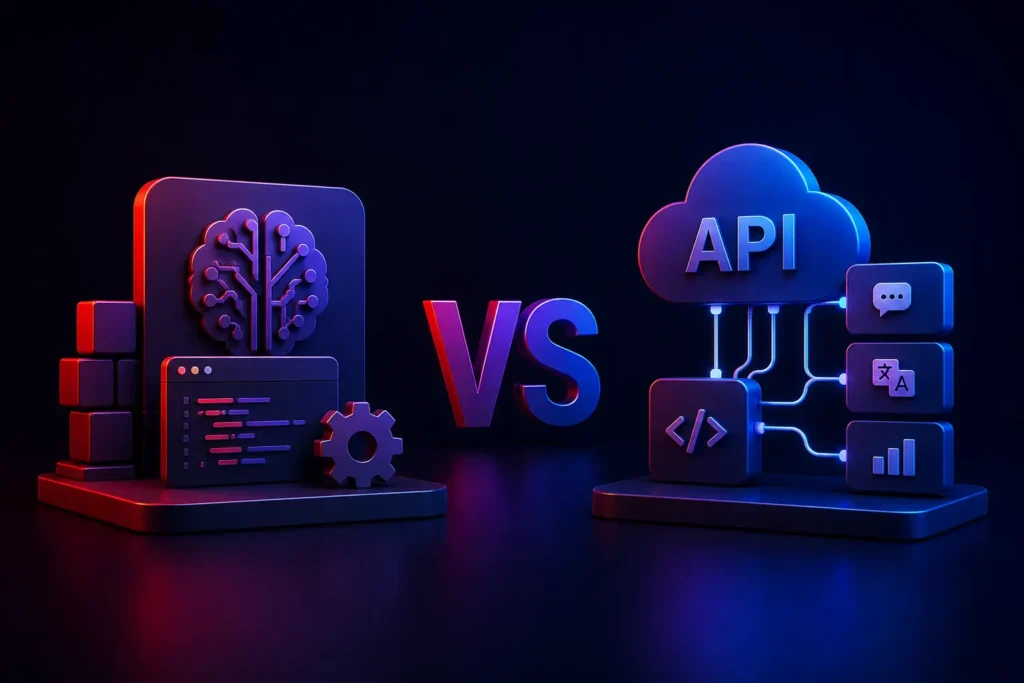
Building Custom AI Solutions vs. Using APIs in 2026
Should I build custom AI or use an API?
You should use an AI API (like OpenAI) if you need to rapidly deploy standard generative text or image features with low initial costs. You should build custom AI solutions if your product relies on highly proprietary company data, if you operate in heavily regulated industries (like healthcare), or if you need absolute control over the model’s architecture and intellectual property.
For Technical Architects, the mandate from the C-suite is almost always the same: “Integrate AI into our platform immediately.”
However, integrating AI is not a singular action; it represents a massive architectural fork in the road. In 2026, when designing a modern digital platform, architects must choose between two wildly different paths: paying to access a third-party AI model via API development, or investing the engineering resources to build and train custom AI solutions in-house.
This decision profoundly impacts your Cloud Architecture, long-term operating costs, and most importantly, your data security. Here is the definitive guide to the “Build vs. Buy” AI debate.
The Case for AI API Integration (Buying)
Utilizing an API means you are sending a prompt from your software to a massive, pre-trained model owned by another company (like OpenAI’s GPT-4 or Anthropic’s Claude), and receiving the generated output back in seconds.
The Pros of APIs
- Speed to Market: This is the fastest way to implement AI. Using standard OpenAI API integration, a single developer can add an intelligent chatbot to your E-Commerce Platform in an afternoon.
- Zero Training Costs: Training a massive Large Language Model (Smart AI) from scratch costs tens of millions of dollars in raw GPU compute power. By using an API, you bypass this entirely, paying only fractions of a cent per query.
- State-of-the-Art Intelligence: You immediately gain access to the smartest, most capable models in the world without having to hire a team of elite Smart Technology PhDs.
The Cons of APIs
- Data Privacy Risks: When you use a public API, you are sending your data to a third party. If you are in the Healthcare Industry or dealing with sensitive financial data, this often violates compliance regulations like HIPAA or GDPR, unless you secure expensive, enterprise-tier zero-retention contracts.
- Vendor Lock-in and Cost Scaling: If your application goes viral, the API costs will skyrocket exponentially. If the API provider decides to deprecate the specific model you built your app around, your software will break overnight.
The Case for Custom AI Solutions (Building)
Building custom AI solutions does not necessarily mean inventing a new neural network architecture from scratch. In 2026, it usually means taking a powerful open-source foundation model (like Meta’s Llama) and fine-tuning it on your own private servers using your proprietary data.
The Pros of Custom AI
- Absolute Data Enterprisety: Your data never leaves your corporate firewall. The model runs locally on your own DevOps Engineering infrastructure. This is the only acceptable route for defense contractors, banks, and enterprise healthcare providers.
- Hyper-Specialization: A massive general API is good at everything (writing poetry, coding, history). A custom AI is trained only on your specific business. If you are a law firm, you train the model exclusively on legal precedents, making it far more accurate for your specific use case than a generic API.
- Intellectual Property Ownership: When you build and fine-tune your own model, the resulting algorithm is a proprietary asset that adds massive valuation to your company.
The Cons of Custom AI
- Massive Upfront Investment: You must hire specialized Data Scientists and Smart Technology Engineers to curate your data, train the model, and maintain it.
- High Infrastructure Costs: Running your own AI models requires renting or buying highly expensive cloud servers equipped with massive GPUs.
The Hybrid Approach: Smart Search and Smart Databases
For many enterprises, the optimal solution is a hybrid. They use a secure, enterprise-tier API for the core intelligence, but they utilize a technique called Smart Search (Retrieval-Augmented Generation).
By using Smart Databases, they index all of their private company documents. When a user asks a question, the system searches the private Smart Database first, pulls the relevant proprietary information, and then sends that specific, secure context to the API to format the answer. This provides the intelligence of an API with the specific knowledge of a custom solution.
Conclusion
Choosing between custom AI solutions and API integration is a matter of scale, security, and strategic value. Use APIs to prototype rapidly and deploy generic AI features. Build custom models when your data is highly sensitive, or when the AI itself is the core proprietary advantage of your business.
Ready to architect your AI platform?
VDPL specializes in both rapid API integration and building secure, custom AI models for enterprise clients. Contact us today to discuss your technical requirements.
Frequently Asked Questions (People Also Ask)
What is a custom AI solution?
A custom AI solution is a smart technology model or artificial intelligence system that is specifically designed, trained, and hosted by an individual company to solve their unique business problems, rather than relying on a generic, third-party AI service.
Is it cheaper to use an OpenAI API or build my own model?
In the short term, using the OpenAI API is massively cheaper because you pay a fraction of a cent per query and avoid the millions of dollars required to train a model. However, if your application processes millions of queries a day, building and hosting a smaller, open-source custom model can become cheaper in the long run.
Can I use ChatGPT for enterprise data?
Using the free, public version of ChatGPT for sensitive enterprise data is highly risky and often violates corporate compliance. Enterprises must use secure API endpoints with “zero data retention” agreements, or host their own custom models internally to ensure data privacy.