
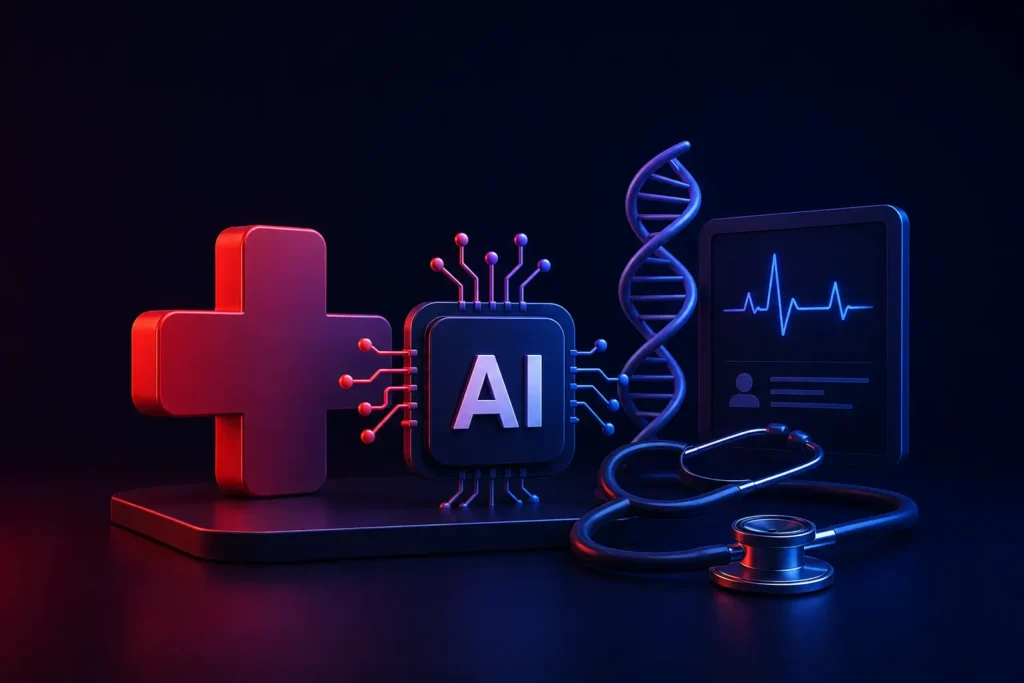
How AI is Transforming the Healthcare Industry in 2026
How is AI used in healthcare?
AI is used in healthcare to analyze complex medical imagery for early cancer detection, predict patient deterioration using real-time IoT wearable data, accelerate pharmaceutical drug discovery, and automate massive amounts of clinical administrative paperwork, allowing doctors to focus entirely on patient care.
For Hospital Administrators and Clinical Directors, the pressure to reduce mortality rates while simultaneously cutting operational costs creates a seemingly impossible paradox. The traditional Healthcare Industry model-reliant on manual diagnostics, massive paper trails, and reactive medicine-has reached a breaking point.
In 2026, artificial intelligence in healthcare is no longer a futuristic concept discussed in medical journals; it is an active, deployable technology that is fundamentally restructuring how care is delivered.
Custom Web Development teams are now building highly secure, HIPAA-compliant platforms that weave deep smart technology directly into the clinical workflow. Here is how AI in healthcare is actively saving lives and streamlining hospital operations today.
1. Predictive Diagnostics and Medical Imaging
The most profound impact of AI is in the field of radiology and pathology.
Human doctors are brilliant, but they suffer from visual fatigue. When a radiologist reviews their hundredth MRI of the day, subtle anomalies can be missed. Modern AI algorithms, trained on millions of high-resolution scans, do not get tired.
Through advanced AI Integration, hospitals deploy software that instantly pre-screens X-rays, MRIs, and CT scans. The AI highlights microscopic patterns that indicate the earliest stages of tumors or internal bleeding, acting as an infallible second pair of eyes. This allows oncologists to diagnose cancers months earlier than previously possible, drastically improving survival rates.
2. Proactive Patient Monitoring via IoT
Historically, medicine was reactive: a patient suffers a heart attack, goes to the hospital, and receives treatment.
As we explored in our guide to Healthcare Mobile Apps, AI has made medicine proactive. Patients now wear IoT (Internet of Things) devices that continuously stream real-time biometric data to the hospital’s cloud servers.
AI algorithms continuously analyze this data stream. If the AI detects a subtle arrhythmia combined with a specific drop in blood oxygen levels, it can accurately predict a cardiac event hours before it happens, automatically dispatching an ambulance or alerting the patient’s cardiologist.
3. Eradicating Administrative Burnout
The leading cause of physician burnout is not patient care; it is the soul-crushing burden of administrative paperwork. Doctors spend an average of two hours doing data entry for every one hour they spend with a patient.
Generative AI (the technology behind Custom AI Solutions) has solved this. During a patient consultation, a secure, ambient AI listens to the conversation in the background. It instantly transcribes the dialogue, structures the medical jargon, and automatically populates the Electronic Health Record (EHR) with the correct diagnostic billing codes. The doctor simply reviews and approves the final note, reclaiming hours of their day.
4. Accelerating Drug Discovery
Bringing a new pharmaceutical drug to market traditionally takes over a decade and costs billions of dollars, largely because scientists must manually test millions of chemical compounds to see how they react to specific proteins.
AI has revolutionized this space through computational biology. Machine learning models can digitally simulate how millions of different molecular structures will bind to a target virus or cancer cell in a matter of days. This allows pharmaceutical companies to identify viable drug candidates exponentially faster, accelerating the timeline for life-saving treatments.
Conclusion
The transformation of the healthcare industry via AI is not about replacing human doctors with robots; it is about augmenting human empathy with superhuman analytical processing. By automating the mundane paperwork and highlighting the invisible diagnostic anomalies, AI allows healthcare professionals to return to what they do best: caring for the patient.
Is your healthcare facility ready to integrate AI?
Building secure, HIPAA-compliant medical AI software requires highly specialized engineering. Contact VDPL today to discuss how our architects can modernize your clinical infrastructure.
Frequently Asked Questions (People Also Ask)
What is the role of AI in healthcare?
The role of AI in healthcare is to assist medical professionals by rapidly analyzing complex medical data (like X-rays or genetic sequences), automating administrative EHR paperwork, and predicting patient health risks before they become emergencies.
Will AI replace doctors?
No, AI will not replace doctors. Medicine requires human empathy, complex physical examinations, and ethical judgment. AI is simply a powerful diagnostic tool that acts as a “co-pilot,” helping doctors make faster, more accurate decisions and freeing them from tedious administrative tasks.
Is patient data safe with AI?
Patient data is safe if the AI system is built with strict adherence to regulations like HIPAA or GDPR. This requires enterprise hospitals to utilize secure Cloud Architecture and deploy private, custom AI models where patient data is heavily encrypted and never shared with public AI networks.