
Custom Software Development vs. Off-the-Shelf SaaS: The Build vs Buy Debate
Should a company build custom software or buy SaaS?
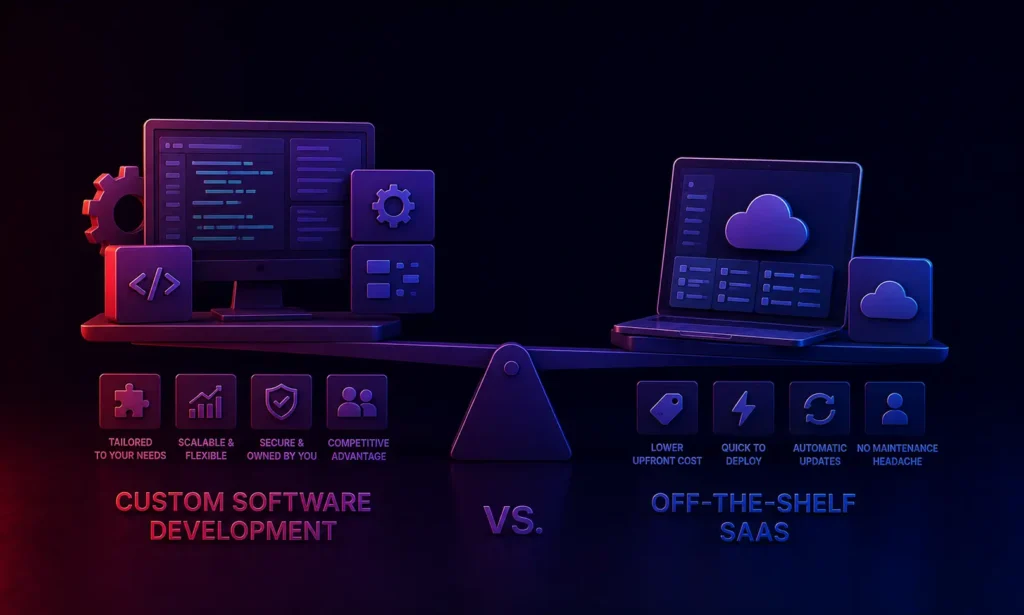
A company should buy off-the-shelf SaaS if they need a standard solution quickly (like email or basic CRM) and have a limited budget. A company must build custom software if their operational workflows are entirely unique, if they require absolute ownership of their data for compliance, or if the software itself is a core competitive advantage that generates revenue.
For Chief Operating Officers (COOs) and Operations Managers, every major technological upgrade begins with the same fundamental question: do we build it, or do we buy it?
This debate-custom software vs SaaS (Software as a Service)-is one of the most critical financial and operational decisions an enterprise will make. In 2026, the SaaS market is flooded with incredibly powerful tools, making the “buy” option highly attractive. However, forcing unique business workflows into rigid, templated software can cripple operational efficiency.
To make the right choice, leaders must move past the initial sticker price and evaluate the long-term strategic impact on their Cloud Architecture, scalability, and competitive advantage.
The Case for Off-the-Shelf SaaS (Buying)
Off-the-shelf SaaS refers to pre-built, mass-market software that you subscribe to, such as Salesforce, Slack, or Shopify.
The Pros of SaaS
- Immediate Deployment: SaaS is ready to use the moment you pay the subscription fee. There is no multi-month development cycle, making it ideal for solving urgent operational needs.
- Lower Initial Cost: You avoid the heavy upfront capital expenditure of hiring an engineering team to build the software from scratch.
- Maintenance Included: The SaaS vendor is entirely responsible for hosting, bug fixes, and feature updates.
The Cons of SaaS
- Rigid Workflows: SaaS is built to solve the problems of the “average” company. If your supply chain logistics are highly unique, you will have to change your business to fit the software, rather than the software fitting your business.
- Subscription Creep: While the initial cost is low, paying monthly licensing fees for hundreds of employees adds up over years. Eventually, the total cost of ownership (TCO) surpasses the cost of building custom software.
- Lack of Ownership: You do not own the code. If the vendor goes bankrupt, raises their prices by 300%, or gets acquired by your competitor, your operations are severely compromised.
The Case for Custom Software Development (Building)
Custom Web Development involves hiring a specialized engineering team to architect and build software specifically for your exact business requirements.
The Pros of Custom Software
- Perfect Operational Fit: The software is engineered around your exact workflows. Whether you need a bespoke ERP for the Healthcare Industry or a highly complex E-Commerce Platform, custom software eliminates all administrative friction.
- A Competitive Advantage: If your software allows you to deliver products faster or serve customers better than your competitors, the software is the competitive advantage. You cannot buy a competitive advantage off a shelf if your rivals have access to the exact same SaaS tool.
- Absolute Data Ownership: You own the source code, the IP, and the data. For enterprises dealing with strict regulatory compliance, housing data in a proprietary system provides unparalleled security.
The Cons of Custom Software
- High Initial Investment: Architecting, coding, testing, and deploying custom software requires a significant upfront financial investment.
- Time to Market: Building enterprise-ready software takes time. Depending on the complexity, a robust custom platform can take several months to go live.
- Ongoing Maintenance: Unlike SaaS, you are responsible for maintaining the code, requiring an ongoing partnership with a DevOps Engineering team.
The Hybrid Approach: API Integration
In 2026, the build vs buy software debate is rarely binary. The most successful enterprises utilize a hybrid approach driven by API Development.
They “buy” SaaS for commoditized functions that don’t provide a competitive advantage (like HR payroll systems or basic email routing). Then, they “build” custom software for their core proprietary workflows. Finally, they use APIs to smoothly integrate the custom software with the SaaS tools, creating a unified, highly efficient digital platform.
Conclusion
The decision to build or buy comes down to strategic value. If a process is generic and non-differentiating, buy a SaaS tool. If a process is the lifeblood of your company’s unique value proposition, you must build custom software to protect and scale that advantage.
Is off-the-shelf software holding your operations back?
Stop forcing your unique business into rigid templates. Contact VDPL today to discuss how a custom software solution can revolutionize your enterprise efficiency.
Frequently Asked Questions (People Also Ask)
What is custom software development?
Custom software development is the process of designing, creating, and deploying software specifically tailored to the unique requirements and operational workflows of a single organization, rather than using mass-market, commercial off-the-shelf software.
Is it cheaper to build or buy software?
Buying SaaS is cheaper in the short term because you only pay a monthly subscription fee. However, over a 5 to 10-year period, building custom software is often significantly cheaper because you eliminate compounding, per-user licensing fees and own the final asset.
When should a company choose custom software over SaaS?
A company should choose custom software when their business processes are too unique to fit into standard SaaS templates, when they need absolute ownership of their data for security compliance, or when the software itself will provide a distinct competitive advantage in the market.