
Why are third-party API integrations important?
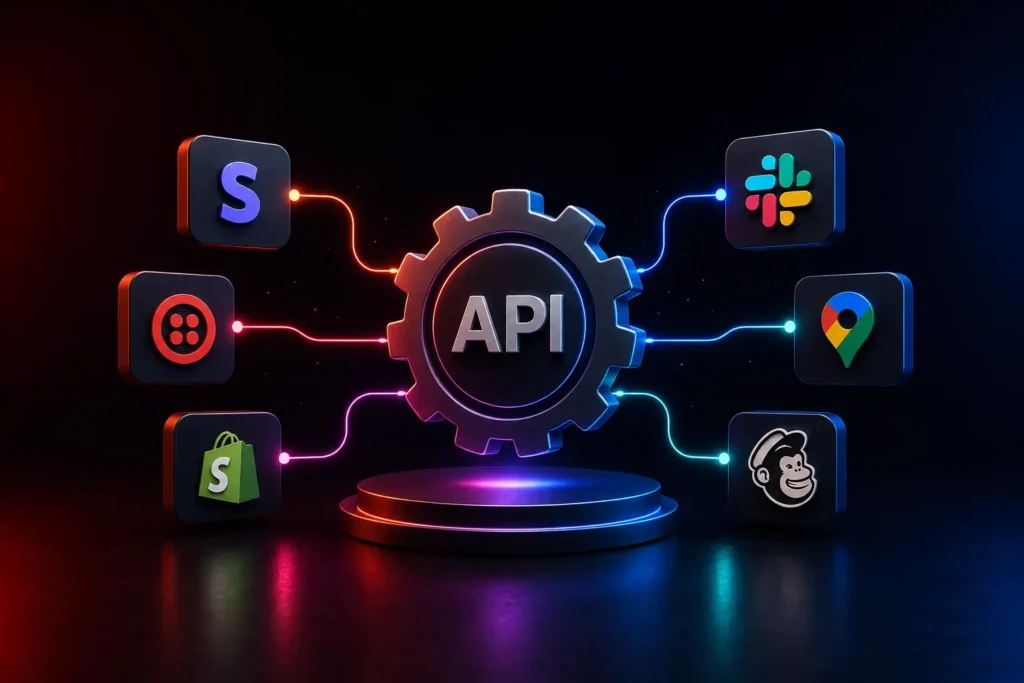
Third-party API integrations allow your custom software to instantly leverage the massive, complex infrastructure of external companies (like Stripe for payments or Twilio for SMS) without having to build that technology from scratch. This drastically reduces development costs, accelerates speed-to-market, and allows your application to seamlessly communicate with the rest of the digital ecosystem.
For Operations Managers and Product Owners, the golden rule of Custom Software Development is: Never reinvent the wheel.
If you are building a new rideshare application, you need a map system. You could spend $50 million and hire 200 engineers to launch your own satellites and map the entire globe from scratch. Or, you could simply integrate the Google Maps API and have a world-class mapping system operational in your app by Tuesday.
We are living in the “API Economy.” The most successful enterprise platforms in 2026 are not monoliths that do everything themselves; they are highly connected hubs that route data flawlessly between specialized external services. Here is why third-party API integrations are the foundation of modern software architecture.
1. Massive Reduction in Development Cost and Time
Building complex features from scratch is incredibly expensive and risky.
If your Headless Shopify e-commerce platform needs to process credit cards, building a proprietary, PCI-compliant payment gateway is a massive legal and technical nightmare.
By integrating the Stripe API, your development team outsources all of that immense complexity, security, and legal liability to Stripe. A senior developer can integrate a secure checkout via API in a matter of days, saving hundreds of thousands of dollars in development costs and allowing you to launch your product months earlier.
2. Best-in-Class Functionality
APIs allow you to “rent” the best technology in the world and embed it seamlessly into your own software.
- Communications: Instead of building a complex telecom infrastructure to send automated text messages, you integrate the Twilio API.
- Email Deliverability: Instead of managing complex SMTP servers and fighting spam filters, you integrate the SendGrid API.
- Data Enrichment: If a user enters an email address in your CRM, you can hit the Clearbit API in the background to instantly pull their job title, company size, and LinkedIn profile into your database.
Your users do not know you are using third-party APIs. They just perceive your application as incredibly powerful and feature-rich.
3. Automating Internal Operations
API integrations are not just for customer-facing features; they are critical for internal operational efficiency.
Most enterprises suffer from “Data Silos.” The Sales team uses Salesforce, the Accounting team uses QuickBooks, and the Support team uses Zendesk. These systems do not natively talk to each other. When a deal closes in Salesforce, an employee has to manually type that data into QuickBooks to generate an invoice.
Custom API Development destroys these silos. Developers can write secure middleware (often utilizing Serverless Architecture) that listens for an event in Salesforce and instantly, automatically generates the invoice via the QuickBooks API. This eradicates manual data entry and human error.
4. The Risk: API Dependency
While the benefits are massive, relying heavily on third-party APIs introduces a distinct operational risk.
If your core product relies entirely on the Twitter (X) API to function, and Twitter decides to shut down public access to their API (as they have done in the past), your business model collapses instantly. When architecting an application, you must carefully evaluate which APIs are “critical dependencies” and always architect fallback protocols or ensure you have alternative API providers available if your primary provider changes their pricing or access rules.
Conclusion
In the modern digital landscape, no software application is an island. Third-party API integrations are the bridges that connect isolated software, allowing businesses to leverage external, world-class technology at a fraction of the cost of building it. By strategically utilizing APIs, enterprises can launch faster, automate internal workflows, and build incredibly powerful digital ecosystems.
Are your software platforms struggling to communicate with each other?
At VDPL, our senior backend engineers specialize in complex REST and GraphQL API integrations, securely connecting disparate enterprise systems to automate massive workflows. Contact us today to discuss your integration needs.
Frequently Asked Questions (People Also Ask)
What is a third-party API integration?
An API (Application Programming Interface) is a set of rules that allows two different software programs to communicate with each other. A “third-party” integration means you are connecting your software to an external platform built by another company (like connecting your website to the Stripe API to process payments, or the Google Maps API to display a location).
Why do companies use APIs instead of building their own tools?
Companies use APIs because it is vastly cheaper, faster, and more secure than building the technology from scratch. It allows a business to focus its engineering resources on its core, unique product, while outsourcing complex, generic functions (like sending SMS messages, processing credit cards, or managing cloud storage) to specialized companies that already do it perfectly.
Are third-party API integrations secure?
Yes, if implemented correctly by professional developers. Modern REST APIs use highly secure authentication protocols (like OAuth2 or secure API keys encrypted via SSL/TLS). However, because an API opens a gateway between your database and an external company, poorly coded API integrations can be a major security vulnerability, which is why they require expert implementation.