
How Smart Technology is Changing E-Commerce Personalization
How is smart technology used in e-commerce?
Machine learning is used in e-commerce to power hyper-personalized product recommendation engines, dynamically adjust pricing based on real-time market demand, detect fraudulent transactions instantly, and optimize global supply chain logistics by accurately predicting regional purchasing trends.
For E-Commerce Directors, the digital storefront is infinitely more complex than a physical retail space. When a customer walks into a brick-and-mortar store, a skilled salesperson can read their body language, ask a few questions, and guide them to the perfect product.
In the digital world, recreating that bespoke experience requires immense processing power.
This is where smart technology in e-commerce comes in. In 2026, the baseline expectation for online shopping is absolute personalization. Consumers do not want to browse through thousands of irrelevant products; they expect the store to rearrange itself uniquely for them the moment they log in.
If your E-Commerce Platform is still relying on static homepages and generic “Top Sellers” lists, you are losing massive amounts of revenue. Here is how AI personalization is redefining digital retail.
1. Hyper-Personalized Recommendation Engines
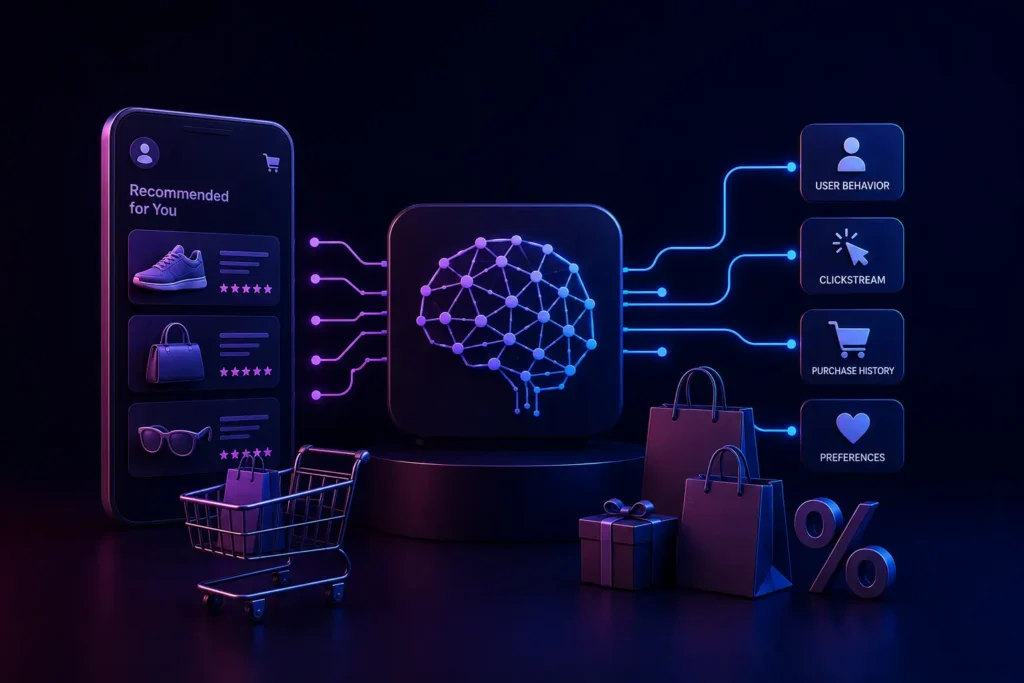
The most famous application of smart technology in e-commerce is the product recommendation engine (pioneered by Amazon).
Modern algorithms do not simply say, “People who bought X also bought Y.” That is outdated collaborative filtering. Today’s AI models analyze hundreds of micro-interactions:
- How long did the user hover their mouse over a specific product image?
- Did they zoom in on the red color variant or the blue?
- What time of day do they usually make high-value purchases?
By processing this data through advanced AI Integration, the system builds a terrifyingly accurate behavioral profile. When the user returns, the homepage dynamically populates with products they have a 90% probability of purchasing, drastically increasing the Average Order Value (AOV).
2. Dynamic Pricing Optimization
Airlines have used dynamic pricing for decades; smart technology has now brought it to mainstream retail.
Pricing is no longer static. An AI algorithm continuously monitors your competitors’ prices, your current inventory levels, historical seasonal demand, and even the individual user’s perceived price sensitivity. If a competitor runs out of stock of a highly demanded electronic device, the AI automatically raises your price by 5% to maximize profit margins, all without human intervention.
3. Visual Search and Image Recognition
Typing text into a search bar is inefficient when a consumer is looking for a specific aesthetic.
With smart technology, visual search has become mainstream. A user can upload a photo they took of a beautiful mid-century modern chair they saw in a café. The e-commerce app (often a custom Mobile App) uses deep learning image recognition to scan the catalog and instantly present the exact chair, or visually identical alternatives, completely bypassing text-based metadata tags.
4. Intelligent Fraud Detection
As e-commerce volume grows, so does organized credit card fraud. Traditional rule-based fraud systems are binary and often flag legitimate high-value purchases, infuriating good customers.
Machine learning models evaluate risk dynamically. They analyze the user’s IP address, device fingerprint, typing speed, and behavioral anomalies compared to their past purchase history. If a user in New York suddenly tries to buy $5,000 worth of gift cards at 3 AM using a new device, the AI intercepts the transaction instantly, preventing costly chargebacks while minimizing false positives.
5. Conversational AI Shopping Assistants
We have moved beyond basic customer service chatbots. We are now in the era of generative AI shopping assistants.
Integrated directly into the UI via sophisticated API Development, a customer can type, “I need a complete outfit for a summer wedding in Italy, budget is $400.” The AI understands the nuanced parameters (summer weather, formal but breathable fabrics, strict budget) and instantly generates three fully styled, shoppable outfits from your catalog.
Conclusion
Machine learning in e-commerce is the ultimate sales engine. It transforms a static website into a highly responsive, personalized digital salesperson that works 24/7. By predicting what the customer wants before they even type it into a search bar, AI reduces purchasing friction to zero, driving exceptional conversion rates and brand loyalty.
Is your e-commerce platform struggling with low conversion rates?
At VDPL, we engineer custom e-commerce platforms powered by advanced smart technology architectures. Contact us today to integrate AI personalization into your sales funnel.
Frequently Asked Questions (People Also Ask)
How is AI used in e-commerce personalization?
AI personalizes e-commerce by analyzing a user’s browsing history, past purchases, and micro-interactions (like image zooming) to dynamically alter the website’s homepage, product recommendations, and marketing emails specifically for that individual user, increasing the likelihood of a sale.
What is an AI recommendation engine?
An AI recommendation engine is a complex smart technology algorithm that filters massive amounts of data to predict what a user might want to buy next. It powers sections like “Recommended for You” or “Complete the Look” on modern e-commerce sites.
Does dynamic pricing hurt customer trust?
It can if implemented poorly (e.g., drastically raising the price of a necessity during a crisis). However, when used intelligently, dynamic pricing simply ensures a retailer remains competitive with market fluctuations and competitor pricing, often resulting in temporary discounts that benefit the consumer.