
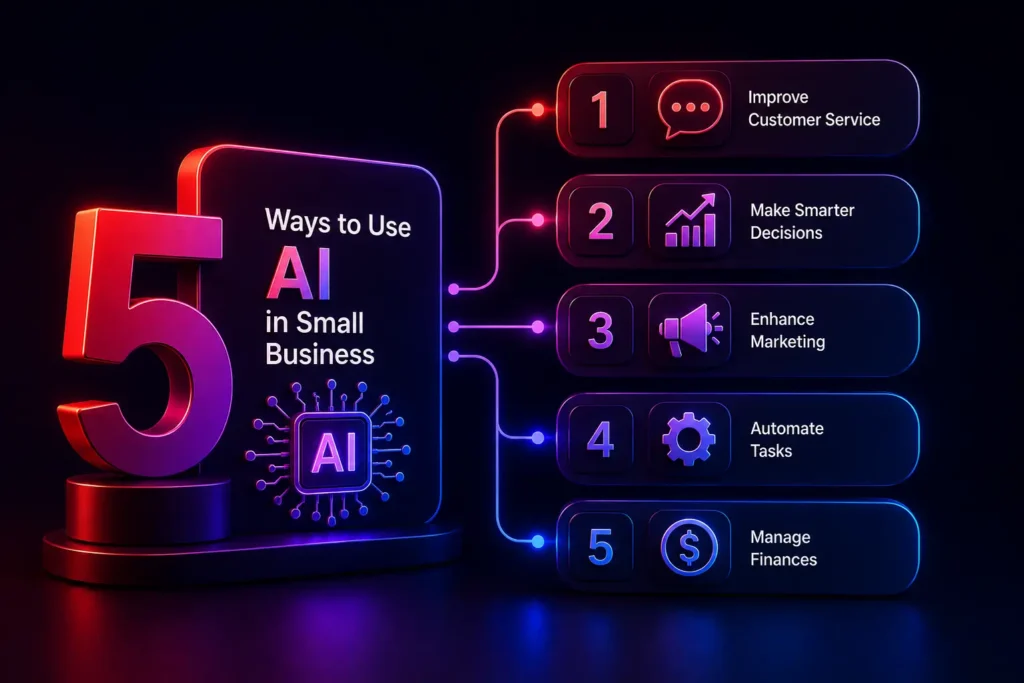
5 Ways to Use Artificial Intelligence in Small Business in 2026
How can a small business use AI?
A small business can use AI to automate repetitive administrative tasks, provide 24/7 customer service via natural language chatbots, personalize email marketing campaigns dynamically, forecast inventory needs based on historical sales data, and automatically generate high-quality social media content and product descriptions.
For Small Business Owners, the phrase “Artificial Intelligence” often sounds intimidating. It evokes images of massive tech conglomerates spending billions on supercomputers. However, the reality of artificial intelligence in small business in 2026 is entirely different.
AI is no longer an experimental technology reserved for Fortune 500 companies. It has become deeply commoditized and is now highly accessible and affordable. In fact, if you run a small business today and you are not actively looking for ways to use AI for business operations, you are operating at a severe competitive disadvantage.
The goal of AI for a small team is not to replace human workers; it is to give your existing team a massive multiplier effect on their productivity. Here are five practical, immediate ways small businesses are leveraging AI today.
1. 24/7 Customer Service Chatbots
Providing excellent customer support is notoriously expensive for small businesses because human agents must sleep.
By utilizing basic AI Integration, small businesses can deploy intelligent chatbots on their websites. These are not the frustrating, rule-based chatbots of 2018 that could only answer “Yes” or “No.” Modern NLP (Natural Language Processing) bots can understand context. They can answer complex questions about return policies, instantly book appointments directly into your calendar, and smoothly hand off the conversation to a human agent in the morning if the issue is too complex.
2. Dynamic Marketing Personalization
Generic email blasts (“Dear Valued Customer”) no longer work. Consumers expect personalization, but manually crafting unique emails for a 5,000-person subscriber list is impossible.
AI tools smoothly plug into standard CRM software. The AI analyzes individual customer behavior-what they clicked on, how long they lingered on a specific product on your E-Commerce Platform, and their past purchase history. It then automatically generates and sends highly personalized product recommendations at the exact time of day that specific customer is most likely to open an email.
3. Inventory and Demand Forecasting
One of the most dangerous cash-flow killers for a small retail or manufacturing business is holding too much dead inventory, or running out of a highly demanded product.
Traditional forecasting relies on a manager looking at a spreadsheet and making a gut assumption. AI completely removes the guesswork. By analyzing historical sales data, seasonal trends, and even external factors (like upcoming local weather patterns), AI algorithms can predict inventory demand with terrifying accuracy, automating the purchase order process before you ever realize stock is low.
4. Automated Content Generation
Content marketing is critical for SEO, but writing weekly blog posts and daily social media captions is a massive drain on a small team’s time.
Generative AI acts as your dedicated junior copywriter. You can provide an AI tool with a simple prompt: “Write a friendly 300-word Instagram post about our new line of organic coffee, focusing on its fair-trade origins.” The AI generates a high-quality draft in 5 seconds. While a human should always review and inject the final brand voice, AI removes the paralyzing friction of staring at a blank page.
5. Intelligent Accounting and Expense Management
Administrative tasks are the bane of a small business owner’s existence.
Modern accounting software utilizes AI to automate expense management. Employees can simply snap a photo of a coffee receipt with their Mobile App. The AI instantly scans the image using Optical Character Recognition (OCR), identifies the vendor, the date, and the total amount, and automatically categorizes it under “Meals & Entertainment” in the corporate ledger. This virtually eliminates hours of manual data entry every month.
Conclusion
The integration of artificial intelligence in small business is the great equalizer. It allows a five-person team to operate with the efficiency, 24/7 availability, and marketing sophistication of a fifty-person enterprise. You do not need a massive budget to start; begin by automating your most tedious administrative task today, and scale from there.
Ready to automate your small business?
At VDPL, we specialize in making enterprise-ready AI accessible for growing businesses. Contact us today to discover how custom AI integration can transform your daily operations.
Frequently Asked Questions (People Also Ask)
Is AI too expensive for small businesses?
No, in 2026, AI is highly affordable. While building a custom AI algorithm from scratch is expensive, the vast majority of small businesses use commoditized “AI-as-a-Service” tools that are integrated into software they already use (like CRMs or accounting tools) for a small monthly subscription fee.
How can AI help a local retail store?
A local retail store can use AI to optimize inventory forecasting (preventing stockouts), run localized, highly targeted social media ads based on demographic data, and deploy an automated chatbot on their website to answer common questions about store hours or product availability.
Will AI replace human employees in my small business?
For small businesses, AI acts as a co-pilot, not a replacement. AI excels at repetitive, data-heavy administrative tasks, which frees up your human employees to focus on high-value work: building deep customer relationships, strategic planning, and creative problem-solving.