
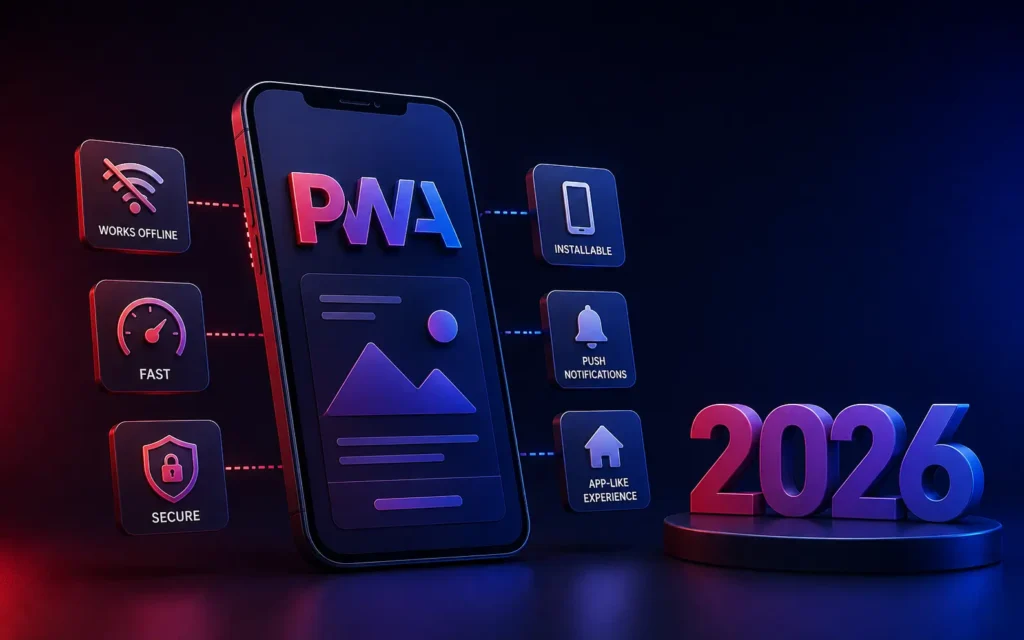
Are Progressive Web Apps (PWAs) still relevant in 2026?
Yes, Progressive Web Apps (PWAs) remain highly relevant in 2026. They provide businesses with a cost-effective way to deliver app-like experiences directly through web browsers, completely bypassing app store fees and approval processes. With advancements in browser APIs, PWAs now offer robust offline functionality, push notifications, and smooth desktop installation.
A few years ago, Progressive Web Apps (PWAs) were heralded as the definitive “app killers.” The industry narrative suggested that within a few years, traditional native applications downloaded from the Apple App Store or Google Play Store would be rendered obsolete by lightweight, web-based alternatives.
Fast forward to 2026. The Apple App Store is still thriving, and native mobile development is still a multi-billion-dollar industry. This reality has led many Product Managers and Tech Leads to ask a valid question: Are Progressive Web Apps still relevant, or were they just a passing fad?
The short answer is an emphatic yes-PWAs are more relevant and powerful than ever. However, the way enterprise businesses utilize them has matured. Instead of viewing them as a replacement for all native apps, smart engineering teams recognize PWA development as a highly strategic, cost-effective tool for specific use cases. Let’s explore the state of Progressive Web Apps in 2026 and whether your business should be building one.
What Defines a PWA in 2026?
A Progressive Web App is fundamentally a website built with modern web technologies (HTML, CSS, JavaScript, and WebAssembly) but designed to look, feel, and function exactly like a native application.
In 2026, a true PWA relies on three core pillars:
- Service Workers: These are background scripts that act as a proxy between the browser and the network. They are the magic behind PWAs, enabling offline access, background data synchronization, and push notifications.
- Web App Manifest: A simple JSON file that tells the browser how your web app should behave when installed on a user’s desktop or mobile home screen (e.g., hiding the browser UI, defining the app icon).
- HTTPS Infrastructure: PWAs require absolute security. They will not function without SSL encryption, aligning perfectly with the security standards discussed in our guide on The Future of Web Development in 2026.
PWA vs. Native App: The 2026 Perspective
The decision between investing in PWA development versus Native App development is one of the most common dilemmas for Product Managers. Here is how the comparison shakes out today.
The App Store Evasion
The most significant advantage of a PWA in 2026 remains its distribution model. If you build a native iOS or Android app, you are subject to the grueling review processes, strict guidelines, and hefty commission fees (up to 30%) enforced by Apple and Google.
PWAs bypass this entirely. A user simply visits your URL, clicks “Add to Home Screen,” and the app is instantly installed on their device. Updates are pushed instantly to all users without requiring them to download a patch from a store.
Development Costs and Maintenance
Unlike template websites, both native apps and PWAs require custom architecture. However, native apps require you to maintain two separate codebases (Swift for iOS, Kotlin for Android), or rely on cross-platform frameworks. A PWA requires only a single codebase that works flawlessly across iOS, Android, Windows, and macOS. This effectively halves your development and ongoing maintenance budgets.
Hardware Access
This is where the debate usually shifts. In the past, PWAs had very limited access to device hardware (like Bluetooth, FaceID, or advanced camera controls). In 2026, Project Fugu and modern Web APIs have drastically closed this gap. Browsers can now access a massive array of device sensors. While highly complex 3D gaming or hyper-intensive augmented reality (AR) still favors native mobile code, 95% of standard business applications can operate perfectly within a PWA container.
Key Benefits Driving Enterprise PWA Adoption
Why are massive enterprises like Twitter (X), Starbucks, and Pinterest still pouring millions into PWA development?
- Frictionless User Acquisition: The friction of searching an app store, downloading 150MB, and waiting for an install is a massive barrier to entry. A PWA requires zero download time. Users can engage with your core product in seconds.
- Ultra-Lightweight Storage: A native e-commerce app might take up 200MB on a user’s phone. The PWA equivalent often takes up less than 2MB. In emerging markets where device storage is limited, PWAs are essential for user retention.
- SEO Discoverability: Native apps are siloed. Search engines cannot index their internal content effectively. PWAs are technically websites, meaning every single page, product, and article within your app can be indexed and ranked by Google, driving massive organic traffic directly into the app experience.
- Offline Functionality: Thanks to advanced Service Worker caching strategies, users can continue to browse your product catalog, read articles, or fill out forms even when they lose cellular connection on a subway or airplane.
When Should You NOT Build a PWA?
While we champion PWAs at Vikalp Development Pvt. Ltd. (VDPL), transparency is key. You should opt for traditional Mobile App Development if:
- Your product is a high-performance 3D video game.
- You require deep, proprietary integrations with iOS-specific hardware (like advanced LiDAR functionality).
- Your entire business model relies on in-app purchases driven by the Apple/Google platform.
- Your audience strictly prefers browsing app stores to find new tools in your specific niche.
Conclusion
Are Progressive Web Apps still relevant in 2026? Absolutely. They have simply evolved from a buzzword into a stable, highly lucrative enterprise strategy.
For B2B SaaS companies, e-commerce brands, and content publishers, PWA development offers the holy grail of software delivery: native-like performance, infinite SEO discoverability, a single unified codebase, and complete independence from app store monopolies.
If your organization wants to deliver blazing-fast, installable digital experiences without the overhead of native app management, a Progressive Web App is the clear path forward.
Want to explore if a PWA is right for your product roadmap?
Explore PWA Solutions with VDPL’s engineering team today, and let’s build an app that runs flawlessly on every device.
Frequently Asked Questions (People Also Ask)
What is the difference between a PWA and a regular website?
While both are built with web technologies, a regular website requires a browser to function and needs a constant internet connection. A PWA is designed to act like an app-it can be installed on a device’s home screen, works offline using cached data, and can send push notifications, unlike a standard website.
Can Progressive Web Apps be put in the Apple App Store?
While PWAs are designed to bypass app stores, it is possible to package a PWA for distribution in app stores using technologies like Trusted Web Activities (TWA) for the Google Play Store, or by using wrapper frameworks for the Apple App Store, though Apple’s guidelines on web-wrapper apps remain strict.
Do PWAs work on iOS (iPhones) in 2026?
Yes. Historically, Apple was slow to support PWA features on Safari, but in recent years, iOS has dramatically improved its support for Service Workers, Web App Manifests, and Web Push notifications, making PWAs highly viable on iPhones in 2026.
Are PWAs cheaper to develop than native apps?
Generally, yes. Because a PWA utilizes a single web codebase (HTML, CSS, JS) that functions across all operating systems (iOS, Android, Windows, Mac), businesses save significant capital that would otherwise be spent hiring separate iOS and Android native development teams.