
How Web Performance Impacts Your Conversion Rates in 2026
How does web performance impact conversion rates?
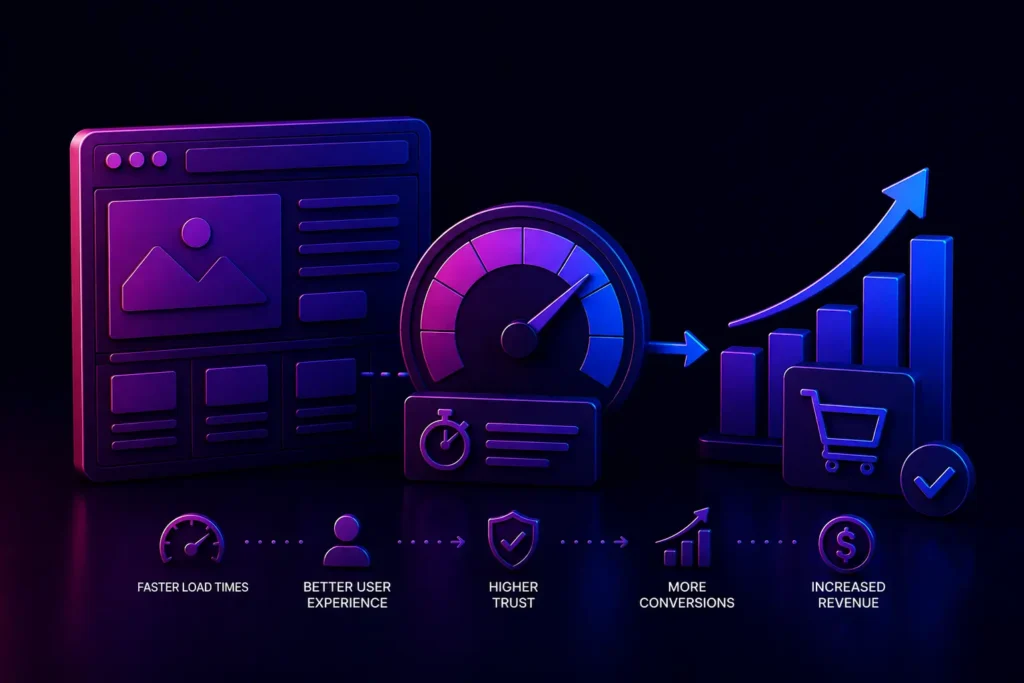
Web performance directly impacts conversion rates by reducing user friction. In 2026, a one-second delay in page load time can cause a 7% to 10% drop in conversions. Fast loading speeds keep users engaged, prevent cart abandonment, and significantly boost SEO rankings, leading directly to higher e-commerce revenue.
In the highly competitive e-commerce landscape of 2026, consumers have zero tolerance for friction. If a user clicks on an ad for your flagship product and is greeted by a white screen for more than two seconds, they aren’t going to wait. They will simply hit the “back” button and purchase from your competitor.
For E-commerce Managers, the correlation between web performance and conversion rates is no longer a theoretical debate. It is a proven, mathematical certainty. Website speed optimization is no longer just an IT issue; it is a fundamental revenue strategy.
Let’s dive into the psychology of waiting, the strict metrics enforced by search engines, and how improving your web performance can drastically increase your bottom line.
The Psychology of Waiting and Cart Abandonment
Human attention spans have adapted to the instantaneous nature of modern digital platforms like TikTok and Instagram. When an e-commerce platform fails to match that instantaneous feedback loop, the user’s subconscious interprets the delay as a lack of professionalism and trustworthiness.
Consider the typical e-commerce checkout flow. A user has added items to their cart, inputted their shipping details, and clicked “Proceed to Payment.” If that payment gateway takes five seconds to load, anxiety spikes. The user wonders: Did the payment go through? Is this site secure? Should I refresh the page?
This anxiety directly fuels cart abandonment. Fast website benefits extend far beyond the initial landing page; a smooth, zero-latency checkout experience builds immense trust, turning hesitant shoppers into loyal customers.
The Financial ROI of Website Speed Optimization
The financial impact of latency is staggering when examined at scale. Retail giants like Amazon and Walmart have famously published case studies showing that every 100 milliseconds of latency costs them millions in revenue. But this isn’t just an enterprise problem.
If your e-commerce store generates $100,000 a month with an average page load time of 4 seconds, optimizing that speed down to 2 seconds can yield massive dividends. By reducing the bounce rate and smoothing out the funnel, you could realistically see a 10% increase in conversions. That is an additional $10,000 a month in revenue, generated entirely without increasing your ad spend.
This is exactly why Custom Web Development often yields a vastly superior ROI compared to bloated, pre-built templates, as we explored in our guide comparing custom web development vs template websites.
Core Web Vitals: Where Speed Meets SEO
In 2026, web performance is deeply intertwined with organic search visibility. Google’s Generative Search and traditional ranking algorithms heavily prioritize Core Web Vitals.
If you are an E-commerce Manager, you must understand these three metrics:
- Largest Contentful Paint (LCP): Measures how long it takes for the largest image or text block on your page (like your hero product image) to render. It must be under 2.5 seconds.
- Interaction to Next Paint (INP): Replaced First Input Delay (FID). It measures how quickly your website responds when a user clicks a button or interacts with an element.
- Cumulative Layout Shift (CLS): Measures visual stability. If a user tries to click “Buy Now” but an ad loads at the last second and shifts the button down, it causes a frustrating misclick.
If your website fails these metrics, search engines will actively suppress your product pages in organic results. No amount of brilliant copywriting can outrank a site that is significantly faster and more stable than yours.
Mobile Performance is the Only Performance That Matters
We are well past the era of “mobile-responsive” design. We are in the era of mobile-first commerce. The vast majority of impulsive e-commerce purchases occur on mobile devices, often on cellular networks rather than high-speed Wi-Fi.
If your desktop site loads in 1 second, but your mobile site takes 6 seconds because it is trying to download massive uncompressed images and bloated JavaScript files, your conversion rate will plummet. Optimizing for mobile requires aggressive caching, image minification (using Next-Gen formats like WebP or AVIF), and implementing edge computing to deliver data faster.
For brands looking for the ultimate mobile commerce experience, exploring Progressive Web Apps (PWAs) can deliver app-like speeds directly in the browser, completely revolutionizing mobile conversion metrics.
How to Fix Your Web Performance Today
If you suspect your conversion rates are suffering due to latency, action must be taken immediately.
- Audit Your Assets: Run your site through Google PageSpeed Insights. Identify large images, render-blocking scripts, and slow server response times.
- Implement a CDN: A Content Delivery Network ensures that users download your site’s assets from a server geographically close to them.
- Audit Your Plugins: Every third-party app and tracking script you install on Shopify or WooCommerce drags down your speed. Ruthlessly eliminate the ones that don’t drive direct value.
Conclusion
The link between web performance and conversion rates is undeniable. In 2026, speed is the most powerful growth lever available to E-commerce Managers. By investing in website speed optimization, you enhance user experience, appease search engine algorithms, and ultimately, drive significantly more revenue.
At Vikalp Development Pvt. Ltd. (VDPL), we specialize in diagnosing performance bottlenecks and rebuilding e-commerce architectures for blazing-fast speeds.
Is your website losing sales due to slow load times?
Schedule a Consultation with our performance engineers today for a comprehensive technical audit.
Frequently Asked Questions (People Also Ask)
How much does website speed affect conversion rate?
Website speed has a massive effect on conversion rates. Industry data from 2026 shows that the highest conversion rates occur on pages that load in 1 to 2 seconds. For every additional second of load time, conversion rates can drop by an average of 7% to 10%.
What is a good page load time in 2026?
To remain competitive and pass Google’s Core Web Vitals assessment, a good page load time (specifically the Largest Contentful Paint) should be 2.5 seconds or faster. The absolute gold standard for e-commerce is under 1.5 seconds.
Why is my e-commerce website so slow?
Common causes for slow e-commerce websites include unoptimized high-resolution images, excessive third-party plugins or tracking scripts, a lack of a Content Delivery Network (CDN), and cheap, shared hosting environments that cannot handle database queries quickly.
How does website speed affect SEO?
Search engines like Google use page speed as a direct ranking factor. Fast websites provide a better user experience, so search engines rank them higher. Conversely, slow websites have high bounce rates and fail Core Web Vitals assessments, leading to severe penalties in organic search visibility.