
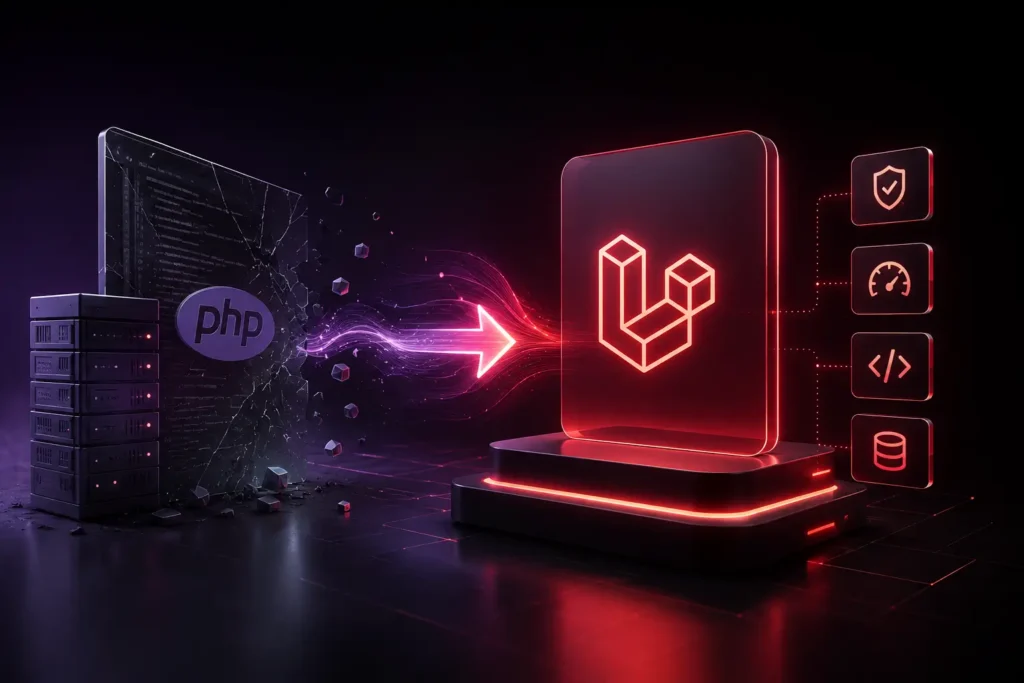
How do you upgrade a legacy PHP application?
Upgrading a legacy PHP application requires migrating the outdated “spaghetti” codebase into a modern framework like Laravel. The safest strategy is the “Strangler Fig” pattern, where the new Laravel architecture is built alongside the old code, and specific features are slowly migrated and routed to the new system until the legacy code can be completely deleted.
For IT Directors and CTOs, legacy code is a ticking time bomb.
Ten or fifteen years ago, a developer built a massively complex, highly customized internal tool using “core” PHP (no framework). Over the years, dozens of different developers bolted new features onto it. Today, it is a tangled web of spaghetti code.
As we highlighted in our article on Legacy System Modernization, maintaining this system is a nightmare. It is highly vulnerable to security breaches, impossible to integrate with modern APIs, and new developers refuse to work on it.
The solution is not to keep patching it. The solution is to upgrade the legacy PHP to Laravel. Here is the technical blueprint for executing a massive Custom Software Development migration without breaking your active business operations.
Why Laravel is the Ultimate Migration Target
When modernizing old PHP, Laravel is the undisputed choice.
- MVC Architecture: Legacy PHP often mixes database queries, logic, and HTML layout in the exact same file. Laravel enforces the Model-View-Controller (MVC) architecture, strictly separating database logic (Eloquent) from the visual presentation (Blade templates), instantly organizing the chaos.
- Composer Dependency Management: Legacy systems rely on outdated, manually downloaded code libraries. Laravel utilizes Composer, modernizing your tech stack and instantly giving you access to thousands of secure, up-to-date modern packages.
The “Big Bang” vs. “Strangler Fig” Migration
There are two ways to migrate a massive legacy application.
The Bad Way: The “Big Bang” Rewrite
This involves halting all new feature development on the old system and spending 12 months trying to rebuild the entire application from scratch in Laravel behind closed doors. When it’s “finished,” you flip the switch.
- The Risk: This almost always fails. Business requirements change over those 12 months, the new system is riddled with untested bugs, and the final transition causes massive operational downtime.
The Good Way: The “Strangler Fig” Pattern
This is the enterprise standard for safe migration. You run the new Laravel application side-by-side with the legacy PHP application on the same server.
- You set up a routing proxy (like Nginx).
- When a user clicks “View Invoices,” the proxy routes them to the old legacy code.
- Your team builds just the “User Profile” section in the new Laravel app. Once tested, the proxy is updated to route “View Profile” clicks to Laravel.
- Slowly, module by module, the new Laravel app “strangles” the old application, taking over its functionality until the legacy code is entirely obsolete and can be safely deleted.
Tackling the Database Migration
The most complex part of upgrading legacy PHP is the database. Legacy databases are often poorly structured, lacking foreign keys or proper normalization.
You cannot simply copy the old database into Laravel. You must utilize Laravel Migrations.
Migrations act as version control for your database. Your engineering team will write PHP scripts that programmatically recreate the database structure perfectly, and then write robust data-seeding scripts to carefully pull the data from the messy legacy database, clean it, and insert it into the newly structured, highly optimized Laravel database.
Conclusion
Upgrading a legacy PHP application is not just a technical update; it is a vital business rescue operation. By utilizing the Strangler Fig pattern to migrate feature by feature, you mitigate operational risk. The result is a secure, blazing-fast, easily maintainable Laravel application that dramatically reduces technical debt and prepares your enterprise for the next decade of digital growth.
Is your business being held hostage by a fragile, legacy PHP codebase?
At VDPL, our senior software architects specialize in rescuing and modernizing massive legacy systems, migrating them safely to scalable, modern Laravel architectures. Contact us today to discuss a modernization strategy.
Frequently Asked Questions (People Also Ask)
What is the Strangler Fig pattern in software development?
The Strangler Fig pattern is a software migration strategy used to safely replace a massive legacy system. Instead of rewriting the entire system at once, a new, modern application is built alongside the old one. Features are slowly and incrementally rebuilt in the new system and traffic is rerouted to them, slowly “strangling” the old system until it can be retired.
Is it worth rewriting an old application from scratch?
Doing a complete “Big Bang” rewrite from scratch is generally highly discouraged for large enterprise applications, as it takes too long, halts business momentum, and introduces massive bugs. It is almost always better to incrementally refactor or migrate the application piece-by-piece using a modern framework like Laravel.
Why is legacy PHP code bad?
Legacy PHP code (usually written before PHP 7 or without a modern framework) is considered “bad” because it is typically unstructured (mixing logic and HTML), highly vulnerable to security exploits like SQL injection, extremely slow, and very difficult for new developers to understand or maintain without breaking existing features.