
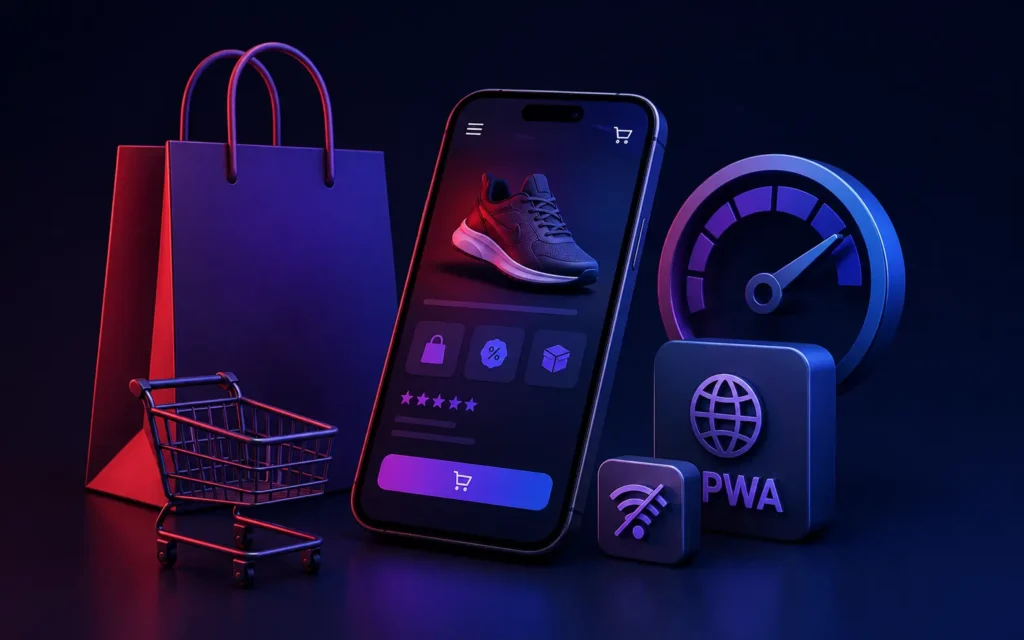
Every retail brand we talk to has already had the “do we need a native app” conversation at least once, and a good number of them built one before checking whether their traffic and repeat-purchase behavior actually justified it. A well-built Progressive Web App gets a retail brand most of what a native app offers - for a meaningful share of the traffic that a native app would never see, because it never survives the install step.
What “native-speed” actually requires from a PWA
A slow PWA is worse than no PWA - it confirms the assumption that web experiences are laggy compared to native ones. Getting genuinely native-feeling performance on mobile web comes down to a specific, achievable set of engineering disciplines, not a framework choice:
- Aggressive code splitting and lazy loading so the initial load only ships what’s needed for the first screen, not the entire app’s JavaScript upfront.
- A real service worker caching strategy - not just “cache everything,” but a deliberate strategy for what’s cached for offline use, what’s always fetched fresh, and how stale cached content gets invalidated, so returning visitors get near-instant loads on repeat visits.
- Optimistic UI for interactions - adding to cart, updating quantities, applying a filter should feel instant, with the UI updating immediately and reconciling with the server in the background, rather than waiting for a round trip before showing anything changed.
- Image and asset optimization tuned for mobile networks specifically - responsive images, modern formats (WebP/AVIF), and genuinely lazy-loaded below-the-fold content, since retail catalogs are usually image-heavy and this is where a lot of “PWA feels slow” complaints actually originate.
What this gets you that a plain mobile website doesn’t
Installability to the home screen without an app store, working offline for previously-viewed content (browsing a cached catalog on the metro with no signal, for instance), push notifications for cart abandonment and order updates, and - the part that actually matters most for retail conversion - a one-tap path from an ad or a shared link straight to the product page, with zero install friction in between. That last point is worth repeating because it’s the actual business case: paid social traffic converts dramatically better through a fast PWA checkout than through a “download our app to buy this” detour.
Where we’ve seen this actually move revenue
The clearest win pattern: brands running significant paid social spend, where the previous flow sent traffic to either a slow mobile web experience or a native app install prompt, both of which lose a large share of users before they ever see a product page. Rebuilding as a fast, properly cached PWA collapses that funnel to essentially one tap from ad to product, which is where we’ve seen the most direct, measurable conversion improvement of any single technical change on a retail site.
Where PWA alone isn’t enough
If your growth model depends on habitual, repeat daily engagement - not just conversion from ad traffic - native app advantages around home-screen presence and push notification reliability (particularly on iOS, where web push is more restricted) start to matter more. We covered this trade-off in more depth in our piece on PWA vs. native ROI for Indian e-commerce - the short version is: PWA first for acquisition-driven growth, native once you’ve earned a genuinely habitual customer base worth the investment.
We build retail platforms with performance as a first-class requirement, not an afterthought bolted on before launch. If your mobile conversion feels like it’s leaking traffic before checkout, get in touch and we’ll take a look at where it’s actually happening.